Seoul, Beijing boost push for cleaner air
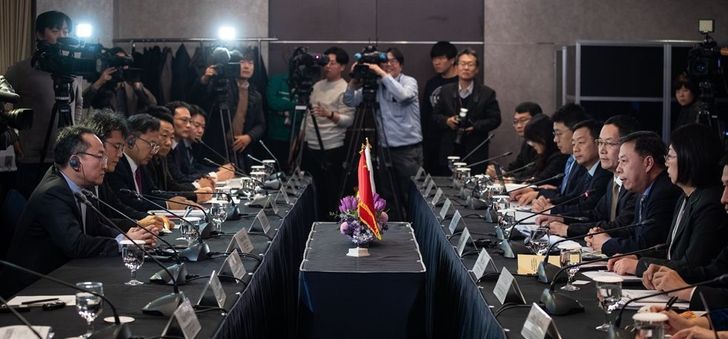
The third environmental cooperation summit between South Korea's Ministry of Environment and China's Ministry of Ecology and Environment, and the first Korea-China Environmental Cooperation Center's operating committee meeting are simultaneously held at Lotte Hotel Seoul on Jan. 22, 2019. Yonhap
By Ko Dong-hwan
South Korea and China have strengthened efforts for a cleaner atmosphere, pouring billions of dollars into the initiative.
Climate Change Strategy Division official Ahn Se-chang, from the South Korean ministry of environment, and Guo Jing, a global venture president from China's Ministry of Ecology and Environment, cemented the deal via videoconferencing on Wednesday. The latest meeting follows the countries' discussion of the topic in April.
After years of air pollution caused by particulate matter PM10 (10 micrometers in diameter) and PM2.5, the two countries this year introduced a massive financing plan and strategies for technology research and green industry growth to reduce the environmental problem.
The Korean central government early this month assigned 586.7 billion won ($486 million) to the environment ministry for 22 new eco-friendly businesses under the Green New Deal. In May, China announced a budget of $6.88 trillion for its own version of new green projects over the next five years.
The latest bilateral agreement has reaffirmed the countries' efforts for a “clean air project.”
Wednesday's discussion reinforced the countries' previous knowledge-sharing videoconference in April, dealing with how each has benefitted from a seasonal air pollution monitoring policy. Under the policy, Korea enforces stronger regulations on air pollution from December to March, and China from October to March.
The latest discussion agreed to share information on state regulations and drone manuals to rein in the industrial sector's atmosphere-heating pollutants and expand on-ground pollution monitoring stations from three in Korea and two in China to four each.
At a May meeting, China's Shandong Province and Tianjin city were designated as central regions for joint clean air efforts. The latest meeting also agreed to involve companies in Shanghai and Guangdong Province.
Ahn said: “The bilateral efforts will be protected to continue, especially before the economic toll from COVID-19's impact and climate change's ecological changes.”