Xi's visit to Korea key to improving bilateral ties

President Moon Jae-in, second from right, take a look at gifts from Chinese President Xi Jinping, left, during a state visit to China in December 2017. Courtesy of Cheong Wa Dae
By Do Je-hae
Chinese Foreign Minister Wang Yi's recent visit to Seoul has renewed Koreans' attention to problems with China that have been overlooked due to other pressing diplomatic issues.
In a year filled with conflicts with Japan and the U.S., Cheong Wa Dae has not been able to pay due attention to putting relations with China back on track. Korea-China relations are still not what they used to be prior to the 2016 decision by Seoul and Washington to deploy a U.S. missile defense system in Seongju County, North Gyeongsang Province.
Beijing has firmly contested the move, saying the deployment of the Terminal High Altitude Area Defense (THAAD) system could hamper its national security interests. Chinese officials have continued to raise suspicions that the THAAD radar system is actually aimed at spying on China’s military activities.
China's incessant protests against the THAAD system have hurt bilateral relations. President Xi Jinping has not yet reciprocated President Moon Jae-in's December 2017 visit to Beijing. In fact, Xi has not been in Korea since July 2014 during the previous Park Geun-hye administration. The THAAD dispute has also hampered the Korean people's sentiment toward China. Many Koreans have seen China's THAAD protest as an encroachment on the nation's sovereignty and are highly discontent with its meddling in a national security decision made under close coordination with its most important ally, the U.S.
During Wang's visit, President Moon expressed his hope to meet Xi amid the growing consensus among the officials of the two countries that it's high time for the Chinese leader's visit to Seoul. In particular, Moon is putting increasing importance on China's role to facilitate talks with North Korea amid escalating tension on the Korean Peninsula. Moon is visiting Chengdu, China for the Korea-Japan-China summit, Dec. 24 after a summit in Beijing today with the Chinese president. Xi will reportedly visit Tokyo in April 2020. The latest reports said Xi's visit to Seoul could possibly be arranged around this time.
“On the occasion of the trilateral summit, I look forward to a chance to deepen our dialogue and cooperation. In particular, we thank the Chinese government for the very positive role and contribution for the path toward peace on the Korean Peninsula. We are at a critical juncture in the process for complete denuclearization and permanent peace. We ask for the Chinese government's continued attention and support for a new era of a nuclear-free and peaceful Korean Peninsula,” Moon said during his meeting with the Chinese foreign minister at Cheong Wa Dae, Dec. 5. “Close dialogue and cooperation between the two countries will help stabilize security in Northeast Asia and overcome global uncertainties together.”
Beijing also views Moon's visit to China as an important occasion to deepen bilateral cooperation. “China and the ROK are important close neighbors and cooperative partners enjoying a sound momentum of China-ROK relations. We hope to take President Moon's attendance at the meeting as an opportunity to hold in-depth communication with the ROK on issues of mutual interest,” Chinese foreign ministry spokesperson Hua Chunying said during a press conference, Dec. 10.
Experts say the two countries see the timely need to improve ties despite the THAAD issue. “THAAD is still an important issue for China, but Beijing wants to improve ties with Seoul and it doesn't want THAAD to become an obstacle,” Lee Seong-hyon, a director the Center for Chinese Studies at the Sejong Institute, wrote in a recent column. “It is notable that the Chinese still praised Moon for his steadfast peace outreach effort in transforming the Korean Peninsula situation even during the recent negotiation impasse.”
During a recent Korea Times interview, Chinese Ambassador to Korea Qiu Guohong made some positive prospects about Xi's visit to Korea in the near future. “President Moon Jae-in has already invited Xi Jinping several times. And he has also accepted the invitation. However, we are only waiting for the right time and we are working on it. I and the Chinese Embassy in Seoul also hope that Xi Jinping's visit to Seoul will take place soon,” the Chinese envoy said.
Impact of Xi's visit
But concerns remain that Xi's visit will have a limited impact on mending bilateral ties as the fundamental issues between the two countries, such as the THAAD dispute, have yet to be resolved. In its 2019 Defense White Paper, Beijing stated that the U.S. has “severely destroyed the strategic balance of the region by deploying the THAAD system in South Korea.”
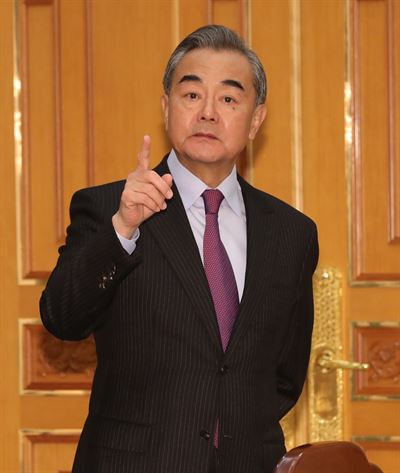
Chinese Foreign Minister Wang Yi at Cheong Wa Dae Yonhap
During his visit, the Chinese foreign minister kept making remarks that were seen as an attack on the U.S. Although he did not mention the country specifically, he criticized the “unilateralism” that was hampering the global order and “big countries' harassment of small countries.” There was little mention about how Beijing would relieve Seoul's concerns about China's “retaliatory measures” against Korean industries in China. Also China has not stopped its meddling in the deployment of THAAD. In addition, Chinese officials have even warned Korea and Japan that their relations with Beijing will worsen if they let Washington base intermediate-range missiles on their soil. China has also warned Seoul not to take the U.S. side in its row over the South China Sea.
The increasing problems with China are presenting new challenges for Korea's diplomacy that cannot be resolved under a certain administration. This is why Seoul is facing growing calls to prepare a new strategy to deal with diplomatic challenges that have hit Korea as a result of China's rise in Northeast Asia and the escalating U.S.-China regional rivalry.