Middle East urged to pay closer attention to North Korea export controls

Korea-Arab Society (KAS) Secretary-General Kim Jin-soo, front row fifth from right, Jeju Peace Institute (JPI) President Kim Bong-hyun, front row sixth from right, and Emirates Center for Strategic Studies and Research (ECSSR) Communication and Public Relation Manager Obaid Al Zaabi, front row left, pose with other dignitaries during the opening of the 16th Korea-Middle East Cooperation Forum jointly organized by the three organizations at Lotte Hotel in downtown Seoul, Nov. 13. / Korea Times photo by Yi Whan-woo
By Yi Whan-woo
South Korea and Middle Eastern countries in general are no exception when it comes to countries whose security is being affected by the United States' short-sighted policies prioritizing its own economic interests.
Such changes in geopolitical circumstances are bringing the two sides closer together on enhancing cooperation on regional security and stability.
And the Middle Eastern countries, while they are mostly faithful to the sanctions on North Korea, were urged to pay closer attention during an annual forum in downtown Seoul this month.
“There are certain areas of cooperation in which we have common interests and share concerns,” Kim Ji-na, a research fellow of the Korea Institute for Defense Analyses, told the audience during the 16th Korea-Middle East Cooperation Forum at Lotte Hotel in downtown Seoul. “When it comes to security cooperation between South Korea and Middle Eastern countries, nonproliferation can be one of key areas of our multilateral cooperation.”
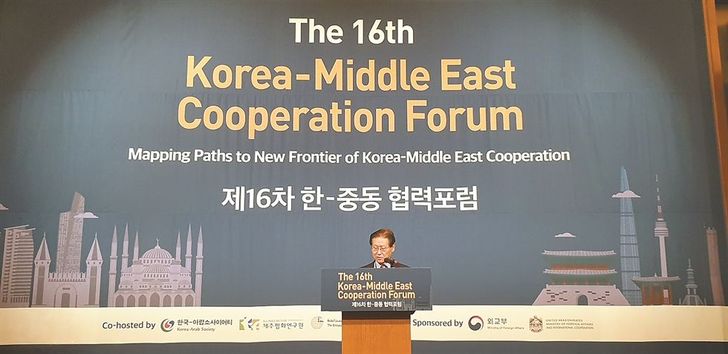
Jeju Peace Institute (JPI) Kim Bong-hyun delivers an opening speech. / Korea Times photo by Yi Whan-woo
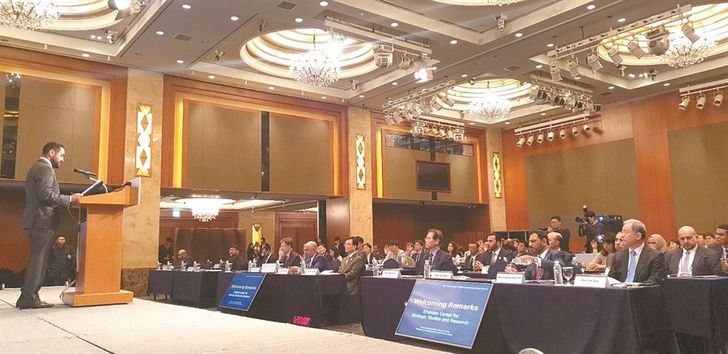
Emirates Center for Strategic Studies and Research (ECSSR) Communication and Public Relation Manager Obaid Al Zaabi delivers a welcoming speech as Korea-Arab Society (KAS) Secretary-General Kim Jin-soo, front row right, and Omani Ambassador to Korea and Dean of the Diplomatic Corps in Korea Mohamed Alharthy, on Kim's right, listen. / Korea Times photo by Yi Whan-woo
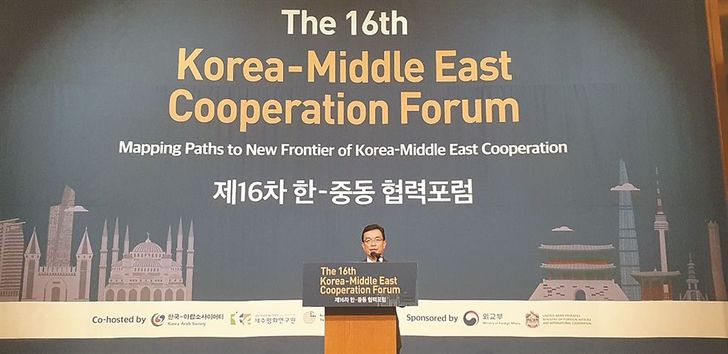
Vice Foreign Minister Cho Sei-young delivers a keynote speech. / Korea Times photo by Yi Whan-woo
Kim was one of the panelists for the first of the three sessions at the forum, Nov. 13, themed “Mapping Paths to New Frontier of Korea-Middle East Cooperation.”
The first session discussed paths to security and stability in the region, while the second dealt with economic cooperation in the post-oil era and the third on public diplomacy.
Citing the United Nations, Kim said strengthened export controls have not stopped North Korea's nuclear development.
She reckoned the loopholes on such controls stem partly from some countries “knowingly and unknowingly” contributing to banned items being brought into the North.
The Middle East's global share of strategic trade with North Korea “is very minimal” and related trade items are also limited, according to her.
“However, no one can rule out possibility that North Korea can do business with companies in the Middle East,” she said, arguing Pyongyang has continuously found new partners to override the sanctions.
She warned that the North's latest tests of short-range and submarine-launched ballistic missiles imply the secretive state continues to increase its threats against South Korea while engaging in denuclearization dialogue with the U.S.
The items to keep an eye on include automatic data processing machines, radar parts, numerical control panels and programmable controllers.
As part of solutions to better curb the North's nuclear arms development, Kim suggested closing loopholes within the sanctions regime, facilitating global implementation of catch-call control, controlling “under-threshold” items, ensuring heightened vigilance in network suppliers, revising the list of items subject to export controls, facilitating information-sharing and supplying education as well as training for capacity-building.
“In a way to uncover suspicious activities, it is desirable to share relevant information to conduct full inspections by establishing cooperative channels between intelligence agencies and law enforcement authorities in the future,” she said.
The forum was co-hosted by Korea-Arab Society (KAS), Jeju Peace Institute (JPI) and the Emirates Center for Strategic Studies and Research (ECSSR).
Among the dignitaries were KAS Secretary-General Kim Jin-soo, JPI President Kim Bong-hyun, ECSSR Communication and Public Relation Manager Obaid Al Zaabi, and Vice Foreign Minister Cho Sei-young, each of whom gave speeches, plus foreign envoys from the UAE, Egypt, Iraq, Kuwait, Morocco and Oman.
The JPI president noted the trade dispute between the U.S. and China is posing “the most serious challenge to all of us” and that it is spilling over into other sectors including global peace and security.
“The Korean Peninsula and the Middle East are within the reach of the influence of the dispute between the two global powers,” he said.
The first session moderated by former Foreign Minister Yoon Young-kwan also dealt with South Korea's security cooperation with the Middle East.
One of the sessions' panelists ― UAE University teaching assistant Ahmed al Mulla ― viewed South Korea's cooperation with the UAE should be considered.
South Korea's s Akh unit has been stationed there since 2011 to train UAE special forces and conduct joint exercises. Their areas of cooperation encompass energy, construction, healthcare, science and technology among others.
In a separate remark, the ECSSR manager said he is happy to see “significantly strengthened their strategic relations across many important sectors.”
“The UAE and South Korea share a common vision for peace and development,” he said, adding the results of such successful bonding are being witnessed in South Korea and Middle Eastern countries as well.
Vice Foreign Minister Cho highlighted the UAE's instrumental role to bring back two Korean citizens kidnapped in western Libya.
“Such extensive partnerships that directly touch upon the safety of our citizens are only possible because of the deep trust and confidence that we place in each other,” he said.
He reckoned the peace efforts on the Korean Peninsula will also resonate in the Middle East, saying, “The interconnected nature of our world means that security here affects the security in the Middle East, and vice versa.”
He added, “It is therefore crucial for us to continue supporting one another in efforts to bring lasting peace to our regions.”
The second session addressed a need to diversify from the South Korea-Middle East cooperation that has concentrated on energy and construction.
It was suggested that more startups from South Korea tap into Middle Eastern markets as part of efforts to better cope with the Fourth Industrial Revolution.
The forum began in Cairo, Egypt, in 2003. Since then, it has been held in South Korea and Middle Eastern countries alternately.