Seoul, Tokyo defense chiefs to meet over GSOMIA
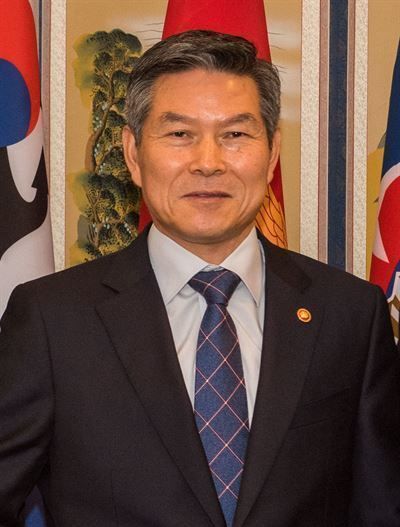
Defense Minister Jeong Kyeong-doo
By Jhoo Dong-chan
South Korea and Japanese defense chiefs plan to meet next week in Bangkok, Thailand, as part of the countries' last-ditch efforts whether to renew an intel-sharing pact between Seoul and Tokyo ahead of the agreement's official termination, Nov. 22.
“Defense Minister Jeong Kyeong-doo and his Japanese counterpart Taro Kono will meet on the sidelines of the upcoming ASEAN Defense Minister's Meeting-Plus (ADMM-Plus) to be held in Bangkok between Nov. 16 and 19. The main agenda of the meeting between the defense chiefs is finding a way to settle bilateral differences to keep the security pact alive,” a ruling Democratic Party of Korea (DPK) lawmaker told The Korea Times.
The pact, known as the General Security of Military Information Agreement (GSOMIA), was signed in 2016 in the face of a growing threat from North Korea's nuclear weapons program. The pact will come to an end unless the South Korean government takes action to renew it.
The scheduled Jeong-Kono meeting will come after Jeong's planned meetings with top U.S. military official Gen. Mark Milley and U.S. Secretary of Defense Mark Esper in Seoul before attending the ADMM meeting.
South Korean President Moon Jae-in dropped hints recently about terminating the GSOMIA as the issue was a matter of principle and sovereignty. South Korean lawmakers floated the idea of creating a joint compensation fund to settle bilateral historical issues but Tokyo insisted Seoul overturn last year's South Korean Supreme Court ruling that ordered Japanese companies to compensate surviving South Korean victims of wartime forced labor.
In Tokyo, Milley told reporters the United States wants to try to resolve the GSOMIA issue before it expires adding Washington views the GSOMIA as an important tool to allow U.S. allies to jointly deal with security challenges, particularly North Korea's repeated test-launches of ballistic missiles. Esper also plans to use his meeting with the South Korean defense chief for the renewal of the bilateral pact in accordance with its signature Indo-Pacific Strategy.
Victor Cha, senior adviser and Korea chair of the Center for Strategic & International Studies (CSIS), said the termination of GSOMIA could weaken the trilateral alliance between Korea, the U.S. and Japan.
“This agreement has allowed for more seamless intelligence-sharing among the two allies and the United States regarding the North Korea activities in the region,” Cha said. “No policy action of this type takes place in a vacuum. This development is beneficial to countries opposed to the U.S. alliance system including North Korea, China and Russia.”
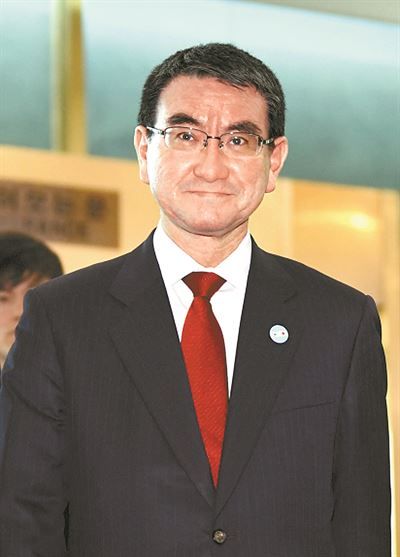
Japanese Defense Minister Taro Kono
Waqas Adenwala, Asia analyst at research firm Economist Intelligence Unit, expressed his concern that ending GSOMIA could also weaken the three countries' ability to monitor North Korea's moves in the future.
“(The termination) will create lags and reduce the effectiveness of the allies' ability to watch North Korea.”
Foreign Minister Kang Kyung-wha is also considering visiting Japan to participate in the G20 Aichi-Nagoya Foreign Ministers' Meeting slated for Nov. 22. During her stay in Tokyo, Kang is expected to meet her counterpart Toshimitsu Motegi.
A Foreign Affair Ministry official said the Korea-U.S. alliance will remain strong regardless of the termination of the GSOMIA.
“We understand Washington's stance. It wants the pact to be continued,” the official said. “The GSOMIA is an intelligence-sharing pact between South Korea and Japan. No matter whether the GSOMIA is renewed or not, the Korea-U.S. alliance will remain strong.”
South Korea's decision to scrap the GSOMIA was met with disappointment in the United States with U.S. Secretary of State Mike Pompeo urging Washington's top two Asian allies to settle their stark differences.
A presidential National Security Council chief Chung Eui-yong said Cheong Wa Dae would welcome Washington's mediation in the bilateral feud. “This will only get worse, and it's only American leadership that can bring the parties together,” tweeted Harry Kazianis, senior director at the Center for the National Interest in Washington.