30 years of Hungary-Korea friendship unswayed by ferry tragedy

Hungarian Ambassador to Korea Mozes Csoma, front row fifth from left, former President Roh Tae-woo’s aide Park Chul-un, front row fourth from left, and other dignitaries join a cake-cutting ceremony to mark the 1956 Hungarian Revolution and the 30th anniversary of bilateral relations at the Lotte Hotel in downtown Seoul, Oct. 23. / Korea Times photo by Yi Whan-woo
By Yi Whan-woo
On the 30th anniversary of bilateral relations, Hungary has cause to be in the spotlight here for reasons other than a boat accident in Budapest that left 26 Korean tourists dead or missing in May.
Hungary was the first Eastern Bloc country to establish diplomatic ties with Korea in accordance with the Northern Policy — then-President Roh Tae-woo’s signature diplomatic initiative.
Aimed at broadening Korea’s diplomatic horizons in the northern hemisphere including communist countries, the initiative has been inspirational for President Moon Jae-in’s New Northern Policy.
Hungarian Ambassador to Seoul Mozes Csoma, who took office in September 2018, also has a deep relationship with Korea.
A scholar-turned-diplomat, Csoma is a fluent Korean speaker, is married to a Korean, and was a founding member and head of the Department of Korean Studies at the University of Budapest.
Against this backdrop, Csoma and other dignitaries emphasized how special Hungary-Korea ties are at a reception last week to mark the Hungarian Revolution of Oct. 23, 1956, and the 30 years of friendship.
They also highlighted how the two sides, despite the boat tragedy, have sought to enhance solidarity and led the way in cooperation.
The latest exchanges include talks between foreign ministers in May and June, the opening of a direct air route between Incheon and Budapest in September, a concert by the Gyor Philharmonic Orchestra at Lotte World Mall in Songpa-gu, southern Seoul, Oct. 22 and the planned opening of a Hungarian Cultural Institute in Myeong-dong, downtown Seoul, in December.
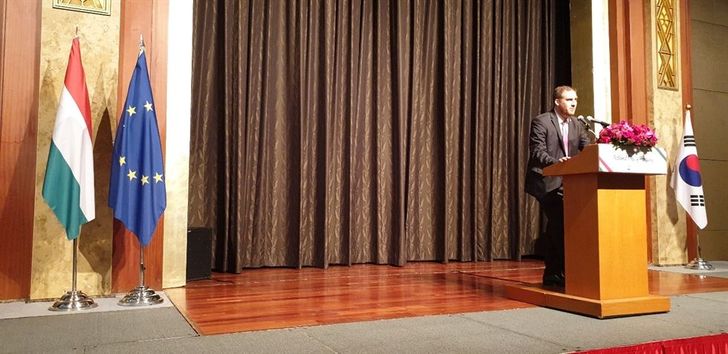
Hungarian Ambassador to Korea Mozes Csoma delvers a speech during a reception to mark the 1956 Hungarian Revolution and the 30th anniversary of bilateral relations. / Korea Times photo by Yi Whan-woo
“We prepared this anniversary year really diligently,” Csoma said in his congratulatory speech at the Lotte Hotel in downtown Seoul, Oct. 23. “However, in May a very tragic accident happened in Budapest, which became a huge common tragedy for Hungarians and Koreans.”
Emphasizing cooperation in the past, present and future, Csoma said he hopes the friendly relations between Hungary and Korea would continue.
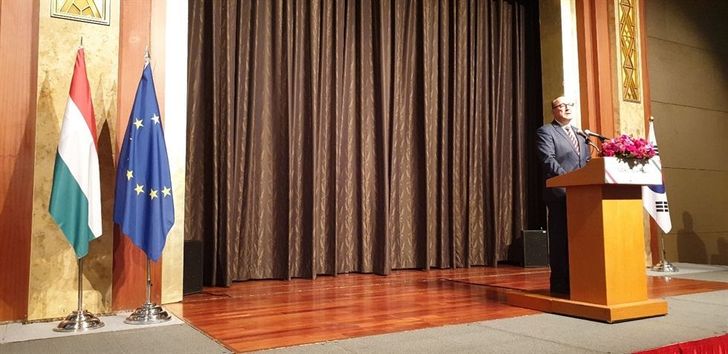
Zsolt Nemeth, chairman of Hungarian parliament's Foreign Affairs Committee, delivers a speech during a reception to mark the 1956 Hungarian Revolution and the 30th anniversary of bilateral relations. / Korea Times photo by Yi Whan-woo
Zsolt Nemeth, chairman of Hungarian parliament’s Foreign Affairs Committee, said the boat accident cast a shadow on the 30th anniversary, but Hungarian authorities and civilians expressed solidarity with Korea.
Nemeth, who visited Korea as part of parliamentary exchanges, noted that Hungarians mourned the dead with a traditional Korean ritual in early October.
“Our essential set of values form a common basis for our close alliance and friendship,” he said.
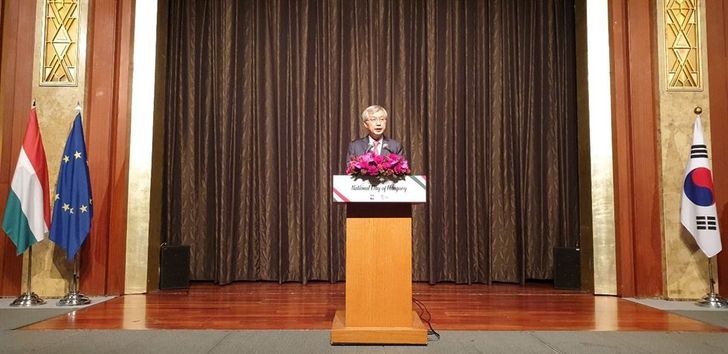
Second Vice Foreign Minister Lee Tae-ho delvers a speech during a reception to mark the 1956 Hungarian Revolution and the 30th anniversary of bilateral relations. / Korea Times photo by Yi Whan-woo
Second Vice Foreign Minister Lee Tae-ho thanked Hungarians for their “heart-touching” tribute, noting that the candlelit vigils and singing of the Korean folk song “Arirang” were “sources of great comfort.”
“I would like to convey once again my profound gratitude to Hungary, a friend that extended a helping hand in a time of need,” he said. “As we look to the next three decades of our ties, the Korean government will redouble its efforts to broaden the horizons further and expand the scope of our close bilateral cooperation steadfastly developed during the previous 30 years.”
Guests included ambassadors and other members of the diplomatic corps.
From the Korean side were Park Chul-un, former President Roh’s aide and an architect of the Northern Policy, and Korea Hungary Friendship Association Chairman Ro Jae-hun.
Hungary has also cooperated with Korea as a member of the Visegrad Group, a cultural and political alliance of four Central European countries including the Czech Republic, Poland and Slovakia.
Meanwhile, Nemeth underscored the Hungarian Revolution as “the most important reason” that made the 30th anniversary of bilateral ties possible and that it played the initial role in the process toward German reunification.
The deadly 1956 uprising against communist repression lasted from October until November when it was quelled by overpowering Soviet forces.
The uprising drew attention in Korea, with nine Yonsei University students forming Volunteer Student Soldiers for the Hungarian Freedom, which asked then-Defense Minister Kim Yong-woo to send them to Hungary to fight for freedom. The offer was denied.
Among the nine were late National Assembly Speaker Lee Man-sup (1935-2015) and Yoo Jay-kun, a former three-term lawmaker in the 1990s and 2000s. They all later received honors from the Hungarian government.
The uprising is also remembered by older Korean generations with a poem, titled “The death of a girl in Budapest,” by Kim Chun-soo.
Hungary is one of Korea’s top three Central and Eastern European partners in trade and investment, with a presence of more than 130 Korean companies there.
Korea was also Asia’s top investor in Hungary last year.
Their joint research projects in science and technology have expanded to high-tech areas, such as biotechnology and information and communications technology (ICT).
The direct flights between Incheon and Budapest run three times a week.
Hungary-Korea ties, according to dignitaries at the reception, date back as early as the 1890s, when an army surgeon named Gaspar from Austria-Hungary arrived at the port of Jemulpo in modern-day Incheon.
In 1892, the Austro-Hungarian Empire signed a Treaty of Friendship with the 1392-1910 Joseon Kingdom.