Polish Constitution anniversary marked in Seoul

Polish Ambassador to Korea Piotr Ostaszewski, third from left, Polish Defense Attache Colonel Swiatek, left, First Vice Foreign Minister Lee Tae-ho, second from left, and ruling Democratic Party of Korea lawmaker and president of Korean-Poland Parliamentarians Friendship Association Chang Byoung-wan join a cake-cutting ceremony during a reception to celebrate the anniversary of the May 3 Polish Constitution of 1791 at Lotte Hotel in downtown Seoul, May 8. / Korea Times photo by Yi Whan-woo
By Yi Whan-woo
The May 3 Constitution of 1791, according to Polish Ambassador to Korea Piotr Ostaszewski, was “one of the most vital incentives” for the nation.
Being the first modern constitution in Europe and the second of its kind after the U.S. Constitution of 1787, it stipulated political equality between townspeople and nobility by placing peasants under government protection and mitigating undue abuses of serfdom.
After being established as a public holiday in 1919, the celebration was forbidden under Nazi Germany and then the Soviet Union.
The national holiday was restored in 1990. Since then celebrations have taken place not only in Poland but other parts of the world, including Korea.
“It helped the nation to preserve its own character ... It was one of the most vital incentives that helped the nation to survive even after the unfortunate Yalta Conference when Poland once again became a dependent country and when May 3 could not be celebrated,” Ambassador Ostaszewski said during the anniversary reception at Lotte Hotel in downtown Seoul, last week. “It reappeared again in 1990, becoming the symbol of our independence.”
The anniversary also coincided with the 30th anniversary of Poland-Korea ties, the 20th anniversary of Poland’s accession to NATO and the 15th anniversary of European Union membership.
“Poland’s political system is stable and based on strong foundations, its economy is one of the fastest-developing in the modern world, its society is open, free and always ready to face new challenges,” the ambassador said.
He added that Poland, along with allies, would like to build a peaceful world with “enough space for everyone who shares the most precious values like human rights, democracy and liberty.”
He noted the Polish presence on the Korean Peninsula within the framework of the Neutral Nations Supervisory Committee was “the best example” of its contribution for building peace.
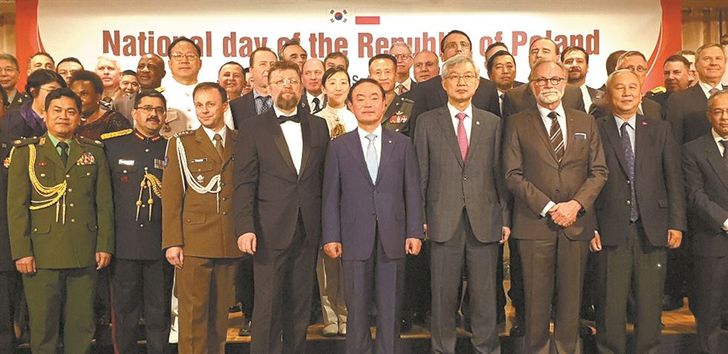
Polish Ambassador to Korea Piotr Ostaszewski and other dignitaries pose during a reception to celebrate the anniversary of the May 3 Polish Constitution of 1791 at Lotte Hotel in downtown Seoul, May 8. / Korea Times photo By Yi Whan-woo
The reception attracted ambassadors and other members of the diplomatic corps in Seoul.
From the Korean side were First Vice Foreign Minister Lee Tae-ho, ruling Democratic Party of Korea lawmaker and president of the Korean-Poland Parliamentarians Friendship Association Chang Byoung-wan, the United Nations Command Military Armistice Commission’s Major. Gen. Shin Sang-bum and Synn Il-hi, who is the honorary consul general of Poland and President of Keimyung University in Daegu.
Vice Minister Lee said the May 3 Constitution had been “a solid foundation for anchoring Poland to the hope of peace and prosperity.”
Lee said bilateral relations over the past 30 years had grown stronger in “a whole spectrum of fields.” He noted that a summit with Polish President Andrzej Duda and President Moon Jae-in was “momentous in exploring ways to enhance further the friendship and cooperation between our two countries.”
Referring to Poland’s membership of Visegrad Group — a cultural and political alliance of the Czech Republic, Hungary, Poland and Slovakia — Lee said the Central European country “has steadfastly rendered its strong support” for Korea’s efforts to establish peace on the peninsula.
Rep. Chang noted that Poland and Korea share common ground in history, suffering foreign invasions repeatedly but continuing to fight for freedom and achieving economic development in a short time.
“I hope bilateral relations continue to build on their historical and cultural similarities,” he said.