Moon, Trump to hold summit in April

U.S. President Donald Trump and President Moon Jae-in shake hands after signing a trade agreement last September. AP-Yonhap
By Kim Yoo-chul
President Moon Jae-in will have a summit with President Donald Trump at the White House in April to discuss the denuclearization of North Korea, Cheong Wa Dae said, Friday.
“U.S. President Donald Trump and first lady Melania Trump invited President Moon and first lady Kim Jong-sook to the White House,” chief presidential press secretary Yoon Do-han told a press conference.
“Moon accepted the invitation. He will visit Washington D.C. for two days from April 10. President Moon will have the summit with Trump on April 11 (local time). The summit will cover the latest updates on North Korea's denuclearization and specific steps on how to strengthen bilateral ties for a permanent peace on the Korean Peninsula by achieving complete denuclearization," the press secretary Yoon added.
Moon's Washington trip was an “official working visit” not a “state visit," according to the presidential office.
The meeting comes amid stalled nuclear disarmament talks after the after the failed Hanoi summit between Trump and North Korean leader Kim Jong-un. Experts hope the Moon-Trump meeting will be an opportunity for Seoul to inject momentum into the diplomatic process.
“They will have deep conversations about all things relating to the North Korean nuclear issue,” Yoon said. “Before the summit, all main issues will be settled on through working-level discussions between representatives of both sides.”
In a statement, the White House confirmed that Moon and Trump would discuss the “latest developments regarding the Democratic People's Republic of Korea, as well as bilateral matters.”
Another senior Cheong Wa Dae official said second deputy chief of the presidential National Security Office Kim Hyung-chong planned to visit Washington early next week to set the agenda. Notably, next month's meeting ― the seventh between Trump and Moon ― will take place while the first session of the North's 14th Supreme People's Assembly is taking place in Pyongyang, April 11.
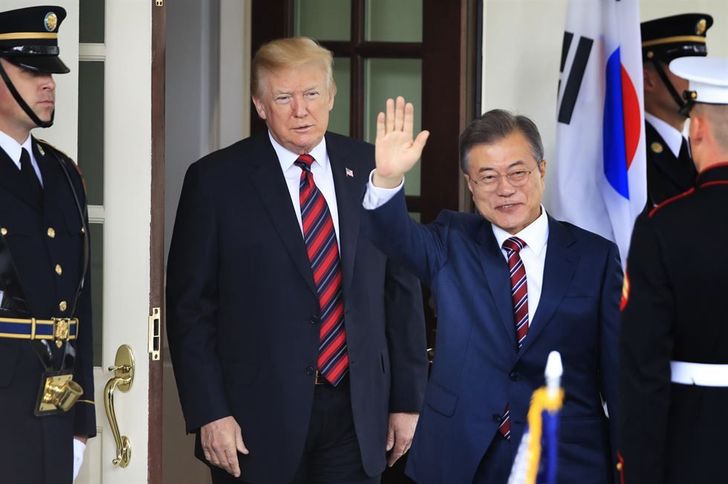
President Moon Jae-in waves as U.S. President Donald Trump welcomes him to the White House last May. AP-Yonhap
After the “no deal” in Hanoi, the denuclearization talks between the U.S. and North Korea have stalled.
The North earlier threatened to end negotiations with the U.S., after Washington rebuffed providing concessions in exchange for Pyongyang's preferred “step-by-step” approach toward dismantling its nuclear program.
The U.S. intelligence community has remained skeptical about the feasibility of North Korea's repeated commitment to end its nuclear program, citing recent satellite imagery that showed “suspicious activity” at a nuclear enrichment site near Yongbyon. This has led Washington to maintain “maximum pressure” on the North ― no concessions without complete and verified denuclearization.
Since the start of the talks, President Moon has proclaimed himself as a “mediator.” But the South Korean leader shifted his role to “facilitator” after the breakdown of the Hanoi summit, to get the nuclear diplomacy back on track.
Moon's top aides officially and unofficially asked their U.S. counterparts to approve an early resumption of frozen inter-Korean economic projects to break the deadlock in talks between the U.S. and the North. But no visible developments have been seen.
“How to set the next path of top-down diplomacy and specific action plans to make that actually happen will be discussed at the upcoming Moon-Trump summit,” the senior Cheong Wa Dae official said.
“That means both Seoul and Washington will pursue rapprochement for a deal which both the North and the U.S. can be happy with, without going through middle stages.”
Cheong Wa Dae said the presidential office planned to hold another inter-Korean summit, although press secretary Yoon declined to elaborate.
“The two Koreas are communicating on the matter using back channels. I can't tell you more,” he said.