INTERVIEW Food exhibition to offer glimpse into Swedish lifestyle

Swedish Ambassador to Korea Jakob Hallgren speaks during a recent interview with The Korea Times about a food exhibition at the embassy in Seoul. The exhibition, “Sweden-Korea Food Culture Exchange,” will take place at the Korean Cuisine Culture Center in Jung-gu, Seoul, Nov. 7, as part of the “Swedish Food Week” from Nov. 5 to 11. / Korea Times photo by Choi Won-suk
'Fika can offer tips for Koreans to pursue greater work-life balance': envoy
By Yi Whan-woo
More Koreans are interested in working productively and efficiently, after the government limited the maximum working hours per week from 68 to 52, including 12 hours overtime.
The new government’s policy in July was to stop chronic overwork and promote a greater work-life balance, especially among the younger generations (with hope that it will potentially lead to more babies.)
Given this, the “Sweden-Korea Food Culture Exchange” will take place in a timely manner as it will offer a glimpse into the concept of the balanced Swedish lifestyle known as “lagom,” according to Swedish Ambassador to Korea Jakob Hallgren.
The food exhibition will be co-hosted by the embassy and Korean Food Promotion Institute (KFPI) at Korean Cuisine Culture Center in Jung-gu, Seoul, Nov. 7 as part of the “Swedish Food Week” from Nov. 5 to 11.
It will feature traditional dishes of the two countries, notably storage and fermentation food.
“There’s definitely a growing interest in Sweden about Korean food and also in Korea about Swedish food. I think this is an interesting trend where both countries can learn from each other and we have several events lined up,” the ambassador said during a joint interview with KFPI President Sunjae Mayul at the embassy in Seoul recently.
He said the Swedish diet trend of eating more vegetables, berries, wholegrain, gluten-free and lactose-free foods as well as other organic and ecological food best explains “lagom,” which is widely translated as “just the right amount” or “in balance.”
“You can essentially say lagom means no extremes ... Don’t eat too much of anything, but in appropriate quantity and appropriate type. Don’t work too hard but take a break,” he said.
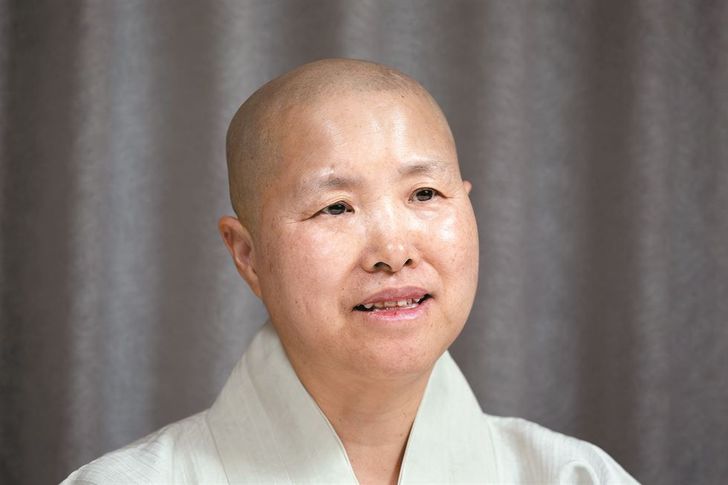
Korean Food Promotion Institute President Sunjae Mayul speaks during a recent interview at the embassy in Seoul. / Korea Times photo by Choi Won-suk
The KFPI president said Korean traditional dishes made of vegetables are about a balanced diet and life, adding “They are made of ingredients from the mountain and sea in four different seasons.”
“We also have developed many cooking methods like fermentation and storage to eat right and healthy. Those foods are really kind of a transition between nature and the human body,” she said.
Among the fermentation and storage food to be featured at the exhibition are kimchi, jeotgal (salted seafood) and jang (fermented soybean).
From the Swedish side will be surstromming (lightly-salted herring), inlagd sill (pickled herring), gravlax (dill-cured salmon), julskinka (Christmas ham) and surkal (sweet and sour cabbage).
The exhibition programs include a reception to be hosted by Ambassador Hallgren, cultural performances from the two countries and display of their cookware and spices.
The visitors can join cooking classes involving chefs from the two countries — Park Jong-sook and David Mill.
They will also have a chance to enjoy a delicious array of refreshments by experiencing dagwa-sang, meaning refreshment table in Korean, and fika, a Swedish coffee break.
Ambassador Hallgren said fika can offer tips for Koreans to improve job performance through coffee breaks and a better pursuit of a work-life balance.
For many Koreans, coffee breaks were merely for goofing around and killing time, because working overtime was seen as a “norm” and they stayed late anyways regardless of their work amount.
Fika, on the other hand, is about sharing not just snacks but also knowledge and ideas with friends or colleagues in a relaxing manner.
“This is probably Sweden’s contribution to food and social culture of the universe,” the envoy said.
“This is a good way to meet your colleagues and the fact that you don’t have pressure in this is a meeting helps you to discuss things that actually are very good for work.
“You meet a colleague from another department, sit together socially, have a cup of coffee, cinnamon or something that contributes to a good atmosphere at the workplace. And you magically get things done that otherwise are not done,” the envoy added.
The KFPI president voiced a similar view, saying “food is social” and can bring people from different cultures closer under the universe. She pointed out both Sweden and Korea use herring as ingredients.
“Although we are from the other side of the world, Sweden and Korea share a common ground that we eat herring and other fermented food. The fact we use similar ingredients make us realize we are the same after all under the universe,” she said.
A kimchi lover, Hallgren said food can be an effective tool for bilateral relations on top of diplomacy, trade and investment, referring to his experience beginning his job in Seoul in September.
“I was for instance was invited by the Korean ambassador (to Stockholm.). And you could talk for hours about your food, culture and similarities. It’s important for diplomacy because if you eat and drink well together something in common, that’s always a very good starting point for diplomatic relations or interaction” he said.
Hallgren was a former deputy director at Stockholm International Peace Research Institute.
A Buddhist nun, Sunjae Mayul is also a kimchi master. She has been serving as the KFPI president since April.
The KFPI operates under the Ministry of Agriculture, Food and Rural Affairs.
East Asia Cultuural Project Chairman Kim Sang-woo, also a former lawmaker and adviser to the KFPI, helped organizing the Nov. 7 exhibition.