Diplomatic consensus needed to end dispute over “Rising Sun Flag”

Korean warships on review on the sea near the nation's southern port city of Busan, during its fleet review in this 2015 file photo. / Courtesy of Republic of Korea Navy
Korea seeks to ban use of Japan's controversial flag
By Lee Min-hyung
Last week, Seoul and Tokyo engaged in a diplomatic battle, with both sides showing no signs of backing down from their positions over Japan's plan to join an international fleet review here with a vessel flying the “Rising Sun Flag.”
As the flag is seen by some Koreans as a symbol of Japanese imperialism and its wartime atrocities, the move drew a strong public backlash here.
The Korean government urged Japan to use another flag in reflection of the negative public sentiment here, but the Japanese naval force complained about the request, calling the flag the pride of the armed forces.
In the end, Japan decided not to send the warship to the International Fleet Review to be held on Korea's southern resort island of Jeju. The review, hosted by the Korean Navy, will take place starting Oct. 10, the third time the Navy has held the event since 1998.
Experts said Korea should no longer react emotionally against such a “flag-related” controversy, and take a more cautious and systematic approach to prevent a similar controversy from recurring.
“Introducing a domestic law to ban the use of the flag in official events in Korea is the most realistic and reasonable step that the government can take at the moment,” Yang Ki-ho, professor of Japanese Studies at Sungkonghoe University, said in a recent interview.
But he underlined the need to take a more careful step, as Korea failed to enact a similar act in 2013.
“To pass the bill, we need to establish a strong social consensus not just from the public, but the National Assembly,” he said. “Even if a domestic legal system does not have authority to regulate the flag-related controversy internationally, this can help stop Japan from pushing ahead with such a plan to provoke the public at least on the Korean Peninsula.”
If the government does not take any proper steps this time again, nothing will change and a similar controversy will recur in 2028 when the Korean Navy holds its fourth global fleet review, according to the professor.
Japan's Maritime Self-Defense Force planned to participate in this year's review with the ship flying the flag, as the Navy and the government couldn't block the plan due to the lack of authority to restrict extraterritoriality.
According to the Navy, warships are governed by the jurisdiction of the country they belong to, so Korea cannot raise legal claims about it.
“So the lawmakers should take a more careful approach in introducing the domestic law in consideration of international practice and the diplomatic relations between Seoul and Tokyo,” he said.
This is also because the controversy is not globally recognized, and only a few Asian countries ― such as Korea and China ― take issue with the flag. Many Asians believe the flag represents Japan's imperial aggression during the late 19th and early 20th centuries.
China, along with Korea, is one of the Asian countries that has a negative sentiment about the Rising Sun Flag. In 2014, China did not even invite Japan for a fleet review in Qingdao because of the flag controversy.
“If we fail to properly deal with the issue, chances are that we can be isolated from international society,” he said.
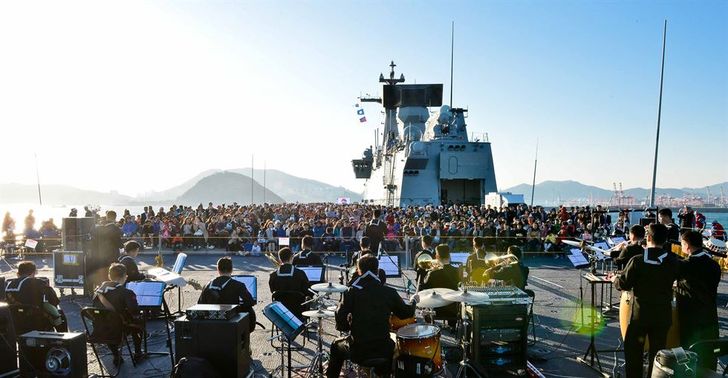
A Korean Navy band performs a concert on a Dokdo-class amphibious assault ship while participating in a 2015 fleet review in Busan. / Courtesy of Republic of Korea Navy
The United States is not raising its voice against Japan's use of the flag, and things are the same with most Western countries, according to the expert.
For this reason, any rash act from Korea may only result in a possible crack in diplomatic relations between Seoul and Tokyo ― such as the security partnership.
The Korean Navy is also in a position that the latest controversy should not cast any effect on bilateral diplomatic relations with Japan.
“We express regret that Japan dropped its plan to send a warship to the event, but the decision should not stop the Navy from maintaining a progressive relationship with Japan's naval forces,” an official said.
Last week, Rep. Lee Seok-hyun of the ruling Democratic Party of Korea proposed a bill to ban vessels flying the Rising Sun Flag from navigating through Korean territorial waters.
He argued Japan would be diplomatically isolated unless it stops the custom of flying the flag during international events at least in Asian territory. This is because a group of Asian countries such as China, Korea and the Philippines will join hands against the move and few countries will support Japan's flying of the flag, he claimed.
The bill bans any vessels flying the controversial flag from navigating Korea's territorial waters. The bill also states that those who produce, wear and spread items ― which symbolize Japan's colonial rule ― can be fined up to 3 million won ($2,600) or sentenced to prison for up to two years.
.jpg?w=728)
Yang went on to say that the bill, if it comes into effect, will help create a social mood to stop the use of the flag on Korean territory.
“From time to time, some Japanese football fans faced public criticism by raising the flag at stadiums here,” said the professor. “The bill will play a critical part in stopping such a controversy.”
But Korea is also expected to face strong opposition from Japan over the move.
“Details should be fine-tuned before enacting the law, as some Japanese companies ― such as Asahi Shimbun ― use the Rising Sun Flag as their corporate logo,” he said. If the government wants to push for a hard-line legal measure against the use of the flag here, it has to come up with concrete countermeasures over a potential backlash from Japan, he said.
Meanwhile, the public here posted many online petitions on the presidential office's website, calling for the government to take measures to stop Japan from causing a public stir here.