Georgia determined to reclaim occupied territories on the 10th war anniversary
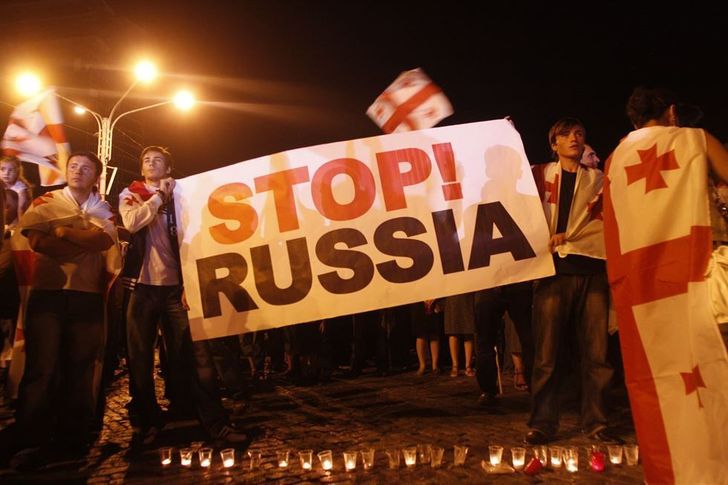
Ethnic Georgians living in separatist-controlled South Ossetia drape Georgian flags around their shoulders and a hold an anti-Russian placard during their protest against Moscow's invasion in August 2008. / Photo By George Abdaladze
By Yi Whan-woo
Ten years after the Russian-Georgian War, Georgia remains ceaseless in its campaign to reclaim its two occupied regions — Abkhazia and South Ossetia — that are safeguarded and recognized as independent states by the Russian Federation.
Georgia and Russia have different approaches over the cause of the war in 2008 that left 850 people killed and 192,000 displaced from their homes.
On the 10th anniversary of the war, Georgian Ambassador to Korea Otar Berdzenishvili said Russia still continues the illegal occupation and steps towards factual annexation of two Georgian regions attempting to incorporate them into Russia’s military, economic and social systems.
Despite the unanimous calls on Russia by the international community to comply with the EU mediated Aug. 12, 2008 Ceasefire Agreement, Moscow hinders the establishment of international security arrangements in Abkhazia and Tskhinvali region/ South Ossetia that is envisaged by the mentioned Agreement and aims at providing security and stability on the ground. Moreover, Russia further intensifies its illegal military build-up and drills in Georgia’s occupied territories.
The ambassador noted that despite Russia’s constant violations, Georgia firmly pursues the peaceful conflict resolution policy that is directed towards the de-occupation of Georgian regions.
Just recently the Georgian goverment introduced the new peace initiative “A Step to a Better Future” to improve humanitarian and socio-economic conditions of people in Abkhazia and Tskhinvali regions and foster people-to-people contacts and confidence building between the divided societies.
The ambassador highlighted that Declaration of the NATO-Georgia Commission, issued on July 12, 2018 during the NATO Summit in Brussels, reiterates NATO’s “full support for Georgia’s independence, sovereignty and territorial integrity within its internationally recognized borders.”
It also calls on Russia “to reverse its recognition of the so-called independence of the Georgian regions of Abkhazia and Tskhinvali/ South Ossetia.”
The declaration read, arguing such withdrawal should be made to reciprocate with Georgia’s “compliance with the Ceasefire Agreement and its commitment on non-use of force.”
It welcomed Tbilisi’s new peace initiative, “A Step to a Better Future,” aimed at improving lives of the people in Abkhazia and Tskhinvali/ South Ossetia regions of Georgia.
With the objective to eradicate the sense of impunity and prevent the aggravation of human rights situation in Georgia’s occupied regions the Georgian government adopted the “Othkozoria-Tatunashvili list” on June 26 to blacklist the 33 individuals who are convicted or charged with murder, torture, kidnapping and other grave crimes committed against Georgians in Abkhazia and South Ossetia since and before the war.
Regarding the mentioned List, Ambassador Berdzenishvili said that the Georgian government asked the partners to issue the relevant decision and/ or resolution considering all the possible restrictions and sanctions against the listed persons.
Also, his embassy sent official request to the Korean authorities to “join to the international community and impose the sanctions and other types of restrictions on the listed individuals.”
Recently, the U.S. House of Representatives passed Georgia Support Act calling on the President Donald Trump to impose the similar sanctions, while the European Parliament adopted a resolution which calls on the EU member countries and European Council to put the 33 individuals on the sanctions list.
Meanwhile, the Russian Embassy in Korea said Moscow remains unchanged in its view over the 2008 war when asked by The Korea Times last week.
During her July 19 interview with Georgian TV, Russian Foreign Ministry Spokeswoman Maria Zakharova said the Othkozoria-Tatunashvili List “has nothing to do with Russia and will have no influence on bilateral relations for this reason.”
She, however, said the list “was made in a confrontational and provocative style and is yet another example of Tbilisi to create obstacles to establishing neighborly relations with Abkhazia and South Ossetia.”
Russia is opposing the NATO’s closer ties with Georgia and Ukraine, both former Soviet republics and now staunch allies of the West.