South Korea upset as UNESCO delays sex slave records listing

A group dedicated to telling the world about Japan’s crime of forcing women into sexual slavery for its troops during World War II holds a press conference at the Northeast Asian History Foundation in Seodaemun-gu, Seoul, Oct. 31. It came the same day UNESCO’s International Advisory Committee postponed listing the victims’ records on its “Memory of the World” register. The banner reads: “We condemn the Japanese government’s diplomatic efforts to undermine culture and politically influence UNESCO’s Memory of the World listing.” / Yonhap
By Ko Dong-hwan
South Korean activists and survivors of Japan’s forced sexual slavery during World War II have expressed anger at UNESCO’s decision Tuesday to postpone listing the records of the women, mostly Koreans, on its “Memory of the World” register.
UNESCO’s International Advisory Committee (IAC) said the issue must be “reconciled between the involved parties” before a listing.
At a press conference at the Northeast Asian History Foundation in Seodaemun-gu, Seoul, Tuesday, the civic group said it will keep campaigning until the records of the so-called “comfort women” are acknowledged and listed on the register.
The group said the reason for the postponement ― a new UNESCO article that all records of colonization, wars and government violence must be reconciled between involved parties ― is unfair. It said the article will prevent countries victimized by war crimes from registering their evidence.
“When UNESCO stated the necessity of reconcilement, they virtually took part in historical reinterpretation,” the group said. It accused the U.N.’s cultural organization of violating its own articles.
The civic group said the Japanese government used its financial clout to lobby for the article. Japan is the second-biggest contributor to UNESCO, behind the United States. The group said South Korea’s former Park Geun-hye administration had not effectively countered the lobbying and cut funding for the group’s campaign.
Japan “blackmailed UNESCO to alter its articles to the Japanese government’s advantage or it would not pay its dividend due for a member nation and sign out from UNESCO,” according to the group. It said the South Korean government could do “nothing but throw in the towel” in the face of Japan’s strong efforts to make UNESCO dismiss listing of the comfort women records as Park’s administration did not defend the issue.
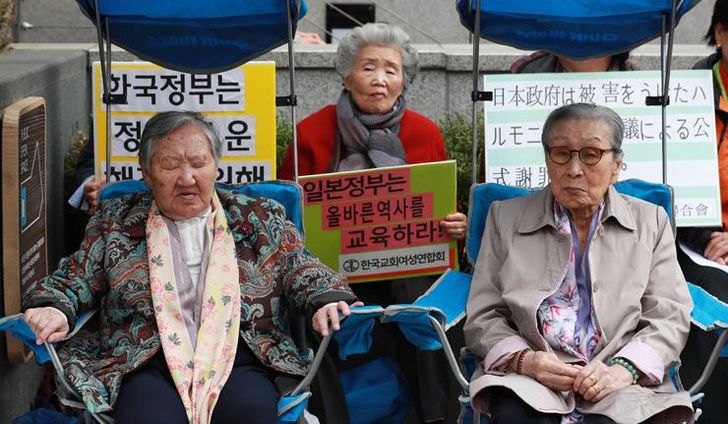
Gil Won-wok, left, and Kim Bok-dong, in the front row, victims of Japan’s wartime sex slavery, join the weekly demonstration in front of the Japanese embassy in Jongno-gu, Seoul, Nov. 1. / Yonhap
On Wednesday, in front of the Japanese Embassy in Jongno-gu, Seoul, former comfort women participated in a demonstration. The UNESCO decision clearly annoyed Kim Bok-dong and Gil Won-wok, who were at the 1307th weekly protest to demand the Japanese government resolve the sex slavery issue.
In May 2016, 15 civic groups from eight countries, including South Korea and China, officially requested that UNESCO list documents related to the comfort women. There are 2,700 kinds of documents, including court records and material given by victims. The documents are considered indispensable first-hand research material.
The Seoul government has supported the civic group-led push for the listing, saying lessons should be learned from the dark history and efforts should be made to let future generations know more accurately the historical facts.
The foreign ministry said the government “expresses regret over the IAC's recommendation and the decision by its secretary general.”
“We oppose any remarks or actions that run counter to the historical truth related to the victims,” a spokesman said. “We will continue possible diplomatic efforts to have the records on comfort women objectively and fairly evaluated.”
The Japanese government protested to the South Korean government that the documents’ listing might run counter to the spirit of a deal reached between the two countries in December 2015 to tackle grievances over Japan’s wartime atrocities. The two then agreed to resolve “finally and irreversibly” the comfort women issue. Tokyo gave an apology for its colonial-era atrocities and agreed to contribute 1 billion yen ($8.9 million) to a foundation dedicated to supporting victims.
More than 200,000 women, mostly Koreans, were forced into sexual slavery in frontline Japanese brothels during World War II, historians say.