China ranks near last in Korean state honors for foreigners
By Ko Dong-hwan
While China is closely linked to South Korea in many fields, a somewhat puzzling fact has been revealed ― that Chinese nationals rate poorly when it comes to being recommended by the Korean government for state honors.
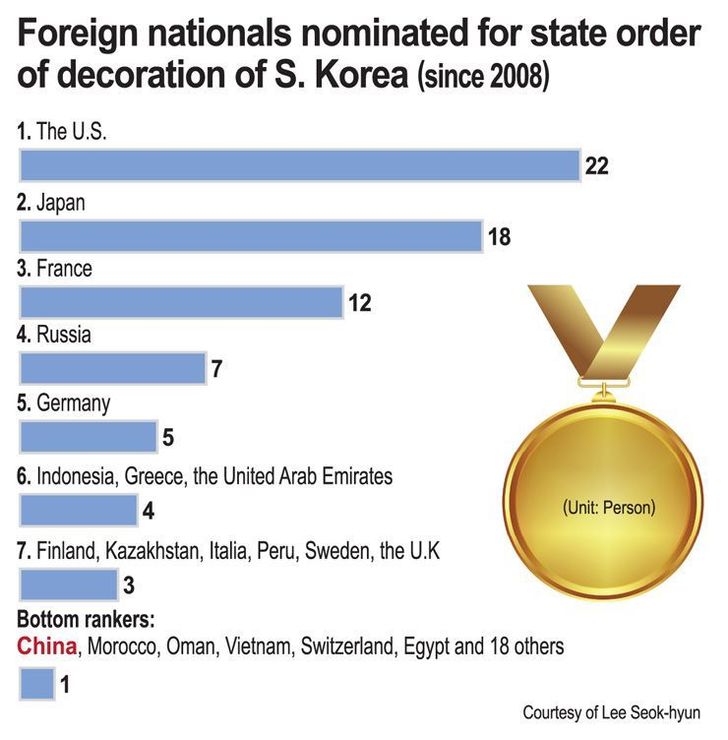
China was one of the lowest-ranked among countries whose nationals were nominated by Korea’s Ministry of Foreign Affairs as candidates for honors, according to Rep. Lee Seok-hyun of the ruling Democratic Party of Korea (DPK) on Wednesday. Rep. Lee is a member of the National Assembly’s Foreign Affairs and Unification Committee.
It reflects that the Sino-Korean relationship, despite consistently functional ties, is perceived rather coldly in Korea compared with other nations like the United States and Japan.
There were 148 candidates from over 50 countries recommended for state honors from 2008 until this year and the U.S. topped the list with 22. Japan ranked second with 18, France third with 12 and Russia fourth with seven.
China was even behind countries from regions like Central America (20), the Middle East (12) and Africa (9).
There is only one Chinese who was awarded an honor: former president of Liaoning University Feng Yuzhong, who in 1993 established China’s first undergraduate program and research center dedicated to studying the Korean language and history. He was awarded in December 2015.
Conferring a state honor on a foreigner is considered a diplomatic act, partly mirroring how deeply ingrained the giver country considers its political ties with the other country.
But the finding is not surprising because China is involved in several national security and economic issues involving South Korea.
China is seen as having a critical role in pressuring North Korea to give up its nuclear weapons and intercontinental ballistic missile programs that are threatening the security of East Asia and the United States.
But it wants South Korea to give up deploying the Terminal High Altitude Aerial Defense (THAAD) battery against the North’s possible missile attacks. To this end, Beijing has taken crippling economic retaliation against Korean firms in China, including major retailer Lotte Mart and auto part manufacturers, as part of a campaign the companies have described as unfair.
“This (honors) finding shows that even 25 years after South Korea and China established their diplomatic relationship, their network is still like a dry land in reality,” the Hankook Ilbo said Wednesday.
The finding also raised questions over whether Korea’s diplomatic efforts are inadvertently concentrated on the U.S. and Japan, which has left the diplomatic ground with China nearly barren.
“It symbolically reflected that, although we say we consider China importantly, our diplomatic agendas are still tilted towards the U.S. and Japan,” said Prof. Kim Heung-gyu from the Chinese policy research group of Ajou University in Suwon. “It has affected Korea making policies without taking China into account enough. It also means that there are not enough Chinese allies whom our government can trust.”