US reaffirms all options open for North Korea
By Jun Ji-hye
The U.S. State Department reaffirmed Friday that “all options are on the table” in dealing with North Korea, indicating it has not ruled out the military option.
Its comments came after a bipartisan group of South Korean lawmakers, after meeting in Washington with Joseph Yun, the U.S. special representative for North Korea policy, told reporters they heard from Yun that the Donald Trump administration is not considering any military options against the North.
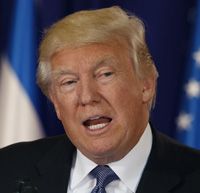
President Donald Trump
Rep. Kim Kwan-young of the opposition People’s Party quoted Yun as saying U.S. President Donald Trump has approved a four-point policy plan that did not include the military option.
The four main strategies are: refusing to recognize North Korea as a nuclear state, imposing every possible sanction and pressure, not seeking regime change, and resolving the problem with dialogue in the end, according to Rep. Kim.
Yun was also quoted as saying Trump signed the policy report by the State Department about two weeks ago.
However, State Department spokeswoman Katina Adams refused to confirm whether or not Trump approved the policy.
“We are not going to discuss our private diplomatic conversations,” Adams said during a telephone interview with Voice of America (VOA).
She indicated the U.S. government has not ruled out the military choice, reaffirming: “All options are on the table.”
She added, “As we pursue our international pressure strategy, we will continue to be flexible and take advantage of opportunities and respond to provocations.”
In the early weeks of the Trump administration, the U.S. President as well as high-ranking officials made a series of hawkish remarks against the repressive state that has continued its missile provocations in defiance of international condemnation and sanctions.
During his visit to South Korea in March, Secretary of State Rex Tillerson declared an end to the Barack Obama administration’s policy of strategic patience in dealing with Pyongyang, vowing to explore all options including harsher sanctions and military action.
Then in April, President Trump also warned of the possibility of military action against the North, saying, “We are sending an armada, very powerful,” during an interview with Fox Business.
The comment was made in reference to the dispatch of a massive aircraft carrier strike group led by USS Carl Vinson to waters off the Korean Peninsula, which was seen as an apparent warning against the North.
However, the Trump administration has recently appeared to shift to a rather soft tone, with the President saying earlier this month he was “absolutely” willing and would be “honored” to meet with North Korean leader Kim Jong-un, though such a meeting could only take place “under the right circumstances.”
During his meeting with South Korean President Moon Jae-in’s special envoy last week, Tillerson also said the United States wants the North to trust its promise of no hostility and conduct no more nuclear or missile tests before Washington can consider opening talks with Pyongyang.
Rep. Kim told reporters, “The U.S. side told us that it was not Washington that has refused to hold a dialogue but Kim Jong-un has shown no willingness to talk.”
The U.S. government’s recent emphasis on dialogue with the North seems to be in line with President Moon’s dual-track policy to pursue Pyongyang’s denuclearization and seek dialogue at the same time.
But observers said Moon and Trump may have some differences about the timing and conditions of the dialogue.
The two heads of state are scheduled to hold a summit late June in Washington.