Moon Jae-in may try to mend China ties
Concerns remain over Seoul-Tokyo relations
By Yi Whan-woo
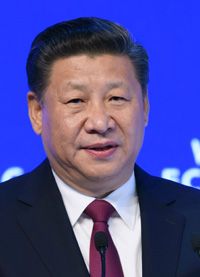
Xi Jinping
.jpg)
Shinzo Abe
South Korea and China are expected to restore ties strained by the deployment of a U.S. defense missile shield here considering liberalist Moon Jae-in won the presidential election, analysts said Tuesday.
But they speculated that South Korea’s deteriorated ties with Japan may deepen, claiming that Tokyo will refuse the new government’s possible call to renegotiate a disputed deal on “comfort women.”
“China is anticipated to have considerable expectations on improving ties with the new South Korean government,” said Kim Han-kwon, a professor at the Korea National Diplomatic Academy. “Regarding Seoul-Tokyo ties, it will be a difficult task as the two neighbors have remain poles apart in their view over history, especially when it comes to issues on comfort women.”
Kim Hyun-wook, also a professor at the Korea National Diplomatic Academy, speculated that Beijing will gradually drop
its economic sanctions against Seoul in retaliation for the installation of the U.S. Terminal High Altitude Area Defense (THAAD) battery.
“But I’m not sure whether Prime Minister Shinzo Abe’s Cabinet will accept the new South Korean government’s request to renegotiate the comfort women agreement.”
Experts said Moon’s pledges have been convincing enough to appease China’s concerns that South Korea may unilaterally take sides with the U.S. in a Washington-Beijing rivalry, such as joining the U.S.-led Missile Defense system.
Moon of the Democratic Party of Korea (DPK) has pledged to seek parliamentary ratification on the ongoing THAAD installation in Seongju, North Gyeongsang Province.
He also vowed for an early takeover of the U.S. wartime operational control (OPCON) of South Korean forces. “Beijing has been concerned THAAD may be used to spy on Chinese military activities instead of deterring North Korea’s ballistic missile attacks. And China can be assured that the liberal government, unlike its conservative predecessor, will not cooperate with the U.S. over any such attempt,” Kim Han-kwon said.
Regarding the comfort women deal struck between South Korea and Japan in December 2015, all political parties here have been calling for its renegotiation.
They claimed that it failed to reflect the views of the surviving victims of Japan’s sex slavery during its 1910-45 colonization of the Korean Peninsula.
But Japan has been insisting that South Korea carry out the agreement, claiming it was “final and irrevocable.”
Tokyo also asked for the removal of two statues of girls placed outside its embassy in Seoul and consulate in Busan to commemorate the comfort women, claiming they are in violation of the 2015 agreement.
The experts said the hawkish Abe’s push to overhaul the Japanese Constitution may add to public resentment against Japan in South Korea.
Abe has argued that the pacifist Constitution now needs to be amended to expand the role of the Japanese military for peaceful purposes. But many South Koreans are concerned that Japanese forces will forcibly enter the peninsula in the event of a war.
US variable on Seoul’s diplomatic relations
Although the experts were optimistic about South Korea-China relations, they said the conflict over THAAD cannot be settled completely without considering Washington’s relations with Seoul and Beijing as well as the geopolitics in Northeast Asia.
“The disputed THAAD deployment basically stems from the Washington-Beijing rivalry and it’s more than South Korea-China relations,” Kim Han-kwon said. “We therefore need to make sure that China does not have too much expectation over THAAD-related issues. Otherwise, South Korea-China relations may face a setback.”
Hwang Tae-soon, a political commentator, said the U.S. may push South Korea to carry out the comfort women agreement as part of efforts to bolster a trilateral security alliance with Japan against China and North Korea.
“And such attempt can only backfire and raise anti-Japan sentiment,” he said.
Kim Han-kwon echoed the view, saying “The U.S. will want South Korea and Japan to reconcile so that it can strengthen security cooperation in the region.”
“But it will not be easy, as comfort women-related issues have been the biggest stumbling block for the Seoul-Tokyo ties for decades,” he said.
All major presidential candidates pledged to either renegotiate or scrap the deal.
Their diplomatic promises were contrary to Japan’s plan to ensure that the next Korean government will carry out the deal as promised by the outgoing conservative administration