Does South Korea need THAAD?

The deployment of a U.S. Terminal High Altitude Area Defense (THAAD) battery here remains controversial. This combination of photos shows supporters of THAAD who claim it will deter North Korea from attacking the South Korea, and opponents who say it will not prevent the North’s threats, but only increase conflict with China.
By Kim Jae-kyoung
THAAD is inevitable choice for Korea
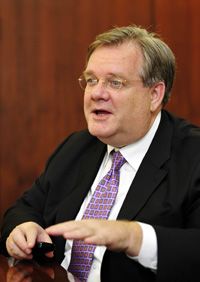
Jeffrey Jones
China must stop its opposition to the deployment of a U.S. missile defense system because it is only a deterrent against North Korea’s current nuclear brinkmanship, according to former AMCHAM Chairman Jeffrey Jones.
“THAAD is not only a deterrent against any kind of nuclear or non-nuclear missile attack by North Korea, it creates an even stronger deterrent to prevent North Korea from taking any unthinkable action to again attack South Korea,” Jones told The Korea Times.
He pointed out that there is a broad misunderstanding in China that the Terminal High Altitude Area Defense (THAAD) is an offensive weapon which could be used against it.
“THAAD is a purely defensive mechanism to prevent incoming missiles,” said Jones who is an international lawyer at Kim & Chang.
“THAAD is not only for the protection of Korean citizens in South Korea, but also for the protection of the more than 28,000 U.S. soldiers on the Korean peninsula.”
He pointed out that given the provocations by North Korea and the threats against South Korea with conventional and potentially nuclear weapons, the U.S. has no choice but to protect its soldiers located here.
“It would be irresponsible for the U.S. not to take action to protect U.S. troops on the Korean peninsula,” Jones said. “Failure to do so would create a strong movement in the U.S. to withdraw troops from Korea leading to severe destabilizing consequences for Korea, Japan and China.”
Regarding economic retaliation over the deployment, he said that such actions appear to be Chinese government policy despite its repeated denials.
He stressed that Beijing must realize that it is one of the greatest beneficiaries of free, fair and open trade.
“It is ironic that the Chinese government is capable of engineering such improper trade and investment sanctions based on a misunderstanding and fear of the U.S.,” he said.
“It is the North Korean provocations that are the genesis of the THAAD issue and the Chinese government is the one party that has the greatest measure of control and ability to prevent North Korea from making threats and implementing such dangerous provocations.”
He expects that any kind of military conflict would lead to disastrous consequences for not only the people of North and South Korea, but China, Japan and the entire global economy.
In his view, a nuclear or conventional war on the Korean peninsula would disrupt the supply of semiconductors, cell phones, chemicals, automobiles and other essential items necessary for the world economy.
“Even shipments of goods in and out of China and Japan would be disrupted leading to an economic disaster for the globe,” he said. “The cost in human lives is unthinkable.”
He said Korea seems to be facing a crisis equal to or more serious than the tense situation in 1994 when there was a real risk of a potential first strike against the nuclear capability of the North.
Against this backdrop, he stressed that Korea needs a strategy and a leader who can implement dialogue with both China and the U.S.
“One of the urgent tasks facing Korea is to elect a new president capable of engaging in a productive dialogue with China to ease the concerns of the Chinese leadership and Chinese public,” he said.
“Also, such a leader is needed to properly interact with the new Trump administration to give sufficient comfort and assurance to the American public and the Trump administration that a first strike on North Korea is not justified or necessary.”
THAAD deployment ‘most thoughtless’

James Rooney
James Rooney, vice chairman of the Seoul Financial Forum, said that South Korea will suffer unwanted consequences for its deployment of a U.S. missile defense system, describing the move as a “self-inflicted” mistake.
He said that South Korea needs to keep the U.S. engaged but not at the expense of antagonizing China through inappropriate access to the latter for either Washington or Japan through a Terminal High Altitude Area Defense (THAAD) system.
“Bringing THAAD onto the Korean Peninsula is the most thoughtless thing that South Korea has done in a long time,” Rooney told The Korea Times.
He said that THAAD is next to the worst solution to solve the North Korea nuclear issue. He believes that it will further sour relations among neighbors and escalate geopolitical tension in the region
“THAAD is an unnecessary and distracting sideshow from much bigger and urgent issues that need to be addressed today, both within Korea and in the neighborhood,” he said.
“But it will not go away by ignoring it, and China's issues with it will not change just because we want to argue the case differently,” he added. “We need to respect their opinion and take actions accordingly.”
Using the example of a spy cam, Rooney, a professor of international finance at Sogang University, explained why China is so sensitive to the missile defense system.
“Imagine your next door neighbor installed a spy cam system that enabled him to look over into your garden and could even tell what was going on inside your house,” he said.
His argument was that he installed it to watch out for thieves and villains coming from the other direction and has nothing to do with the neighbor.
“You cannot imagine why your neighbor would want to give this party access to information about themselves like this, but you certainly do not want any third parties to have greater abilities to monitor you and potentially threaten you with defensive weapons,” he said.
It is claimed that THAAD is purely defensive, but he said that there is no good reason to believe that the claims made for its defensive capabilities will play out to prevent loss of human life in the future.
“Many may not realize that it actually adds to the potential for death and destruction in the neighborhood because once it is installed there will be a temptation for the targeted adversary to test it to see what happens,” he added. “That temptation is not present if THAAD is not present.”
Rooney pointed out that THAAD is not at the heart of the South Korea-U.S. alliance, noting that alliance has survived for 60 years built upon a more solid foundation than one imperfect piece of technological hardware of limited utility.
“South Korea should have just said ‘No’ to THAAD when it was first proposed or once the reaction of China had been understood, but it is never too late to stop doing something that is unproductive,” he said.
Regarding Beijing’s trade curbs, Rooney said that he does not see this reaction as "economic blackmail."
“I think that South Korea has failed to see the issues with THAAD sufficiently clearly from its neighbor’s point of view and it has failed to listen to its important neighbor in ways that could have avoided the arrival of this issue in the first place.”
He said the leadership vacuum has made things worse.
“I think that the current leadership vacuum and related distractions in South Korea has led to a failure to engage in constructive dialogue at a sufficiently high level to resolve the matter quietly,” he said.