Japanese envoy becomes laughing stock in Korea
By Yi Whan-woo
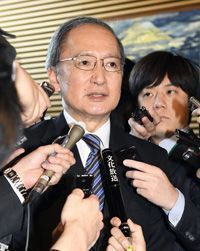
Yasumasa Nagamine
Japanese Ambassador Yasumasa Nagamine is becoming a laughing stock on online communities after he returned to Korea “empty-handed,” Tuesday, in a tug-of-war between the two countries over a “comfort woman” statue.
His return promoted mockery online as it came despite no concrete action taken by Korea in line with Japan’s demand to remove a statue of a girl set up outside the Japanese Consulate in Busan.
The Japanese government had kept Nagamine at home for nearly three months after recalling him on Jan. 9 in retaliation for the installment of the statue, which symbolizes Korean wartime sex slaves.
In February, Japan said Nagamine would not be sent back unless the Korean government took satisfactory measures to remove the statue. Tokyo claimed it was against an agreement reached between the two countries in December 2015 to end the dispute over “comfort women.”
Despite this, the statue still remains in its place.
“Why bother to return?” a Daum user named gangjwa wrote just hours before Nagamine’s arrival, Tuesday.
Another user, Maleunsem, commented, “You can go back to Japan again.”
A Naver user, lgo2****, called the Japanese ambassador an “idiot” for “sneaking back after leaving Korea voluntarily.”
The citizens also downplayed reasons listed by Japanese Foreign Minister Fumio Kishida, Monday, concerning Tokyo’s decision to return Nagamine.
Kishida cited a need to collect information on Korea’s presidential election, May 9, to better cope with the new Korean government and to maintain the alliance between Seoul and Tokyo against Pyongyang’s nuclear and ballistic missile threats.
He also said it will be needed for Nagamine to meet acting President and Prime Minister Hwang Kyo-ahn in person and ask him to ensure that the new government will carry out the deal over “comfort women.”
“To many, it really may sound silly to ask an acting president from an outgoing government to make a promise over a controversial deal. But for Japan, sending Nagamine back was something it had to do at least considering Korean politics has changed drastically in recent months,” said Park Won-gon, an international relations professor at Handong Global University.
“Recalling Nagamine was to press the Park Geun-hye administration to implement the December 2015 agreement. And all of a sudden, Japan has no counterpart to talk in Korea as Park has been ousted from the presidency while the idea of re-negotiating or even scrapping the sex slavery agreement has become a hot topic among presidential candidates here.”
Japan’s recall of Nagamine re-ignited controversy over the December 2015 agreement and fueled public complaints against the Ministry of Foreign Affairs for remaining low-key regarding sex slavery-related issues.
The foreign ministry has been citing “inappropriateness” of the location of the “girl statues” outside the Japanese missions in Korea, including the one across the street from the Japanese Embassy in Seoul.
The view reflects Japan’s argument based on the Vienna Convention on Diplomatic Relations. Article 22 states that a host country should protect the premises of diplomatic missions “against any intrusion or damage and to prevent any disturbance of the peace of the mission or impairment of its dignity.”
Japan, however, has been lodging protests against statues that are not in proximity of its diplomatic missions abroad.
Last month, a senior official from the Japanese Consulate in Munich raised an objection after Europe’s first “girl statue” was set up at a park in Wiesent, Germany, according to Korean activists.