NZ encourages women's leadership
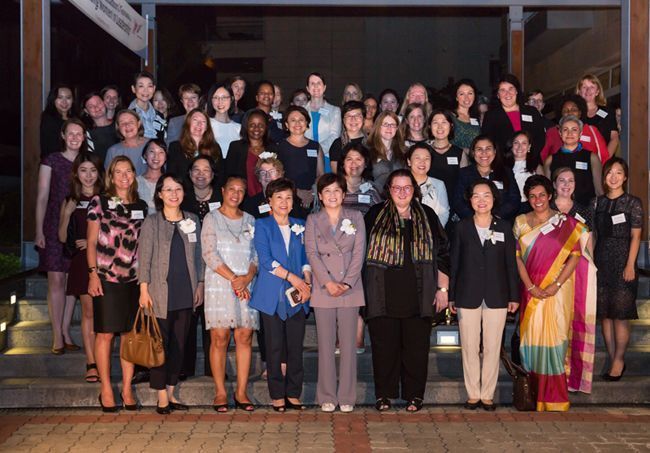
New Zealand Ambassador to Korea Clare Fearnley, fifth from left in the front row, poses with Gender Equality and Family Minister Kang Eun-hee, fourth from left in the same row, ambassadors and lawmakers as well as female leaders from Korea and other countries during a reception to celebrate women’s leadership at her residence in Yongsan-gu, Seoul, Sept. 5. / Courtesy of New Zealand Embassy in Korea
By Yi Whan-woo
New Zealand has been a pioneer in women’s rights, becoming the first country in the world to grant all women the right to vote in national elections in September 1893.
It set another pioneering example 123 years later, this time in Seoul, by hosting a reception for diplomats, legislators and other working women from Korea and abroad as part of efforts to enhance women’s leadership globally.
“This sort of wide invitation to women from all sectors is the first time we’ve done something like this,” New Zealand Ambassador Clare Fearnley told The Korea Times during a meeting at her residence on Sept. 5.
She added that around a dozen women ambassadors and female leaders in Seoul met only in smaller groups in the past.
The participants at the reception included Adalgisa Maria Soares Ximenes of East Timor, Dato Rohana Ramli of Malaysia, Emma-Francoise Isumbingabo of Rwanda and Manisha Gunasekera of Sri Lanka, as well as Signe Poulsen, the representative of the U.N. Human Rights Office of the High Commissioner in Seoul.
From the Korean side were Gender Equality and Family Minister Kang Eun-hee and Korean Red Cross President Kim Sung-joo, who also serves as the chairwoman of fashion house Sungjoo Group. Junior officials from the Ministry of Foreign Affairs (MOFA) were also present at the reception.
“There are a lot of young foreign service women here from our own embassy, from other embassies and from MOFA. And we want to support young women to connect with each other as they begin their careers,” Fearnley said.
She also anticipates that the meeting will facilitate exchanges of ideas among the participants concerning their careers, such as how to overcome challenges they face as female professionals.
“Every country has something to learn from every other country,” she said.
The envoy cited that New Zealand has the lowest gender pay gap, the difference between men and women in their earnings is 5.6 percent among the Organization for Economic Co-operation and Development (OECD) member-countries.
She also pointed out that women account for 64 percent of the lower house of parliament in Rwanda ― a far higher percentage than in any other nation.
Kang said, “Gatherings like this are important because we can discuss what steps women leaders should take to be one step ahead of our work and also enhance and strengthen our bonds with each other.”
Kim feels strongly that encouraging each other at the reception will help the women enhance their strength in their workplaces and make further contributions to society.
“In the information society, combing women’s strengths and perceptions with men’s is critical to make our society grow, and this meeting can lay the groundwork for such a goal,” she said.