Myanmar, Vietnam learn Korea's legislative policies
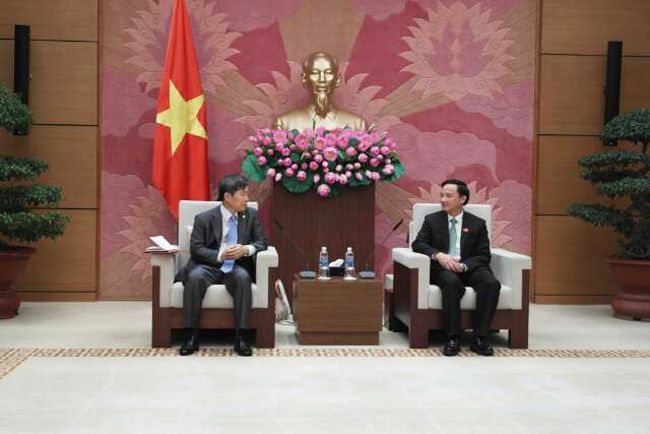
Je Jeong-boo, left, minister of government legislation talks with Nguyen Khac Dinh, chairman of the Law Committee of the National Assembly of Vietnam, at the committee building in Vietnam, Aug. 31. / Courtesy of the Ministry of Government Legislation
By Kim Jae-kyoung
A growing number of Southeast Asian nations are seeking to take a cue from South Korea in upgrading their legislative policies by strengthening cooperation with the country’s Ministry of Government Legislation (MOLEG).
Vietnam and Myanmar are leading the trend. They are keen to learn Korea’s knowhow and experience on how its legislative system has helped the Korean economy achieve such fast development over a short period of time.
“Korea has developed its industries through a systematic legal system. Korea's experience in legislation and legislative information management systems will contribute significantly to legislative policies in Vietnam,” Vietnam’s Justice Minister Le Thanh Long said in a recent meeting with Je Jeong-boo, minister of government legislation.
The meeting came after Korea’s legislation ministry and Vietnam’s justice ministry held a workshop, Aug. 31, on “Efficient Management and Provision of Legislation” to share their experiences and seek ways to intensify cooperation.
Je also met with Nguyen Khac Dinh, chairman of the Law Committee of the Vietnamese National Assembly, to discuss ways to bolster cooperation in legislative policies and maximize the effect of a bilateral FTA that came into effect in November, 2015.
“For the smooth progress of the Korean-Vietnam FTA, our two nations need to swiftly exchange information on the most recent laws in order to enhance understanding of both nations’ investment climate,” Je said.
The agreement was the outcome of a six-day visit by a delegation from MOLEG to Vietnam and Myanmar from Aug. 30 to Sept. 4. The visit sought to strengthen relations regarding exchanges and cooperation between the respective legislative bodies and governments of the two countries.
In Myanmar, Je visited the Ministry of Justice and the Bill Committee of the Lower House, and discussed what more could be done to successfully implement a Myanmar Law Information System, Sept. 2
Je and Myanmar’s Justice Minister Htun Thun Oo agreed to make joint efforts to complete the development of a legislation database system by 2017, which is an Overseas Development Aid project worth 3.7 billion won over two years
"Once the system is in place, the people of Myanmar will be able to easily access the increasing number of laws in accordance with our Rule of Law policy,” Oo said.
In response, Je said, “We look forward to a successful system laying the foundation for economic development through democratization and the vision of Myanmar’s new government.”
“In particular, Korean companies doing business in Myanmar shall be able to research Myanmar laws easily and therefore reduce their legal services costs significantly," he added.
The Korea International Cooperation Agency estimates that the average Korean company doing business in Myanmar spends about 20 million won a year to research local laws.
If a company is able to research laws by itself through the new information system implemented in Myanmar, current legal services costs for these companies will be reduced by 30 percent, or 1.8 billion won annually.
The project in Myanmar has gained momentum when Aung San Suu Kyi became Myanmar’s de facto leader when her party took office in April.
“Myanmar became more interested in establishing the legal information system, as she proposed various goals for the country, such as democratization, market-opening and industrialization, and claimed that the rule of law shall be the ruling ideology,” Je said.
“It is definitely meaningful that Myanmar recognized Korea as a partner who will establish its legislative IT system, when many countries are trying to build relations with Myanmar.”
MOLEG also plans to offer advice on organizing laws to other developing countries. Laos and Cambodia are keenly interested in Korea’s legislative consulting program.
The ministry is scheduled to support Cambodia in its organization of laws related to urban development together with the Korea Land & Housing Corporation.