Ban Ki-moon's ambiguity fuels speculation about 2017 presidential bid
By Yi Whan-woo
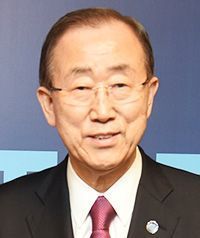
Ban Ki-moon
U.N. Secretary-General Ban Ki-moon remains tightlipped over speculation that he may run in the 2017 presidential election as a conservative candidate.
He has never clearly said whether he will join the race or not. However, many liberal politicians think that there has already been a behind-the-scenes deal between Ban and President Park Geun-hye.
“If Ban doesn’t have the intention to run, he should have clearly said so,” said Rep. Park Jie-won, floor leader of the minority opposition People's Party, Tuesday. “I expect he will run as a candidate for the Saenuri Party.”
Ban’s possible presidential bid is a keen issue ahead of his six-day trip to Korea, which begins on Wednesday.
His visit mainly includes doing what is seen as the usual routine for the U.N. chief.
He is scheduled to attend banquets, deliver speeches and meet participants at the Jeju Forum in Seogwipo, Jeju Island, the 2016 Rotary International Convention in Goyang, Gyeonggi Province, and the UNESCO-designated Hahoe Folk Village in Andong, North Gyeongsang Province.
He will then attend the U.N. Department of Public Information (DPI)/NGO Conference in Gyeongju, North Gyeongsang Province, before returning to New York.
Nonetheless, some critics questioned whether Ban, a former Korean foreign minister, may use these events to build relationships and draw support from people across the country.
There is growing speculation that he may join the ruling Saenuri Party after his term at the U.N. ends in December.
“With his U.N. term to expire this year, speculation and misunderstandings concerning Ban’s possible presidential bid will not let up,” said Choi Chang-ryul, a political professor at Yongin University. “Whoever Ban will meet and wherever he goes in Korea will have political significance.”
Lee Kang-yun, a journalist-turned-political commentator, echoed this view.
“Ban would have refrained from engaging in activities that can be seen as politically motivated if he were not interested in the presidency at all,” he said. “But I don’t see anything like that.”
Coincidently or not, there have been media reports critical of him.
In its latest edition, The Economist assessed Ban, who took the U.N.’s top job in 2007, as “the dullest ― and among the worst” for being “painfully ineloquent, addicted to protocol and lacking in spontaneity and depth.”
Main opposition Minjoo Party of Korea (MPK) floor leader Rep. Woo Sang-ho said the MPK will not consider fielding him as its presidential candidate, adding “he’s not that good.”
Some political sources speculated that Ban may try to win public support during his tour to Hahoe Folk Village, citing that it is in a region that has been a stronghold of the Saenuri Party.
They claim that Ban is scheduled to have a luncheon with the elders of the country’s Ryu clan in addition to watching a traditional performance and touring the village. Hahoe Village has preserved a clan-based community since the 16th century.
A North Gyeongsang provincial government official said the U.N. proposed the village tour for Ban, citing Andong’s closeness to Gyeongju and that it is customary for a U.N. chief to visit UNESCO heritage sites in countries they travel to.
The organization committee of the 2016 Rotary International Convention said it is “concerned about political debate” related to Ban, saying it was the committee that invited him to join the event.
The five-day event will also run in downtown Seoul and relevant local government officials are invited to the convention aimed at assessing volunteer activities and cultures among some 50,000 participants from around the world.
“Let’s make sure that Ban’s speech targets international guests. Also, a number of officials invited have not said they will attend, so it’s uncertain whether Ban can meet them or not,” an official said on condition of anonymity.