EMBASSY LINE
Israel Israel asked to ease visa rules
The government requested Israel to ease work visa rules and implement a working holiday program during the sixth meeting of their joint economic commission in Jerusalem, June 24.
According to the Ministry of Foreign Affairs, it also asked Israel to speed up the domestic procedure to allow Koreans who obtain drivers’ licenses issued in Korea to drive vehicles in the Middle Eastern country even though they don’t have locally issued permits.
“The government believes that people-to-people exchanges will pave the way for the foundation of economic cooperation in the two countries,” the ministry said in a press release.
Korea asked Israel to ease rules on issuing work visas as some businesspeople find it difficult to obtain them, the ministry said.
During the meeting, the two sides assessed bilateral economic relations and discussed further cooperation in trade, research and development, scientific research, climate change, water and energy issues.
Bilateral trade between the two countries marked $2.2 billion last year. The two sides agreed to hold a seventh meeting in Seoul next year.
Panama
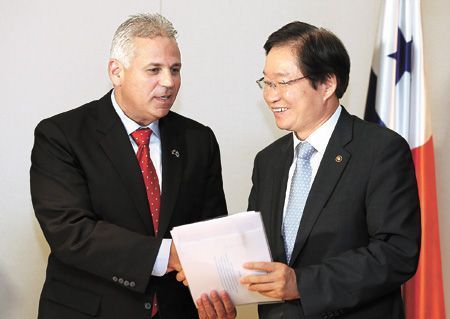
Support for IMO candidate: Ambassador of Panama Ruben Eloy Arosemena Valdes, left, hands over a dossier at the Shilla Hotel in Seoul, June 24, certifying his government’s endorsement of Lim Ki-tack, president of the Busan Port Authority who is seeking to become secretary general of the International Maritime Organization (IMO). / Yonhap
Russia
Korea-Russia consular meeting held
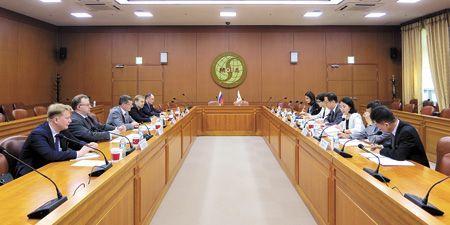
Korean and Russian officials at the Ministry of Foreign Affairs for talks on June 23.
Officials in charge of consular affairs of Korea and Russia held a meeting in Seoul, June 23.
The two sides discussed ways to cooperate in consular affairs to better protect their nationals in each other’s countries.
They evaluated follow-up measures of the visa waiver program and examined possible ways to strengthen ties.
They shared the view that consular affairs accords signed earlier contributed to an increase in people-to-people exchanges and the streamlined procedure benefitted
businesspeople of the two countries.
The Korean side proposed that both governments recognize each other’s drivers’ licenses so that their nationals don’t need to obtain those issued by the local
authorities.
It said such a measure would help facilitate
people-to-people exchanges.
Korea also requested Russia to allow Korean nationals who were arrested to have swift access to consuls and ease punishments for those who violated Russian
administrative law.
The government offered explanations about the outbreak and spreads of the Middle East Respiratory Syndrome in Korea to better inform Russian tourists of the
virus.
The two sides shared the view that the regular consular affairs meeting helped them share related information and also served as a channel for exchanges of views.
They agreed to hold another meeting next year in Russia at an appropriate time.