Indian ambassador pitches yoga to Korea
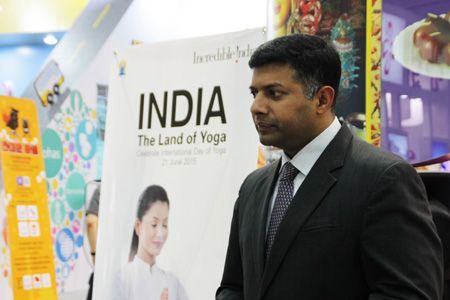
Ambassador Vikram Doraiswam at the Indian Embassy in Seoul / Korea Times
By Kang Hyun-kyung
New Indian Ambassador to Korea Vikram Doraiswami has been working on a challenging assignment: promote yoga and consequently, increase the number of participants during the International Day of Yoga.
June 21 was designated as a day of celebration for the ancient Indian practice, following Prime Minister Narendra Modi’s proposal during his speech to the United Nations in September last year.
It’s hard to find creative ways to promote yoga compared to other Indian practices because it is already well-known in Korea and around the world, with many practicing it on a regular basis to improve their physical or mental well-being. Nevertheless, the envoy is determined to find an innovative idea that will rekindle the public’s interest in yoga. The most challenging part of the task is dispelling suspicions about the real motives behind the Indian government’s global promotion of yoga.
Some people believe Prime Minister Modi is motivated by cultural nationalism, which Doraiswami denied.
“What we are promoting is not an Indian system. Just practicing taekwondo doesn’t make practitioners Koreans,” he said on June 5 at the Indian embassy in Seoul. “What we are trying to do is to support yoga organizations in Korea that are already undertaking activities to promote yoga, which is why we you see Korean groups, not the Indian Embassy, are promoting yoga.”
The envoy noted that tens of millions of people practice yoga as a form of exercise or meditative training.
“The idea of marking the International Yoga Day is to bring together as many yoga practitioners as possible and to introduce yoga to as many people who are not familiar with it as possible across the world,” the envoy said.
“Yoga is a holistic system of exercise. It is also a system that promotes collective, holistic well-being. So it is more than a kind of exercise.”
The Indian envoy met reporters at the embassy to preview a set of events for International Yoga Day. Yoga practitioners were also at the embassy to give an overview of their groups’ activities and how they would celebrate the day.
According to them, on June 21, some 2,000 people will practice yoga at Seoul Square near the City Hall. After the three-hour opening ceremony, they will perform yoga in other parts of Seoul. Promotional yoga events will simultaneously take place in the nation’s second-largest city, Busan, as well as in Daegu.
According to Korea Yoga Association (KYA) in Seoul, there are no figures on the yoga-practicing population in Korea. “There are several yoga groups and associations in this country, but they manage their own membership data. We don’t share our data with others,” a KYA staff member told The Korea Times. She said there are approximately 8,000 KYA members.
A massive yoga performance will also take place in India on June 21. According to Doraiswami, Prime Minister Modi, himself a yoga enthusiast, will lead a mass yoga event at the monument park that commemorates the late democracy fighter Mahatma Gandhi. Up to 40,000 Indians are expected to join the celebration of Modi’s campaign to spread the yoga practice globally.
“Yoga is an invaluable gift of India’s ancient traditions. It embodies unity of mind and body, thought and action, restraint and fulfillment, harmony between man and nature, and a holistic approach to health and well-being,” the Indian prime minister said during his speech to the United Nations in September last year. “It is not about exercise but discovering the sense of openness with yourself, the world and nature.”
Doraiswami also touted the health benefits of yoga, sharing his and his family’s experiences. The envoy said he practices some yoga postures every morning for his back problems.
“When I was in school, I spent five years doing yoga. I gave it up for basketball. It was a mistake,” he said. “Now, I have problems with my back, knees and joints. I felt I needed to restart yoga again. But I still do some yoga in the morning.”
He said his mother, who is in her 70s, has benefitted from the exercise since she began practicing it when she was in her 40s for her knee problems.
The envoy kindly turned down a request to demonstrate some of his favorite yoga postures in front of the reporters.
He said the Indian practice is one of the items that he will focus on to help strengthen Korean-Indian relations, during his tenure as ambassador to Korea.
Prior to coming to Seoul, he briefly served as the Indian ambassador to Uzbekistan. However, in February, merely six months after arriving in Tashkent, he got an urgent call from India’s foreign minister asking him to move to Seoul for a new posting.
Prime Minister Modi’s visit to Seoul in May appeared to be behind the call, as former Indian ambassador to Korea Vishnu Prakesh left the country to assume his new post in Canada in February.