Gov't to go ahead with construction plan on Dokdo
By Yi Whan-woo
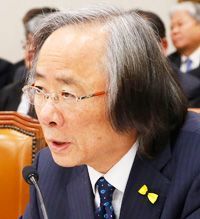
Lee Ju-young
Oceans and Fisheries Minister Lee Ju-young said Wednesday the government will go ahead with a plan to build a maintenance and safety facility on Dokdo, the country’s easternmost islets, after reviewing an initial construction plan.
“We haven’t scrapped the plan yet,” Lee said during a meeting of the National Assembly Agricultural and Fisheries Affairs Committee. “We’ll revise a few things and carry out the plan.”
His announcement came after a recent dispute over the government’s ambiguous approach in promoting the nation’s sovereignty over Dokdo amid a territorial dispute between Korea and Japan regarding the islets.
On Nov. 1, the Prime Minister’s Office said during a Cabinet meeting that the government will scrap its plan to build the facility.
The plan was first proposed in 2008 under former President Lee Myung-bak, President Park Geun-hye’s predecessor.
Under the Park government, the Ministry of Oceans and Fisheries has been pushing to build the facility, equipped with an electric generator and evacuation shelter, on 590 square meters of land by 2017.
The Ministry of Strategy and Finance also allotted 3 billion won ($2.73 million) early this year for the construction.
According to a government source, Foreign Minister Yun Byung-se opposed the plan at the Cabinet meeting. He reportedly cited frayed Seoul-Tokyo ties and expressed concerns that the plan would further worsen bilateral relations.
Since then, politicians and scholars have been divided over whether it was appropriate for the government to scrap the plan.
“Dokdo has been an integral part of Korea’s territory historically, geographically and under international law. And Japan can’t interfere in our construction plan for our people,” Lee said at the National Assembly.
The government has been stepping up its effort to promote Dokdo globally. On Oct. 25, the Ministry of Foreign Affairs unveiled a new promotion video clip for the islets in seven languages — French, Arabic, Russian, Italian, German, Portuguese and Hindi — on its website. The foreign ministry previously offered the video footage in Korean, English, Japanese, Chinese and Spanish.