Uzbekistan eyes Korea's IT expertise
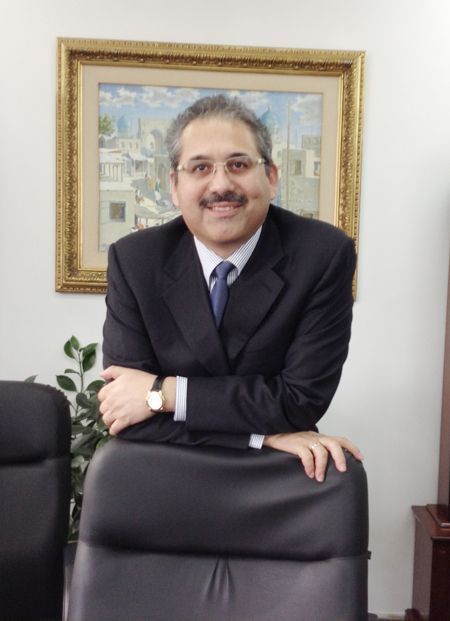
Uzbek Ambassador Alisher Kurmanov poses for a photo after an interview with The Korea Times at the embassy in Seoul, Thursday. / Korea Times
By Kang Hyun-kyung
Ambassador Alisher Kurmanov has not hidden his ambition to attract a Korean university to establish an overseas campus in Uzbekistan since he arrived in Korea last year.
His effort is about to bear fruit earlier than expected. A Korean university delegation is now traveling to Uzbekistan for negotiations with the Uzbek government to establish an overseas campus there.
If their talks go smoothly, Inha University based in the port city of Incheon will open a campus in the Central Asian country in September.
“Koreans’ pali-pali (hurry up) spirit partly helped the project move swiftly,” Kurmanov said with laughter during a recent interview with The Korea Times.
Ambassador Kurmanov hinted that the Korean university project aims to help his nation learn Korea’s IT technology and logistics and is also closely related to his government’s long-term goal to achieve a developed nation.
“We were looking for a university which has strong programs in IT and logistics,” the envoy said. “We are learning Korea’s experiences in IT technology and setting up an electronic government. Therefore, we need a strong university which has experiences in these fields.”
The Uzbek ambassador explained that the New Silk Road project was another key factor behind his government’s push to attract a Korean university.
“We need to revive the Silk Road which is part of the Eurasian Initiative as well.”
His remarks were construed as meaning that Inha University’s strength in logistics programs prompted his government to start negotiations for the overseas campus project.
Since 2007, Uzbekistan, along with nine other countries, has been working on the creation of a New Silk Road, a term initially coined to refer to China’s trade in silk with the West nearly 2,000 years ago.
The nine other countries involved in the project are China, Afghanistan, Pakistan, Azerbaijan, Kazakhstan, Kirgizstan, Mongolia, Tajikistan, and Turkmenistan.
South Korean firms are involved in the project.
In December, POSCO won a bid to construct an 85-kilometer four-lane highway connecting Kishlak and Gazil in Uzbekistan, which is part of the New Silk Road project.
POSCO is scheduled to complete the highway project in two years.
Ambassador Kurmanov indicated that the project has led Uzbekistan to upgrade its capability in the logistics area to benefit once the trade route project is completed.
He said the foreign university project has a strong backing from his government, noting it was the idea of President Islam Karimov.
“President Karimov directed our first deputy prime minister to take care of the project. If our negotiations with Inha University bear fruit, it will be the seventh foreign university in Uzbekistan,” he said.
The envoy has knowhow in attracting a foreign university as he successfully did it when he served as ambassador in Singapore before coming to Korea.
Uzbekistan is home to nearly 200,000 ethnic Koreans who are called Koryo-saram among the members of the Korea community there.
Most of them are the descendents of Koreans living in the Far East. In 1937, these people were forced to leave their place by then Soviet Union leader Joseph Stalin.
Ambassador Kurmanov noted that his government respected ethnic Koreans as they work hard and make efforts to learn the Uzbek language.
He said some of them are very successful. The envoy cited the general director of Uzbek Airways as one of the successful Korean descents in his country.
Kurmanov said ethnic Koreans played a critical role in upgrading his country’s relations with Korea.
The envoy stressed that the Uzbek government provides equal opportunity for all ethnic groups, including Korean-Uzbeks, explaining that there are approximately 100 ethnic minority groups in his country.
The selections of government officials are based on meritocracy and no ethnic groups are subject to discrimination because of their ethnicity, the envoy noted.
The ambassador said his recent interest is expanding bilateral relations with Korea.
He noted that there are a lot of areas that the two countries can work even more closely together in.