Park, Obama united against NK threats
.jpg?w=728)
President Park Geun-hye, escorted by Maj. Gen. Michael Linnington, walks past the colors of American states during a wreath-laying ceremony at the Tomb of the Unknowns at Arlington National Cemetery in Arlington, Va., Monday. / AP-Yonhap
By Kim Tae-gyu
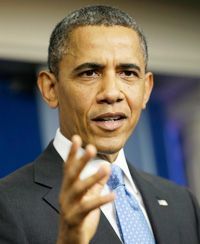
U.S. President Barack Obama
WASHINTON — President Park Geun-hye and U.S. President Barack Obama agreed to keep a united front against North Korea’s threats during their summit in the White House, Tuesday.
“Amid the continuing North Korean threats, the two leaders reconfirmed their collaboration in policy,” presidential spokesman Yoon Chang-jung told a press conference.
“Based on Obama’s support for Park’s Korean Peninsula Trust Process, they reaffirmed they will sternly deal with North Korean provocations while keeping the door for dialogue open.”
The Korean Peninsula Trust Process refers to Park’s flagship North Korea policy of trying to engage the belligerent regime by building trust without rewarding its trademark brinkmanship and aggressions.
The two also came up with a joint declaration in commemoration of the 60th anniversary of the alliance between their countries, which stretches back to the Korean War (1950-53).
“They shared their willingness to maintain and develop the two states’ military alliance while deepening strategic bilateral ties,” Yoon said.
Park and Obama also talked about the Northeast Asian Peace Initiative, tentatively named “The Seoul Process,” geared toward strengthening cooperation not only among regional economies but also in politics and diplomacy.
The summit included economic collaboration in three fields of creating next-generation growth engines, benefiting people’s daily lives and beefing up the global partnership between the long-time allies.
To build future cash cows, they will make concerted efforts in research on renewable energy sources while jointly working on the extraction of new resources such as shale gas and gas hydrates.
They will also establish a vice minister-level meeting to focus on information and communication technology (ICT), which is important to achieve President Park’s goal of a creative economy.
“Through the ICT meeting that will take place every year, the ICT technologies of the United States will quickly spread to Korea while our ICT firms will be able to advance into the U.S.,” Yoon said.
The next target is how to directly benefit people via increasing the number of annual U.S. visas issued to Korean specialist workers to 15,000 from the current 3,500.
Yoon said that the associated bill revision is now pending at both the House of Representatives and the Senate and the approval of the U.S. administration will accelerate its fast passage.
They also opted to extend the policy allowing hundreds of Korean students in the U.S. to work, engage in English study and travel (WEST), which is supposed to expire this summer.
Under the program that was agreed upon in August 2008, Korea sent about 350 students to the world’s largest economy annually to study and work for one and a half years.
Finally, Park and Obama said they will seek global partners in areas such as the environment.
They plan to adopt a joint declaration on climate change aimed at reducing green house gases and continuing multilateral cooperation.