Taiwanese envoy speaks up on Diaoyutai

Taiwanese representative to Korea Liang Ying-ping
By Kim Se-jeong
The Republic of China (ROC) has a stake in the territorial dispute over the Diaoyutai Islands in the East China Sea largely reported as a row between Japan and mainland China, said Taiwan’s top representative to Seoul.
Speaking with The Korea Times, Thursday, Liang Ying-ping said, “Our stance is clear. The Diaoyutai Islands are the ROC’s territory. It (the dispute) is a three-party concern, not just confined to Japan and China.”
Diaoyutai is the Taiwanese name for the islands, whereas mainland China calls them Diaoyu, and Japan, Senkaku.
The dispute is often labeled as a contest between Japan and mainland China. Mainland China is discontent with Taipei’s claim, as it doesn’t recognize Taiwan as a sovereign nation.
The island group 140 kilometers east of the ROC’s Pengjia islet has emerged as one of the world’s most contentious spots. The Council for Foreign Relations, a think-tank based in the United States, included it on its list of volatile regions recently.
Both mainland China and Taiwan argue that the islands have been part of their territory since 1534.
They were “secretly annexed” by Japan in 1895 when Japan took up Chinese land as a result of the Sino-Japanese War (1894-1895). China was defeated.
When the 1943 Cairo Declaration and the 1945 Potsdam Proclamation stated Japan must return all the land it had taken, the Diaoyutai Islands were renamed and placed under Okinawa, instead of being restored.
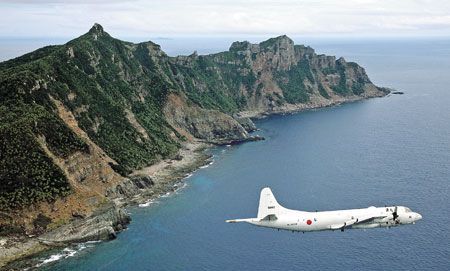
Japan Maritime Self-Defense Force’s P-3C Orion surveillance plane flies over the disputed islands in the East China Sea, called Diaoyutai in Taiwan, Senkaku in Japan and Diaoyu in China. / AP-Yonhap
Japan currently has control over the islands. It doesn’t accept that there’s a dispute, and also rejects the claim that China controlled the islands prior to 1895.
Tensions were at its peak earlier this month as China sent an aircraft flying near the territory prompting Japan to scramble fighter jets.
The representative says the government is tasked with raising awareness of the islands being part of its territory. That explains the piles of brochures in stock at its Seoul office. Taipei issued them for public distribution via its foreign missions scattered throughout the world.
The brochure cites three reasons why the islands belong to Taiwan.
Geographically, “the air and water currents are favorable for sailing from northern Taiwan to the Diaoyutai Islands.” Geologically speaking, it states, the Okinawa Trough “separates the ocean crust from the continental crust in the East China Sea, which makes the Diaoyutai Islands sit on different tectonic plates.” And historically, “according to existing historical documents, the Diaoyutai Islands were first discovered, named and used by the Chinese.”
In addition to brochures, Taipei intermittently organizes public awareness and scholarly events, one of which took place in Seoul earlier this month.
On Aug. 5, Taipei announced the East China Sea Peace Initiative.
The core of the initiative, a proposal for resolving the dispute, is pragmatism. It urges all parties “set aside the sovereignty issue,” and find ways to explore their potential.
Taiwan proposed three sets of separate bilateral negotiations — Japan-China, the ROC-China and the ROC-Japan — to narrow initial differences.
As responses from Japan and mainland China have been lukewarm, the initiative hasn’t seen a major breakthrough yet.
Korea has been in a territorial dispute with Japan as well. Its two easternmost islets in the East Sea are subject to claims of sovereignty from Tokyo, while Seoul denies there’s a dispute.
Tensions went up this summer after President Lee Myung-bak made an unprecedented visit to the islets, stirring political outrage in Japan. The situation is anticipated to exacerbate as new Prime Minister Shinzo Abe and his cabinet members are ultra conservatives.
Representative Liang is a career diplomat, serving in New York, Melbourne and Hanoi before coming to Korea a little over two years ago.
He held high anticipations for future bilateral relations especially under new president Park Geun-hye. He remembers Park as a visionary person, recalling his first meeting with her when she was still a member of the National Assembly.
The envoy envisions a Free Trade Agreement between Taiwan and South Korea in the foreseeable future.
“I hope that Taiwan and Korean can set up a group to study the feasibility to push an FTA,” he said.
He also hoped for the trilateral trade agreement among Korea, Taiwan and China. Korea and China are negotiating an FTA.