Revenge, affairs and fast twists: Inside Korea’s 2-minute drama boom
Summary
Tving’s new short-form dramas are driving Korea’s 2-minute drama boom with revenge, adultery and fast-paced twists. The platform launched its first Tving Short Originals lineup on Aug. 4, led by Shut Up, You’re the Villain of my Work and The Killer Next Door. More titles are set to follow on Aug. 18, and the short-form lineup will be free through the end of the year.
Key Facts
- Shut Up, You’re the Villain of my Work centers on a high school rooftop assault that happened 15 years ago.
- Tving’s first Short Originals lineup launched on Aug. 4.
- The lineup includes The Killer Next Door, a 60-episode series with 2-minute episodes, and later adds I Will Repay Infidelity with Infidelity and Me, Me and Me on Aug. 18.
- Kakao Ventures estimated the global short-form drama market at 13 trillion won and the Korean market at 650 billion won as of May last year.
- An OpenSurvey poll in November found that eight out of 10 Koreans aged 15 to 59 had watched short-form content.
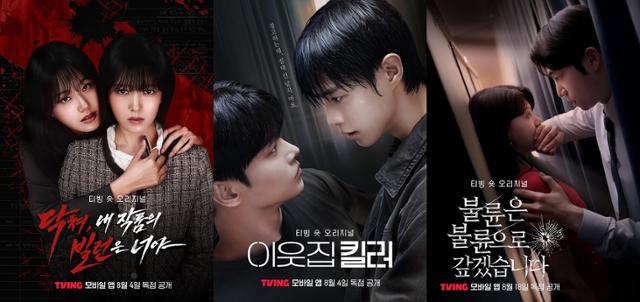
Posters for Tving’s original short-form dramas, streaming in a dedicated section of the app since Aug. 4 / Courtesy of Tving
A high school rooftop assault 15 years ago sets the stage for revenge in Tving’s new short-form drama, “Shut Up, You’re the Villain of my Work.” In the series, Seo-yeon, now a top TV writer, casts her former bully Hye-ji as the lead in a drama based on their real-life past, using the places she endured abuse as shooting locations and a script that mirrors the violence she endured. Each episode is just 2 minutes long, with twists and new conflicts keeping viewers hooked.
As audiences increasingly value “time efficiency” in entertainment, Korea’s short-form drama market is expanding rapidly. On Aug. 4, Tving launched its first “Tving Short Originals” lineup, debuting “Shut Up, You’re the Villain of my Work” alongside “The Killer Next Door,” a 60-episode, 2-minutes-per-episode series about a hitman who fears guns and knives and a former baseball player who becomes his unlikely partner. On Aug. 18, the platform will add “I Will Repay Infidelity with Infidelity,” about a woman betrayed by her husband and friend, and the teen coming-of-age drama “Me, Me and Me.” All Tving short-form dramas will be available for free through the end of the year.
Short-form dramas have emerged as a lucrative niche in the content industry over the past two years. Platforms dedicated to the format, such as Fox Media’s TopReels, Spoonlabs’ Vigloo, and Watcha’s Shortcha, have launched in quick succession. Kakao Ventures estimates the global short-form drama market at 13 trillion won ($9.6 billion) and the Korean market at 650 billion won as of May last year. With Tving’s entry, the market is expected to grow further.
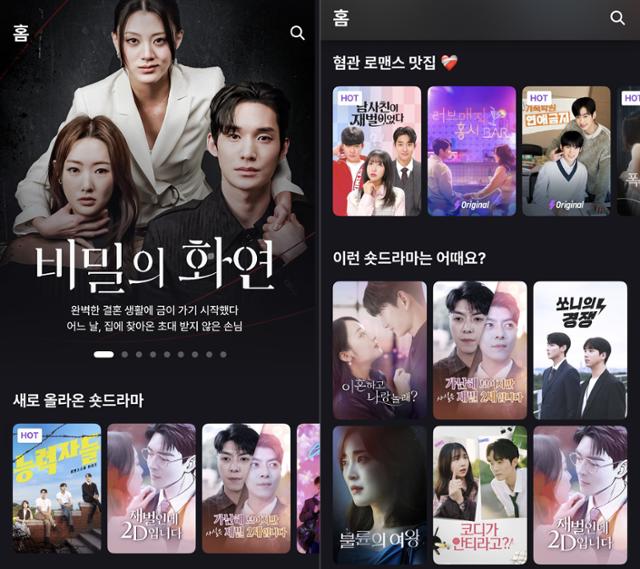
Watcha’s short-form drama platform Shortcha, launched in September last year / Captured from Shortcha app
Driven by the popularity of YouTube Shorts, TikTok and Instagram Reels, demand for vertical, mobile-optimized dramas has increased. A November survey by research firm OpenSurvey found that eight out of 10 Koreans aged 15 to 59 have watched short-form content. Like other vertical videos, short-form dramas are viewed by swiping up, with fast pacing and sensational themes such as revenge and adultery drawing viewers in. The pay-per-episode model mirrors that of webtoons.
Compared with traditional TV dramas, short-form series require less time and money to produce, making them efficient for investors and accessible for new actors, writers and directors. Streaming platforms see them as a tool to keep subscribers on their apps longer.
However, some industry insiders warn of possible addiction to provocative material. “When you have to show everything and drive payment in one or two minutes, the focus tends to be on sensational content in the early stages,” one industry official said. “As the format grows, we expect to see greater diversity in genres.”
This article from the Hankook Ilbo, the sister publication of The Korea Times, is translated by a generative AI system and edited by The Korea Times.
Explore More
- Q.
- Q.
- Q.