Creators of 'killer' content will invigorate 'hallyu'
.jpg?w=728)
Song Sung-gak, president and CEO of the Korea Creative Content Agency
By Song Sung-gak
Recently, the cultural content industry was greeted with good news. Korean pianist Cho Seong-jin, 21, won the gold medal at the 17th International Fryderyk Chopin Piano Competition , which was held in Warsaw, Poland, on Oct. 21. The competition, which was founded in 1927 to commemorate Polish composer Frederic Chopin, is regarded as one of the three major music competitions in the world, along with the International Tchaikovsky Competition in Russia and the Queen Elisabeth Competition in Belgium. Upon hearing this news, Korean netizens rejoiced, calling Cho’s achievement as a “Nobel Prize in music,” perhaps in comparison to the Nobel Prizes that scientists in China and Japan recently received.
Classical music is an area in which Korean musicians can succeed overseas, as it is a type of content that they can share with audiences around the world. We are already seeing many Korean classical musicians performing brilliantly on the world stage. Classical music is a cultural industry with a rich pool of talented musicians. Cho’s recent success made me think about how the content industry could secure a competitive edge in the global market, not through reliance on a few geniuses but through systematic and strategic growth-oriented support.
The Korean content industry, which includes “hallyu,” or the Korean pop culture wave, is reeling from a shrinking overseas market. In Japan, anti-Korean sentiment is surging amid history-related conflicts between the two countries. In China, meanwhile, tight control on foreign content, including a strict broadcasting quota on foreign dramas, warns of the gradual demise of hallyu. It is high time for us to come up with fundamental measures to cope with the recent decline in the popularity of hallyu content in Asia, Latin America and Europe, which actually started as early as the late 1990s.
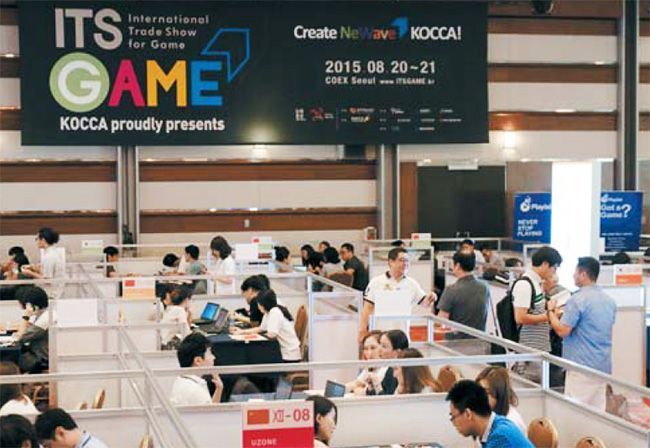
Participants in “ITS GAME 2015,” a trade fair to boost exports of local game developers, consult at the COEX in southern Seoul. Organized by the Korea Creative Content Agency, some 200 local game developers participated in the fair, which took place from Aug. 20 to 21. / Courtesy of KOCCA
Very few industries or sectors grow 10 percent or more annually. One of these exceptions, according to experts, is the content market, whose high growth rate also has ripple effects on other industries. According to a report of the Korea International Trade Association on the economic effects of hallyu, a 10-percent increase in the export of hallyu content is found to lead to a 0.18-percent growth in exports of consumer goods and a 0.22-percent of growth in the number of foreign tourists. The annual turnover of the domestic content industry surpassed 91 trillion won last year and is projected to reach more than 100 trillion won this year.
While compiling its 2016 budget, the government set aside 742.9 billion won for the content industry, a 21.6-percent (132.2 billion won) increase over the last year and a higher rate of increase than those for any other industry. This significant budget increase indicates the government’s willingness to promote the content industry, which is capable of revitalizing the economy and creating decent jobs. Since taking office as the president of the Korea Creative Content Agency (KOCCA) late last year, I have been focusing on the upcoming three years, which will be an opportune time for the content industry to take a new leap forward. The government and the KOCCA have been working to chart policies that will assist the content industry in finding new paths.
After setting cultural resurrection as one of its top four priorities, along with economic recovery, people’s well-being and unification preparation, the government has made significant efforts to create a renaissance in the artistic and cultural industries, supporting such projects as the “Cultural Belt for Creative Convergence,” among others. One of the key projects for cultural resurrection is to foster talented creators of “killer” content, and to this end, the KOCCA is opening the Creative Culture Academy. The academy, which is scheduled to open at the government-run Creative Center for Convergence Culture next March, is designed to promote experimentation and creation of entertainment programs that would bring new cultural experiences by integrating high technologies for robotics, automated controls, virtual environments, augmented realty and wearable devices with a wide range of artistic genres, from performance, exhibition and animation to media art.
The KOCCA hopes that the Creative Culture Academy will help the Korean content industry better cater to the demands of the global mainstream society by producing creators of killer content and making a virtuous circle in which the number of foreign tourists increase, which, in turn, ultimately contributes to the revitalization of the national economy.