Can military comedies be funny anymore?
By Kim Tong-hyung
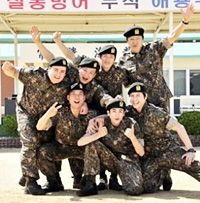
MBC’s ‘Real Men’
Korean men talk as if they would rather die than serve their mandatory military duty again. And yet, they can’t seem to get enough of national service-inspired comedy shows on television, such as MBC’s ``Real Men.’’
But it remains to be seen whether these shows will begin to feel less funny in the wake of a tragic accident at Taean Beach, South Chungcheong Province, last week, where five high school students drowned during a summer camp modeled after soldier training exercises.
Their deaths touched off public anger over the negligence of school officials and camp operators, who were businessmen with no military credentials and thought it was appropriate to send students into water without swimming vests.
There are critics who attempt to expand the question as to why these camps were so popular in the first place, expressing discomfort about a country that continues to romanticize military culture.
``Korea is among the most militarized societies among developed economies, solidified by the high proportion of men who fulfill their period of service. This has led to a militarization of the culture at school and in the workplace, which I believe is a huge problem,’’ said Vladimir Tikhonov, an East Asian Studies professor at the University of Oslo also known by his Korean name, Park No-ja.
``At companies, employees are considered as soldiers who follow orders because it’s what they do. They are sent to these camps by employers who want to discipline them to accept a pattern of voluntarily giving overtime work for an insufficient level of pay and to inject a sense of powerlessness in them. The popularity of shows like Real Men could be seen as an extension of this (problem) because they reinforce the idea that you go to the military to `become a man.’’’
Schools and companies frequently send students and employees to military-style camps, called ``Marine corp. experience camps’’ or other similar names, which promise to help participants gain experience of leadership, teamwork as well as develop mental strength.
Then there are television shows such as Real Men, which puts a group of male entertainers through military boot camps and draws laughs from their adventures and misadventures.
The biggest star of the show is Sam Hammington, an Australian funnyman with a fluent command of Korean. Putting this goofy foreigner into the thick of Korea’s macho military nonsense has proved to be primetime entertainment.
There are people who are disturbed by the success of shows like Real Men, which they believe softens criticism about Korean military life that should be more modern than it is.
While the situation has improved over the past years, Korean soldiers still experience unnecessary verbal and physical abuse and are tightly restricted from leaving their camps during free time or when using mobile phones.
Yoon, a 32-year-old worker at a five-star hotel in southern Seoul, said she never really found Real Men watchable because of uncomfortable personal memories about a boot camp her company required its employees to participate in.
``It was very gruesome and I found myself crying in front of my colleagues. I was like `I am over 30. Why do I have to put myself through this?’’’ she said.
``They make you do things that test the limits of your physical ability for the sake of doing just that. The idea of teamwork is that, if one of you fails, you all have to go through the whole thing again. It’s a process of distinguishing the `weak’ from the rest and allowing the rest to dislike the weak. I really resented that.’’
Eom, a 34-year-old public servant, who didn’t want to be named, is another employee frustrated by military culture at work.
``Of course, Real Men will continue to be popular. Most of the news articles on the Taean deaths are treating it like a safety accident and ignoring the fact that a deeper reason beneath the incident was the stupid faith that experiencing the military in any form has educational value,’’ he said.
``This is a culture that forces people to endure physical and mental abuse without any particular purpose and persuades them that this is somehow good for their character-building and growth as a person. Five students have died as a result of this and people become enraged when reading about this. But they will then tune into Real Men several hours later and laugh.’’