'Character' industry lacks strategy
.jpg?w=728)
Korean animation character Pororo statues set in lines outside the COEX exhibition halls in the capital’s Gangnam district where “Seoul Character & Licensing Fair 2013” is being held. This year marks the 10th anniversary of the creation of the little penguin character.
‘
Asians love cute
little characters,
Americans
aggressive ones’
By Park Jin-hai
With 10-year-old Pororo, Pucca and Robocar Poli in the lead, domestic character companies are aggressively expanding overseas.
Armed with active government support, the sales of local character brands in the nation also surpassed those of foreign-born ones for the first time in 2011.
Aspiring animators with the hope of repeating the global success of Pororo created a whole bunch of cute and children-friendly characters.
Vital at this stage for domestic animators is to have the right marketing strategy, with the right licensing agents on its side to turn their ideas into products to put on store shelves.
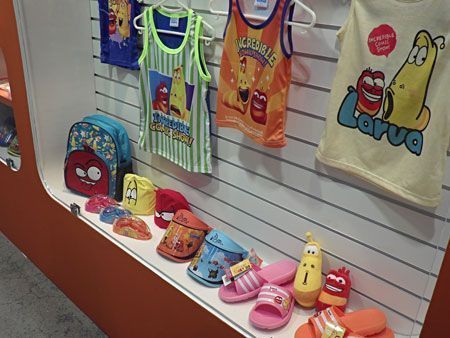
Larva, an animation character produced by Tuba Entertainment, is printed on various customer items, including clothes, swimming goggles and slippers. / Korea Times photos by Park Jin-hai
To facilitate the strategy, one of Asia’s biggest animation character and licensing fair, connecting animation creators and licensing companies, opened in Seoul on Wednesday.
The Seoul Character & Licensing Fair (SCLF) 2013, organized by the Korea Creative Content Agency (KOCCA), runs through Sunday at COEX in Samseong-dong in southern Seoul.
During the five-day event, local companies including Tuba Entertainment, producer of Lava, and Roi Visual, producer of Robocar Poli, will hold sessions to let their brand known to buyers.
And “Global Market Workshops” invites experts such as Charles Riotto, president of the International Licensing Industry Merchandisers’ Association, for the industry to learn about traits of specific markets.
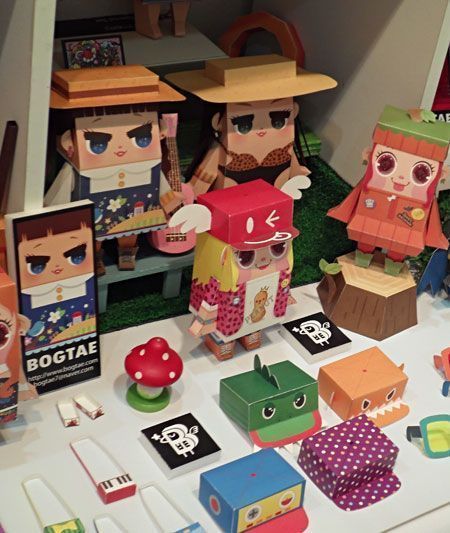
Single artist showcases his paper-fold character lines Bogtae at his booth at the Seoul Character & Licensing Fair on Wednesday.
“The fair, in its sixth year, beefed up business matching programs. Some 140 overseas buyers came this year, almost twice the previous year,” said Hong Sang-pyo, president of KOCCA.
The KOCCA expects to patch more than $13 million from the business deals during the event.
Single artists or individual members of animation clubs as well as big-name animation producers set up booths, luring foreign buyers with uniquely designed items.
As for the marketing strategy, one-size-fits-all doesn’t seem to work.
“In Asian markets, cute characters really sell. When we were representing skinny brands like Pink Panther, Chinese customers wanted us to make him rounder,” said Maria Roisa, CEO of Click Licensing Asia.
“They need something chubby to hug,” she added.
According to her, education is also an important factor to consider in Asia. For instance, in China, where foreign children’s programs are hard to get airtime, but if the content is educational, the censors become more lenient.
“Every parent wants their child to learn something from programs, whether it be animation or not," she said.
Another Buyer from the United States says otherwise.
He said while Asian market tends to have fascination with “cute little” characters, American taste is more “aggressive.”
“What makes it difficult for Asian properties to crack into the American market is that there isn’t the same interest in the same kind of characters.” said Danny Simon, CEO of the Licensing Group.
He added that “Pucca” has been the best Korean property that has broken through the American market because it caters to the American taste.
“If you look at the characters that come out of Asia and have been popular in the United States like Pokemon and Digimon from Japan, they are more aggressive and have a lot of different characters, which appeal more to the American market.”
As for the educational elements, he has a different stance from Loisa. He says everybody is confused lately between entertainment and education.
“In the past, if it is educational, nobody talked about it. But now, if it is educational, nobody wants to hear about it,” he said. “There is value in just presenting somebody with entertainment without message or a point.”
There are some challenges the Korean character industry faces globally. One of the weakness of Korean properties mentioned is the lack of a good story line.
“You spend enormous amount of money and talent in developing characters. And you make some of the best. But, you don’t usually carry that through to a story line that has real depth meaning,” said Simon.
He said for Korean animation companies, it is more about the creation of visual images. But, for Americans, the story component is extremely important, like the Simpsons.
“Even poorly drawn characters with great storylines are more important. You take the Simpsons. That is badly drawn character. What carries it is writing, the content," Simon said.
A Thai producer who is on a hunt for animations to air in her country said that people are familiar with Pororo because its shape is simple to draw and recognize and is regarded as the signature Korean character.
But, she said, some Korean characters are too similar in appearance and story. Also, she said even though the quality of animation is good because there are Korean distributers but the cheap character goods circulating in the Thai market are copies that might tarnish the image of Korean products.