'We Koreans need to change'

Street signs and boards in different languages grace districts in the “Borderless Village” in Ansan, Gyeonggi Province. Korea Times photos by Park Jin-hai
.jpg?w=728)
Leading advocate says migrants are 'not tools'
By Park Jin-hai
The “godfather” of migrants says that the country's multiculturalism policies so far have been misguided, and it’s time to change the mindset of the majority.
"If there exists prejudice and discrimination against minorities, policies should give more attention to the majority to educate them and change their perception toward ethnic minorities. Because, minorities will anyhow try their best to adapt to the society,” said Park Chun-ung, 52, who is leading the Ansan Multicultural Center (AMC) in Gyeonggi Province.
Park, a pastor and activist, will work with fellow experts on analyzing how the media portrays ethnic minorities. He and 49 other critics who have either studied multiculturalism or have worked in relevant professions at least three years in May launched a multicultural critics association to that end.
“The government has different standards in viewing immigrant laborers and marriage immigrants. They take the former as the subject of repulsion, while the latter a subject to win over,” said Park.
Thus was reflected in the media. For instance, films “Wandeuki” (2011) and “Seri & Harr” (2009) depict children born to immigrant laborers’ families as secluded from the rest of society, while the children of multiracial couples are featured in a positive way.
Park opined that both the immigrant laborers and migrant brides should be treated as one multicultural group.
“The government in the first place imported foreign laborers to raise the nation’s economic competitiveness, while it promoted international marriage as a way to maintain demographic competitiveness.
However, he claims this should end at a time when immigrant laborers, if they stick to a work place for five years in a row, can extend their stay for an additional five years. Thus they, too, should be included in the national policies as long-time residents.
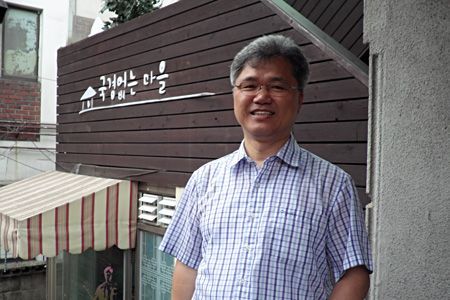
Park Chun-ung, president of the Ansan Multicultural Center (AMC) in Gyeonggi Province pose in front of AMC, as he urged the majority of Koreans to change their mindset that foreign residents in Korea are not the target of assimilation.
Park should know what he is talking about. He holds many "first" titles in terms of multiculturalism. He first coined the word "Kosian," combined word of "Korean" and "Asian," and started to creat the "Borderless Village" in Ansan, Gyeonggi Province in 1999.
He recently earned the country's first Ph.D. in multiculturalism. In his paper titled “A Critique of Korea’s Multicultural Discourses from the Perspective of Hybrid Critical Discourse Analysis,” he looks at the reality of multiculturalism in Korea from different angles.
For instance, if migrant wives are emotionally disturbed, the paper pores over personal agonies within the context of society.
He further criticized the government-led multicultural policies.
“A number of different ministries compete to take control of such policies, because they perceive it is easy to tap into the budget from the central government once any project is labeled as multicultural,” Park said.
“As a result, different ministries put forth overlapping policies to secure budget and, in the process, make civic groups, immigrants and academia passively queue up for the government money.”
Another initiative Park has started is the "Eureka," where Korean students could hear in person from migrant workers and immigrant wives and later are asked to express what they feel about multiculturalism by using various mediums including pictures and videos.
“Eureka” is currently operated only in the AMC, which is nestled in the "Borderless Village," the district where most of the foreign population in Ansan reside and run their businesses.
Except for some specks of Korean letters, streets are full of foreign elements. Signs and boards are marked in the Arabic, Indonesian and Chinese, while people of different colors and customs pas along the street.
"The village itself is a field for multicultural education. Streets are a school, while goods on display at stores and people in the streets all become great education tools," Park says.
By the time the six-week program ends, Park witnessed students' negative image against immigrants such as "criminals” and “brokered marriage” slowly dissipate. At the same time, participating immigrants’ perception against Koreans as “exclusive” and “selfish” disappeared.
In addition, he will offer classes for immigrant women from July. During the classes women will be asked to answer such questions as who they are as members of society as well as mothers from different culture. Through the process, Park believes they will recover their identities.
He says that mothers should be proud of being Vietnamese or Malaysian first. That way, their children will say out loudly, “My mom came from Vietnam or Malaysia.”