Korea's development models help other countries

Delegates of Tanzanian local government officials participate in a “Meet the President” hour with Rheem Chae-ho, fifth from left, president of Local Government Officials Development Institute (LOGODI), at its headquarters in Suwon, Gyeonggi Province, on June 10. / Courtesy of LOGODI
Some 2,540 officials fom 83 nations receive LOGODI education
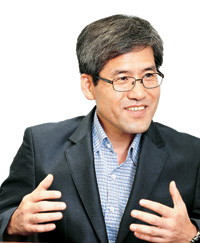
Rheem Chae-ho, LOGODI president
By Park Jin-hai
Korea’s development model has been largely regarded as raising the country from the ashes of war to the fastest economic development, dubbed as the “Miracle of the Han River.”
As a responsible member of international society, Korea now exports the development model, giving a beacon of hope to the developing world.
Korea’s move is praised highly, in that unlike one-time material assistance, the model teaches them “how to catch fish.”
At the center of this effort is the Local Government Officials Development Institute (LOGODI), spreading the country’s tips for administrative innovation.
“Senior officials of developing countries often say that they have the human and natural resources needed for development. And then ask us why they can’t (have the same development success as ours), while we could,” said Rheem Chae-ho, 55, president of LOGODI, in an interview with The Korea Times.
Since its inception in 1996, some 2,539 local government officials from 83 countries have visited Korea to learn the “answers.”
According to Rheem, their foremost interests are split into two areas. One is the rags-to-riches development of Korea, starting from the heavy industry of the past to IT revolution of today; the other is Korea’s electronic administrative system featuring one-stop services for citizens.
The United Nations has listed Korea’s e-government system as the best for two consecutive years, and visiting foreign officials believe that this is behind the transparency of its administration.
The state training institute, catering to their needs offers lectures such as “Korean Economic Development at a Glance,” “The Local Government Administration System in Korea,” and “Development Strategies for Developing countries.”
Rheem has newly adopted a “Meet the President” hour, where Rheem takes some time to listen to the participants’ voices and their needs in each program.
Their voices are well heard. During the recent hour on June 10, Tanzanian officials told him that if African officials visiting Korea at a similar time of the year could have training together, they could benefit more from the program.
They said it will serve as an invaluable venue to exchange their development experiences and challenges with their African neighbors. The request was accepted by Rheem, and now a joint Tanzania-Rwanda program is under discussion.
Another noteworthy request from participants was to strenghen follow-up programs. At present, the institute has about 10 percent of its total capacity dedicated to such programs, which are done three to five years after the initial one.
“Current follow-up programs, in the form of on-site checks, alumni communities and SNS communications, will be expanded further in close relation with Korea International Cooperation Agency (KOICA), embassies and other related organizations,” said Rheem.
“We plan to crank up the weight of follow-up programs to 20 percent in the future. Thus programs don’t end up as one-time events,” he said.
Another small but meaningful initiative Rheem has been pursuing is the effort to diversify training programs. Under the current curriculum, regardless of the needs of each participant, all of them receive some hours of training on Korea’s development history, including the “Samaeul” campaign, a state-led rural development movement of 1970’s, and the remaining hours on Korea’s e-government system.
However, Rheem wants to diversify this. Thus the participants, depending on their local needs, can choose how much weight they put on the two classes.
“It seems a little improvement on surface, but given the fact that it gives practical help, I think, its implications are more than meets the eye,” he said.
In addition, he plans to beef up the field training part. This is to help foreign local government officials visit provincial offices more and get some help to benchmark the administrative innovations of each one they visit.
As to an area which has yet to be developed, he pointed out that although the recipients of the programs praised highly the practical use of the programs, they are less known in the international arena. This is because information on the programs is not easily available.
Despite challenges, Rheem suggests that many things could be different during his tenure, because he said he has the will and an open heart to embrace critics and upgrade the institution.
Born in Hamyang, South Gyeongsangsang Province, Rheem passed the state civil service examination in 1983 and had served at the Ministry of Home Affairs, now the Ministry of Security and Public Administration.
He also worked as vice governor and acting governor of South Gyeongsang Province before moving to take over the presidency of LOGODI early this year. His stints include service at the Korean embassies in the United Kingdom and the United States, which seems to have helped him to become internationally savvy, coupled with his deep understanding of the local culture.
Korea has turned into a donor nation though it had been a recipient and is now poised to expand its support to less developed countries based on the knowledge and experience of its fast development. “We are fully committed to helping the needy countries around the world toward mutual prosperity as global villagers,” Rheem added.