Food cluster to lead innovative growth of Korea

An artist's concept of the Korea National Food Cluster that will open in Iksan, North Jeolla Province, in 2015. More than 160 food companies and research centers are expected to invest in the industrial complex specializing in food products. / Courtesy of Ministry of Agriculture, Food and Rural Affairs
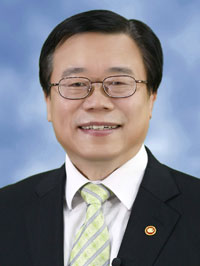
Lee Dong-phil Minister of agriculture, food and rural affairs
By Lee Dong-phil
Traditionally, the primary role of the food industry was perceived as supplying sufficient safe food to the people through the process of production and distribution. And before, merely supplying fine tasting food was good enough for the industry.
However, nowadays, the food industry is emerging as a promising future one that generates added value and creates jobs. Moreover, the global food market is estimated to be $4 trillion (1.5 times bigger than the semiconductor industry) and competition among nations is intensifying.
The world’s leading nations that already have acknowledged the pioneering value of the food industry are focusing on advancing it by endorsing their own country’s development.
By doing so, they intend to create both added value businesses and jobs, and contributing to export expansion by securing international competitiveness. Through development of food clusters, such as Napa Valley in the United States, Food Valley in the Netherlands, and Emilia-Romagna in Italy, several nations or companies are effectively responding to food related issues and trends.
For clarification, a food cluster is an environment optimized for building networks among food processing, packaging, and marketing companies, professional support agencies, universities, research institutes and government agencies.
Together, they create added value, making the case for them to be the next growth industry with sustainability. It is expected that the market size of the food industry is going to reach $6.4 trillion, which is three times larger than automobile industry (approximately $1.6 trillion).
In the case of Napa Valley, it is responding to the global wine trend with active research in order to produce better products.
From harvest to fermenting and aging, every process of wine production is managed by IT technology, contributing to development of the wine industry. Napa Valley is not only focusing on wine production but it is also engaging with tourism and culture in order to create various types of added value as well.
As a result, it has developed into one of the nation’s biggest in commercial competitiveness while being considered as the wine producing district of California.
Responding to the current global trend, the South Korean government started the first Asian National Food Cluster titled as Foodpolis in Iksan, North Jeolla Province. Foodpolis will operate as the “think tank” of the food industry, which is seeking to lead discussions on essential topics such as rises in food prices, demographic change, relationship between well-being and food, increase of anxiety regarding food and starvation.
In addition, it will conduct research into functional foods, packaging and processed foods.
It is expected to launch in full-scale in 2016; similar to Napa Valley, it is planning to advance itself by becoming a food industrial cultural city by applying Korea’s regional resources (food, tourism, and culture)
As the food industry is becoming more important, one of the leading futurologists, James Allen Dator emphasized the importance of the food cluster for the future food industry: “If the food cluster merges with robotics, artificial intelligence, nanotechnology, etc., it is going to accomplish a major role for the development of next generation’s food industry.”
By utilizing Korea’s geographical strengths and resources, as well as cultural contents like hansik (food) and K-pop (music), the author expects Foodpolis to create innovative and outstanding added value.
The writer is minister of agriculture, food and rural affairs.