Impostors not always bad to celebs
Fake doubles
walking fine line
between impostor,
impersonator
.jpg)
Na Hun-ah, top, is a popular Korean singer whom Na Woon-ha, below, respects and impersonates to the extent that the latter has released several albums with the similar-sounding name.
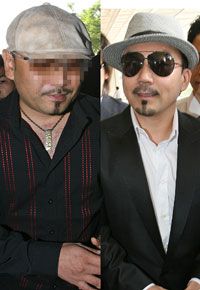
Park Sang-min’s impostor, left, and the real singer enter the Seoul Central District Prosecutor’s Office for questioning in this June 26, 2007 file photo. The impostor later changed his name to Park Sung-min and works as a Park Sang-min impersonator. / Korea Times
By Kim Ji-soo
Recently, an impostor pretending to be Psy roamed free at the Cannes Film Festival, pretending he was the rapper/singer.
He wore all Psy’s accoutrements - the sunglasses, hair and suit - that got him the red-carpet treatment for a few days.
He also had stars including actress Naomi Harris, actor Adrien Brody and Portland Trailblazers player Nicolas Batum joining him for photos. Psy and his agency said they will not take legal action against the man, adding that the presence of an impostor was an invariable byproduct of Psy’s popularity.
The man turned out to be a Korean adoptee, Denis Jae-wan, who received the red-carpet treatment for his act.
While Elvis impersonators emerge out of contests, fake doubles appear voluntarily or through singing contests in the Korean entertainment business ― walking a fine line between impostor and impersonator.
Not everyone gets off lucky. In January 2009, the Supreme Court ruled that a man posing as the singer Park Sang-min should pay 7 million won in fines. The man was found guilty of making money while singing on some 90 occasions at three night clubs in Seoul and its vicinity in the year 2005.
The real Park Sang-min sued the man, who never apologized to him. The impostor later changed his name to Park Sung-min, in October 2010, and became a full-fledged impersonator. In response, the real singer’s agency said it hoped he would carry on well with the activities as the fake singer was promoting the real singer’s image.
Na Hun-ah is a popular Korean singer who with many loyal fans. He has an impersonator whose alias is “Na Woon-ha,” whose real name is Park Seung-chang. The fake publicly emerged through a “mock singing contest” of the famed singer that was hosted by SBS. He was among 10 out of 1,500 applicants to make it to the finals and receive the “Na Hun-ah Gesture Award.”
He had already been making a living as a fake Na Hun-ah in Busan nightclubs. But the SBS contest gave him national fame and he appeared on numerous talk shows. Korean expatriates living overseas began inviting him for concerts, since the real Na Hun-ah is hard to contact and expensive to host. Beginning in 2005, Koreans in Japan also invited him for concerts.
The real Na was not favorably disposed toward Na the impersonator, but the two allegedly have grown friendlier recently. Na Woon-ha held a dinner show at a hotel in Gangnam, southern Seoul on May 9. A dinner show is usually an event only top singers like the real Na, or Lee Mi-ja or Patti Kim hold.
Singer Lee Mun-se also has a look-alike who can fool almost anyone.
“The genuine singers cannot grace all the stages that demand them so naturally these fake singers will emerge,” said Lim Jin-mo, a music critic in Seoul.
“Some of the imitators will adore the stars, … but, basically, as everyone knows, the real stars have high commercial value,” said Lim.
The real Park Sang-min said, while appearing on a television show, that his impostor had earned billions of won by using Park’s name.
At the same time, Lim sees the phenomena as part of the process of breaking into the music or entertainment industry. “Those who aim to be stars start out by singing the songs of top singers,” Lim said. “There is that show now on cable called ‘Hidden Singer.’”
The program pits the real singer against five imitators, with all hidden from the audience, and asks the audience to choose the genuine article.
With the spread of SNS, other celebrities have publicly spoken out against their “doubles.” Sayuri, a Japanese native who is a TV personality in Korea, warned in March there was a fake Sayuri on facebook. She warned her followers via Twitter that, “I don’t do facebook.”
Soo-young of Girls’ Generation in March wrote on the group’s official website warning of a “fake” Soo-young posting photos and conversing with fans through SNS. The real Soo-young wrote, “I would like to thank you for wanting to communicate with our fans for a brief time, but no more. If you should continue to do so, I will not just sit by.”
Famous comedian Yoo Jae-suk and other entertainers have also been victims of impersonators.