'Hybrid' character products mar originals
Legal loophole
responsible for
generating fakes
.jpg)
Mashiporo, a “hybrid doll” combining Pororo and Mashimaro
.jpg)
Pororo, The little penguin
.jpg)
Mashimaro
By Chung Ah-young
Where can you buy a doll with Hello Kitty’s face on Pooh’s body for your children? This is happening in Korea where diverse “hybrid” children’s character merchandise mixing fictional icons are widely produced and bought.
Arcade machines are a main channel to get various “hybrid” dolls; from Mashiporo, a combination of Pororo, the little penguin, known as “the president for children,” and Mashimaro, a fictional rabbit; to a doll with Pucca’s face and Rilakkuma’s body. Sometimes Mashimaro wears Spider Man’s costume.
According to the Korea Copyright Commission, such fusion character-inspired goods are sold at a price 70 percent lower than originals ― a market worth 1.6 trillion won or one fifth of the original character goods sales.
Naturally this has dealt a serious blow to small and medium-sized manufacturers of original character products who spent tens of billions of won in developing their own merchandise over the past years.
CLKO Entertainment, a character developer for Mashimaro, suspended production three years ago as sales of its merchandise dramatically declined due to such imitation dolls.
The firm said that it had no choice as the fake character goods now account for more than 90 percent of the market.
However, there is no legal ground to crack down on the case of Mashiporo products because the Korean Intellectual Property Office (KIPO) allowed such imitations to use their designs in 2011.
Mashiporo manufacturers have been fusing various characters such as Mashimaro, Pucca and Pororo. Under the current design protection act, anyone can modify existing characters and turn them into new items, even if a copyright holder owns a trademark to the original design. A revised act has been under discussion at the National Assembly, but there is no quick measure to fill this loophole. .
The Korea Culture Contents Licensing Association said that it is hard to protect original designs because the Design Protection Law is limited to a few “tangible” items. Also, the Supreme Court previously ruled that a rabbit is diverse in shape and has commonly been used as a doll for a long time because it is simple in design and thus it cannot be said its design is similar with certain characters. “The relevant act should reflect the fast-changing trend of designs in characters in this digital era. The originality of the characters should be more thoroughly protected,” an official of the association said.
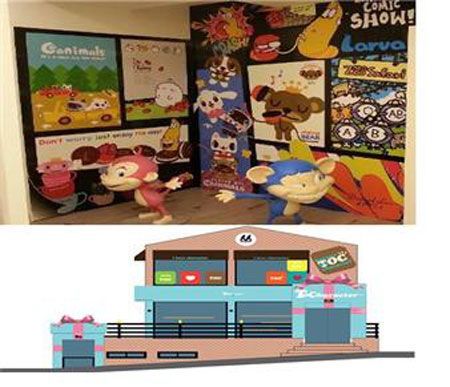
To prevent such copyright breaches, the Korea Creative Content Agency (KOCCA) opened Toc, a Korean character shop on May 11 to boost the domestic animation character industry in the Bukchon Hanok Village in Seoul. / Korea Times file and KOCCA
The recent situation, however, isn’t helping the nation’s rapidly growing animation and character-inspired merchandise industry.
Strongly driven by Pororo and Pucca, the scale of the Korean character industries has rapidly increased from 2.07 trillion won in 2005 to 7.2 trillion won in 2011, about 3.5-fold increase. The amount of overseas exports of the character products has also risen by 40 percent from 320 billion won in 2010 to 425 billion won in 2011.
As the characters are not properly protected as design rights, imitation products such as Mashiporo, which are openly distributed in the market, are hampering the development of the Korean character industries.
To tackle this issue, KIPO and the Korea Creative Content Agency (KOCCA) decided to cooperate in eradicating these fake products last year.
KOCCA will collect and provide data on over 30,000 animated and cartoon characters created in the nation while KIPO will use this data to review and judge designs.
To prevent the similar registration of counterfeit or imitations of the originals, KIPO said it will revise the Industrial Design Protection Law to better protect the creators of the characters. The revised law is expected to go into effect by 2014.
Also, KOCCA opened Korean-born fictional character shops in downtown Seoul in 2010 as part of efforts to nurture them and boost the relevant industry.
“Cuvid” in Gwanghwamun, central Seoul, sells home-grown character-inspired items such as Pororo, Robocar Poli, Cloud Bread, Larva, Canimal as well as a slew of newly-developed characters. “Toc” near Bukchon Hanok village, central Seoul, specializes in fashion items.
Also, Seoul Character & Licensing Fair annually takes place to boost home-grown comic characters and the animation industry and promote it to buyers from across the world.