Sample flavors of traditional marts

Members from multicultural families pose before starting a tour of a traditional market in this 2011 file photo. / Courtesy of Agency for Traditional Market Administration
15 tours to give real feel of Korea
By Kim Ji-soo
To browse through a market is a way to get a sliver of daily human drama. The products on stalls and on display seem to reflect creativity and entrepreneurial spirit while seeing people haggle over prices gives a strange sense of camaraderie that people’s lives are similar the world over.
A tour program is under way to provide a chance to discover the charms of traditional markets as well as areas in Korea.
Take for instance Yeongju in North Gyeongsang Province. Every year, it hosts a royal azalea festival in May and a ginseng festival in October. It also plays host to a specialty market held at Punggi scholar’s village ginseng market. The effects of ginseng are well known, but the cool and smooth man-made silk of Punggi is a new discovery for many people.
The Agency for Traditional Market Association and the Small and Medium-Business Administration will conduct tours to 15 such destinations through Nov. 30.
The Namhae Traditional Market in Namhae, South Gyeongsang Province, features organic farm and sea products from the southeastern region all year round. The market, situated along the southern stretch of the East Sea, is also known for its scenic surroundings that attract many visitors.
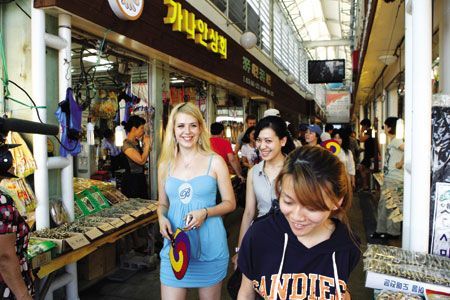
Foreign visitors walk the alleys of traditional market in Boeun, in North Chungcheong Province in this 2010 file photo.
Suncheon is home to the widest reed bed in Korea and one of the world’s top-five coastal wetlands. Currently, an international garden expo is underway in the city in South Jeolla Province. Suncheon also has a specialty market titled “Suncheon Utjang,” famous for its sprawling local merchandise and “gukbap” – a soup that combines rice, vegetables and meat from a pig’s head.
Some of these specialty markets date back to as early as 1930s. While they have their aficionados who will trek the distance to savor the local ambience and produce, the two government agencies want to bring in more visitors.
“The tour program is a good way to enjoy popular tourist destinations in Korea, while experiencing the local food, sights and other entertainment,” said Kim Sang-gon, an official with the traditional market association.
The programs cost 15,000 won for a day-tour and 28,000 won for a non-stay, two-day tour.
The low price is due to the two agencies subsidizing transport and tourist insurance. The program, which began in 2005, initially targeted travelers in their 40s and 50s, but is now looking to attract those in their 20s and 30s.
The agency said it plans to invite members from multicultural families and also foreign migrant workers and tourists to the program during the promotional period that includes the national holiday of Chuseok in fall. Last year, the agency invited 35 foreign migrant workers to a traditional market in Heongseong and Anheung in Gangwon Province.
The first tour over the weekend will head to Jumunjin fish market and traditional markets in Gangneung in Gangwon Province and to the central Chungcheong area of Daejeon. The Jumunjin Fish market was established in 1936 in association with the Jumunjin Port. The tour to the fish market will include stops at Hyuhyuam and the temples of Woljeong and Sangwon.
Other destinations include the Jungang Market in Ulsan and Boeun Traditional Market in North Chungcheong Province.
For more information, visit www.sijang.or.kr or www.centertour.co.kr.