Korean literature presence grows in Japan

From left, Shin Kyung-rim’s “Riding a Camel,” Ku Hyo-seo’s “Nagasaki Papa,” Kim Jung-hyuk’s “The Library of Instruments,” Han Kang’s “The Vegetarian” and Park Seong-won’s “What Makes Up a City” have been translated into Japanse by Cuon, a Japan-based publisher.
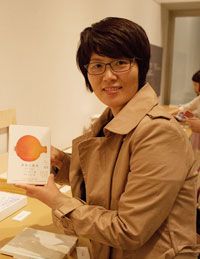
Kim Seung-bok, head of Cuon, publisher and content agency based in Japan, holds the Japanese version of “The Vegetarian” by Korean author Han Kang. / Courtesy of Cuon
By Chung Ah-young
Japanese literary works by world-renowned authors such as Murakami Haruki and Ekuni Kaori have a solid fan base in Korea. Korean literary works that struggled with a peripheral presence in Japan just a few years ago are now being rediscovered there.
Korean contemporary works with universal themes, such as Gong Ji-young’s “The Crucible,” Shin Kyung-sook’s “Please Look After Mom,” Han Kang’s “The Vegetarian” and Kim Jung-hyuk’s “The Library of Instruments,” are gaining growing recognition from Japanese readers.
Kim Seung-bok, head of Cuon, a publisher and content agency based in Japan, has tried to introduce works by young, talented Koreans into Japan.
Kim said the growing popularity of the Korean literary scene there coincides with the growth of Korea’s national status, which is attracting interest around the world in various fields.
“Japanese readers are showing great interest in Korean literature despite the conventional belief that Korean pieces would not appeal to Japanese fans. But it is not an overnight phenomenon. It is a sort of synergy effect combining Cuon’s efforts and the growth of the Korean national status abroad,” she said in an e-mail interview with The Korea Times.
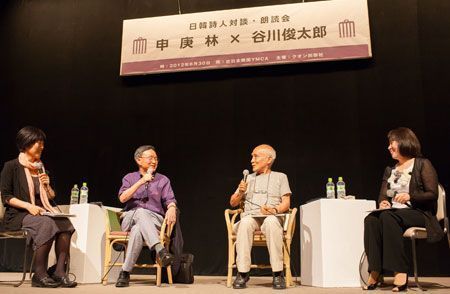
Korean poet Shin Kyung-rim, center, talks with Tanikawa Shuntaro, right, a Japanese poet, as part of the promotional events of releasing Shin’s poem collection “Riding a Camel” in Japan in June 2012 in Tokyo. / Courtesy of Cuon
Established by Kim in Japan in 2007, Cuon has striven to introduce Korean literary works to Japanese readers as Korean books were rare there. Some 900 Japanese titles are published in Korea every year while a mere 20 Korean titles are released in Japan.
Cuon’s publications, such as “The Vegetarian,” “The Library of Instruments” and “What Makes Up a City” by Park Seong-won and “Nagasaki Papa” by Ku Hyo-seo, reflect a change of themes within the Korean literary scene.
“Cuon is trying to bring more universal works rather than the pieces depending on nationalism and ideology that were written in the 2000s. Such works develop their own styles ― a kind of humor, the greatest virtue of the authors, which can be created from a distance from reality,” she said.
Kim said since the 2000s, a few young Korean authors have shown their literary prowess based on this universal humor.
Lee Seung-u’s “Journals from Days Past” is gaining positive reviews among Japanese readers and critics. His previous works “The Reverse Side of Life” and “The Private Lives of Plants” also received rave responses from Japanese literary circles.
Kim also said that due to the hallyu (Korean wave) phenomenon, many Japanese perceive Korean products including literature as “premium” or “cool.”
“Hallyu has contributed to uplifting the overall status of Korean cultural products. Korean literary works are one of the beneficiaries of the hallyu effect to jump on the bandwagon,” she said.
Heibonsha, one of the Japan’s major publishers, recently released a Korean modern literature series, which is seen as a positive sign to raise the awareness about Korean literature in general.
Park Kyung-ni’s “Land,” which is regarded as one of the nation’s epic masterpieces, has also been published in a six-volume children’s edition in Japan.
Kim Ae-ran’s “My Palpitating Life,” Park Min-gyu’s “Pavane for a Dead Princess” and Lee Jyung-myung’s “Stars Brushing on Wind” are to be published this year.
“I want to make Cuon a beacon to introduce Korean literary works in Japan, which was once regarded as a difficult market with a high barrier to break into. So Korean literary works were not published or translated much, only because many publishers thought they would not sell well. But how can they be sold if they are not on the bookshelves? My first attempt is to put Korean works on the shelves,” she said.
To reach a wider range of readers, Cuon is trying to introduce Korean books through Japanese literary magazines and newspapers. Korean short stories have been featured every month since this year in Subaru, a Japanese literary magazine.
Various promotional events have also been organized by the publisher to raise awareness about Korean literature. As a result, Korea has been invited to be the theme nation at the Tokyo International Book Fair, which will be held from July 3 to 6.
Kim set up the K-Literature Promotion Committee in Japan in 2011, consisting of literary critics, professors, translators, editors, journalists and students.