'Three-strike' rule for stalkers; size matters for T-ara
By Kim Tong-hyung
Here’s your midweek update on the stories in entertainment and media you might have missed while reading about Psy galloping into self-parody or because your life is probably a lot more fulfilling than ours.
That’s three "nos,’’ you sick stalker
In face of increasingly aggressive threats from North Korea, it was mind-boggling that the first thing Park Geun-hye’s Cabinet decided to do last month was to rewrite the penalties for minor offenses.
According to the changes that were enforced on March 22, anyone wearing overly-revealing clothes in public can now be tagged with a fine of 50,000 won (about $44). An 80,000 won fine was set for stalking. Neither of these actions was considered remotely as bad as ticket scalping, which will bring a 160,000 won fine.

Interestingly, the police guideline on punishable stalking didn’t include this kind of behavior. / Korea Times file
It’s difficult to grasp just how ridiculous the new law really is. There is absolutely no way politicians can ever agree to a clear-cut line between dressing fashionably and indecently. And really, is stalking, considered in some countries to be a criminal offense, really just 30,000 won worse than cruising around Gwanghwamun in a skimpy outfit?
And now law enforcement officials, left with the unenviable job of finding a way to enforce these silly rules, are managing to make things weirder with their clumsy, heterosexual definition of "stalking.’’
Recently publishing the guidelines for punishment on its website, the National Police Agency said people who continue asking out a person of the "opposite sex’’ after they are rejected three times could be punished as stalkers. Authorities stressed that ``simple pursuit of love’’ would not be punishable ― as long as the futile attempts stop at three. Of course, threats or any other actions invoking fear are a no-no.
The announcement touched off a philosophical debate on the blogosphere.
"I wonder how the police came to the conclusion that 'three’ was the magic number that makes the difference between what is normal behavior and what isn’t,’’ wrote one blogger.
"The old Korean saying about love was that `there isn’t any tree that wouldn’t fall over if you hack at it ten times.’ Well, wouldn’t that make you a three-time offender,’’ tweeted someone else.
To be fair, not all the responses were negative.
"Well, what’s wrong? These rules will only be applied to the people who were reported to the police as stalkers in the first place. These behaviors were often unpunished in the past due to vague guidelines and we can expect improvement on this end,’’ said a user on Facebook.
8-member T-ara to debut
4-member spin-off group
One of the unusual trends on the K-pop scene is the increasing number of spin-off groups as entertainment agencies continue to look for different ways to milk the popularity of the artists they have already established.
The companies were inspired by the success of Girls’ Generation-TTS, consisting of Taeyeon, Tiffany and Seohyun from the nine-member Girls’ Generation, last year.
Other popular subgroups include Sister19, the fembot-like duo of Hyo-rin and Bo-ra spun off the sexy four-member group Sistar, and 2YOON, consisting of Heo Ga-yoon and Jeon Ji-yoon from 4minute.

You stay classy, T-ara N4. / Courtesy of Core Contents Medi
The latest spin-off group to debut is T-ara N4, consisting of Eujung, Hyomin, Jiyeon and Areum from the eight-member group T-ara.
According to their agency Core Contents Media, the name stands for "brand new four.’’ The foursome will reveal a sexier and edgier side of T-ara, the company said, a bold comment for an agency that previously let the girls perform pole dances on television.
The agency said the members of T-ara N4 were picked for their "good chemistry.’’ It is a rare event when the words T-ara and ``good chemistry’’ are used in the same sentence.
T-ara’s popularity waned amid a scandal last year that ended with its youngest member, Hwayoung, being booted from the group. She was said to have been bullied by the older girls.
B.A.P. named as 'top rookie' in China
Boy band B.A.P., a new music act that has already booked its place in the ``Weird K-pop Names Hall of Fame,’’ took "Rookie of the Year’’ honors at China’s Yinyue V Chart Awards.
The annual awards fest is organized by the country’s biggest music website, Yin Yue Tai, which atracts about 200 million visitors a month. Junsu, a singer from another Korean boy band JYJ, won the "Best Korean Male Artist’’ title.
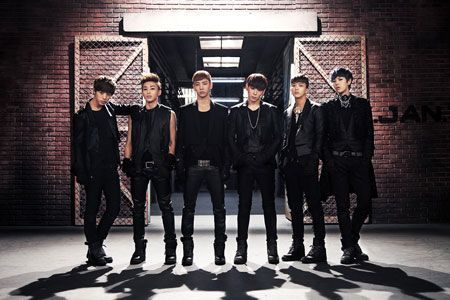
B.A.P. is popular in China. / Korea Times file
"We want to become globally renowned as artists," B.A.P. member Yongguk said in his acceptance speech.
B.A.P. is scheduled to hold its first global tour, titled "B.A.P. Live on Earth’’ starting next month and its agency said the concerts scheduled in the United States and Japan have already been sold out.
It’s strange to see B.A.P. off to a nice start to their careers because there is absolutely no chance the group will live up to its expectations. Not when B.A.P. stands for "best, absolute and perfect.’’