'Action, communication hand in hand'

President of the Corea Image and Communication Institute (CICI) Choi Jung-wha, center in second row, and first-place winner Mamadjanov Zohid from Uzbekistan, center in first row, pose with other contestants and organizers of the “Communicating for a Brighter Future of Korea” at Seoul Museum in Buam-dong, Seoul, Saturday. / Courtesy of CICI
CICI speech contest offers expats with chances to promote Korea's image
By Park Jin-hai
When the name of each anxious contestant is called, each scurries to the podium to deliver a speech.
It’s a familiar scene to an audience reared on reality audition programs.
This time, however, the contestants gathered at the Seoul Museum Saturday were foreigners and Koreans tackling the theme of the future of “hallyu,” or the Korean wave, and the concept of multiculturalism in Korea.
Opening the event, Choi Jung-wha, president of the Corea Image Communication Institute (CICI), thanked the more than 100 students who attended the event on such a beautiful afternoon. The second annual speech contest was hosted by the CICI in conjunction with the Communication Strategy Institute (CSI).
The CICI aims to promote Korea through interactive communication with opinion leaders and the general public. It holds various events to that end, including an annual Culture and Communication Forum (CCF).
The CCF brings together world opinion leaders to give hand-on experiences of Korea, aiming for cultural ripple effects on the public of their respective countries. Saturday’s winner will participate in this year’s CCF in September.
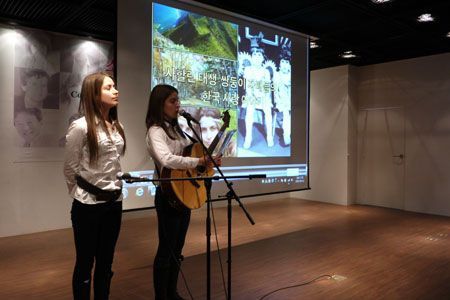
Sisters Tatiana and Natalia Kogan from Russia sing “Yeonga”(love song), while playing the guitar during the “Communicating for a Brighter Future of Korea” contest organized by the CICI.
Over four hours, 21 students from countries including Russia, Turkey, Uzbekistan and Egypt presented six-minute speeches, at times coupled with video clips and costumes.
Some surprised judges with their eloquent use of Korean vocabulary, sprucing up their presentations with sophisticated concepts such as “Todae” (foundation), “Bangan” (method) or “Geungjeongjeok” (positive).
Others simply played on the audience. They danced and made Korean-like quips, inspiring the judges to laughter.
Participants discussed methods to market Korean food, better use social service networks and expel the notion that “multiculturalism” mainly includes Southeast Asians.
Ten finalists were selected and given impromptu questions, such as being asked to define “heung” or expressing passion, the Korean “hon” or soul and what communication is.
“Please give me a hug,” Marwa Mohamed Zahran from Egypt asked of Rep. Jasmine Lee of the ruling Saenuri Party when asked to define heung. After some initial confusion, Torrin Mike, 24, from the United States exclaimed “Assa!” (excellent).
They then waited nervously for the judges’ decision as to who best expressed themselves in Korean and was also able to think on their feet.
Zohid Mamadjanov from Uzbekistan, a sophomore in Tourism at Hankuk University of Foreign Studies in Seoul won the top prize, a round-trip ticket to Europe and a cash prize of 2 million won.
In his speech, he pointed out that inbound tourists are most often from Asian countries, and suggested using social network services to attract European or South American tourists.
“I am really moved. I would really like to thank my Korean language teacher who is taking photos,” Mamadjanov said.
The judges this year included Rep. Lee, Sohn Ji-ae, president of Arirang International Broadcasting Foundation; Seo Kyoung-duk, professor of general education at Sungshin Women’s University and a Korean public relations expert; and Theresa Rah, former spokeswoman for the 2018 PyeongChang Bid Committee.
“Korea is now a world brand, but today I found that foreigners also understood our culture well,” said Seo.
He added that Korea needs to now focus on promoting culture that foreigners can enjoy.
Zahran came second for a cash prize of 2 million won. She currently works as the host of a local radio show that airs news about multicultural families.
Korean student Choi Jin-seop won the third prize.
The popularity award went to the five-member Filipino group PIKO, who applied to the competition by making a promotional video about Korea’s IT prowess.
Lee, the Filipino-Korean lawmaker, said seeing is worth more than a thousand words, emphasizing the importance of the role of experience in promoting Korea’s image.
On what she thought communication meant, Rep. Lee answered, “Action.”