Master calligrapher seeks ultimate spirit of lines

Calligrapher Jung Do-jun checks brushes at his work room in Hannam-dong, Seoul, on Mt. Nam during an interview with The Korea Times, Tuesday. / Korea Times photos by Shim Hyun-chul
By Shim Jae-yun
An artist in the truest sense may pursue an essential masterpiece that can be seen as a result of his or her total dedication throughout life. That may be the reason master ceramic artists, for instance, without hesitation break seemingly flawless artworks with which they are personally dissatisfied.
As music is the art of sound, brush calligraphy is the art of lines. As a singer of traditional Korean pansori usually has a dream of “deugeum” (obtaining sound), so do most calligraphers seek “deugseon” (obtaining lines).
For Jung Do-jun, 65, who uses the penname So Hun, deugseon has been the ultimate goal throughout his life. “It takes all life to acquire the line,” he said during an interview with The Korea Times. “As an old saying goes, ‘the beads can be jewelry when threaded together,’ it is important to design lines beautifully from an artistic perspective.”
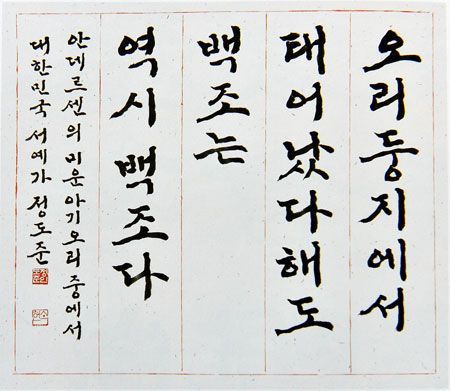
A phrase translated from “An Ugly Duckling” by Andersen
It is not a matter of practice to produce artwork. Rather, it is a process requiring the strenuous effort of fully pouring one’s energy into creating it. The calligrapher stresses the need to put priority on “will” before embarking on writing. “This means calligraphers should have specific plans in mind as all lines, thick and thin, and spaces have their own unique meaning.”
Jung has been cited as the nation’s most prominent calligrapher and was selected to write on the ridge beam of Sungnyemun on March 8, 2012, during restoration of the country’s No. 1 National Treasure that was burnt down several years ago in an arson attack.
“At that time, I had mixed feelings. Of course, it was a great honor for me to write for the nation’s treasure No. 1. But on the other hand, I was much saddened because such a thing would not have happened unless the gate had been set on fire.” He needed to put all his energy into writing 2,500 characters on the ridge, which took 10 days to complete.
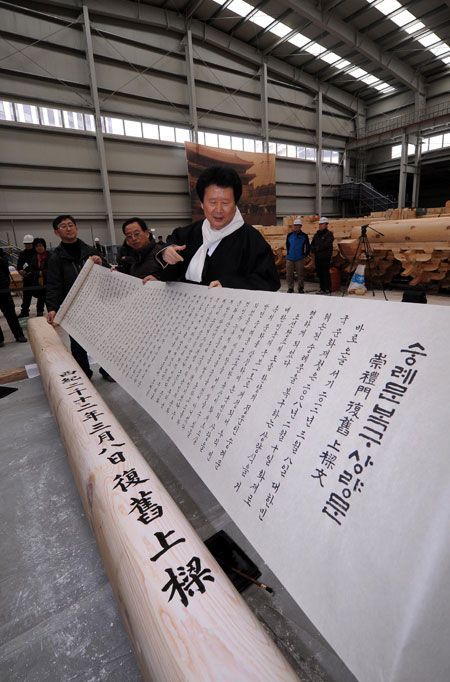
Jung speaks during a press conference after completing writing for the ridge beam for restoration of the Sungnyemun, the National Treasure No. 1, on March 5, 2012.
Jung made a solo debut on the global stage in 1999 when George Teodorescu, then dean of the State Academy of Fine Arts Stuttgart, in Germany, invited him for an exhibition. The world began to focus light on Jung’s works for his uniqueness of maximizing the beauty of lines and space, mainly utilizing the Korean alphabet, or Hangeul.
The nation’s most outstanding calligrapher is now poised to leap forward again, riding on the wide-spreading popularity of “hallyu” (the Korean wave) in the category of K-line (calligraphy).
Robert Morgan, a renowned international art critic and a Fulbright Fellow, said what makes Chung’s calligraphic script so important from an aesthetic point of view is his ability to reunite passages from the five Chinese scripts — the Seal, Clerical, Normal, Cursive and Draft used in Chinese calligraphy that evolved from ancient dynasties — in relation to Hangeul. In Feb. 2008, in the Tenri journal, published by the Cultural Institute of New York, Morgan praised Jung for exploring the unique yet indigenous potential of creating variations within Hangeul.
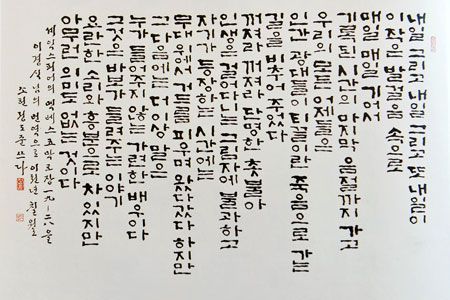
A phrase translated from William Shakespeare’s Macbeth Verse 5, lines 19-28.
Jung saw bright prospects for calligraphy to be spread globally despite rapid digitalization and the wide use of information exchange tools such as the Internet and mobile phones. “It is like seeing the various types of painting that sprouted in the wake of the invention of the camera despite earlier concerns over the fate of artistic works. What is important in art is the human touch coupled with freshness, the two aspects which succeeded in moving the world with my artwork,” he said.
Speaking of the beauty of brush calligraphy in East Asia, he said, “We can absorb ourselves into the rice paper with its softness. The paper accepts lines, compared to the stiff and hard paper or canvas used in Western paintings. As it can receive them inside, it can put out any time, which makes it strong.”
Born in Jinju, South Gyeongsang Province, Jung took calligraphy lessons from his father who was also a master calligrapher. Compared to China and Japan, which have led the international calligraphic sector, the world has yet to recognize Korea for its unique calligraphy. Given this, Jung has been dedicated to disseminating the country’s calligraphic art to the world as a master calligrapher, on behalf of the nation.
Invited solo exhibitions o’seas
1999 Kunst Academy Stuttgart (Stuttgart, Germany)
2000 KIST EUROPE (Saarbrucken, Germany)
2001 UNESCO Miro Gallery (Paris, France)
2003 Palazzo Pretorio Certaldo Museum (Firenze, Italy),
Embassy of the Republic of Korea Gallery (Brussels, Belgium)
2004 Linden Museum Stuttgart (Stuttgart, Germany)
Museum Ettlingen (Ettlingen, Germany)
Chapelle Des Jsuites Chaumont (Chaumont, France)
2005 Espace Art Et Liberte, La Coupole (Charenton-le-Pont, France)
2006 Grassi Museum (Leipzig, Germany) Jordan Schnitzer Museum of Art (Oregon, US)
2008 Tenri Cultural Institute of New York (N.Y., US)
2012 Artevie, Espace d’Art Contemporain International (Lorrez-le-Bocage, France)
2012 Espace d’Expression Artistique de Nogent (Nogent-sur Marne, France)
Current positions
Honorary Academic Membership (State Academy of Fine Arts Stuttgart, Germany)
Honorary Doctor of Philosophy (Konkuk University, Korea)
Invited artist of the National Modern Art Gallery
Director of Korean Headquarters, International Association of Artistic Calligraphy Styles
Member of the Korean Artists Association
Instructor at Sungshin Women's University
Visiting Professor at the State Academy of Fine Arts Stuttgart of Germany
Organizing Committee of International Calligraphy Biennale held in North Jeolla Province
Studio: Hannam-daero, 42-gil, 14, 5F, Yongsangu, Seoul, Korea (zip140-894)
jungdojun@hotmail.com www.jungdojun.com, www.sohun.com