Korean-American singer tells how she feels part of Korea

Zoe Yungmi Blank sings “Aegukga” on March 1. Courtesy of Zoe Yungmi Blank
Zoe Yungmi Blank, a Korean-American singer-songwriter, sang Korea's national anthem, “Aegukga,” on the 100th anniversary of the Korean Independence Movement Day at the Seodaemun Prison in Seoul. This is her account of how she felt during the ceremony and her participation in it. ― ED.
By Zoe Yungmi Blank
As I prepared to sing the Korean national anthem, “Aegukga,” at the March 1 celebration, I studied the history behind it and reflected on my non-full Korean identity.
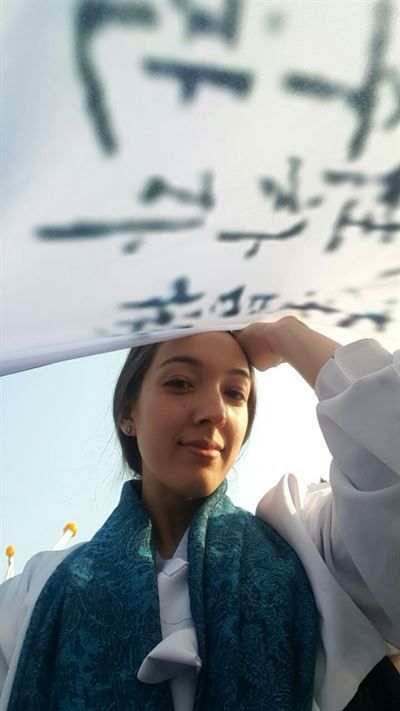
A selfie of Blank during the celebration. Courtesy of Zoe Yungmi Blank
With no current plans of returning to America, I have cherished moments when I feel like a part of Korea ― when my “halmoni” (“grandmother” in Korean) sits me down to straighten my ratty hair; when elder relatives firmly pat my hand with reverence; when my colleagues at the International Strategy Center play gawi-bawi-bo (“rock-paper-scissors” in Korean) to choose who washes the dishes, and when they assign me responsibilities that remind me I am a real part of the community. So in addition to honoring the March 1 Movement, I was looking to feel part of Korea by participating in the celebration.
President Moon Jae-in spoke while I pestered my friends for translations, trying not to disrupt the sea of attentive audience members. Due to my poor Korean abilities that prevented me from communicating and connecting with the festival organizers, I was introduced onstage as a “foreigner.”
I was reminded that regardless of how much I have studied Korean history, volunteered in Korean civil society and learned Korean music, language fluency should have come first to get deeply integrated. I have been struggling with this since my babyhood, but I will try harder to achieve this.
After my gig, people shook my hand and commended me for my interest in Korea. I shook my head, knowing I needed to go home and hit more Korean books. Because I mostly inherited my dad's features ― a tall nose bridge and big eyes ― not a single audience member could guess that I grew up around more Koreans than non-Koreans, that I grew up hearing stories of the war, that I have been singing Korean songs since I was a baby, or that Korea is the only country I have been where I actually have native blood. The audience was not as critical of me as I was with myself.
My mom has also been proud that I have continued to dive into our heritage by participating in the celebration and thinks it makes sense with the trajectory of my life. She raised me in a Korean American community where I attended Korean immersion elementary school, did Korean musical theater, fan danced and played Janggu (Korean traditional drum).
As a kid, I loved the puzzle of correctly completing the Korean flag trigrams with black crayon and always appreciated that I had, not one, but two flags to love. I later did volunteer work for Korean culture programs often tied to government events as well.
As a member of the Korean diaspora ― especially as someone who is perceived as white ― I value input from my Korean mentors, elders, colleagues, friends and family. So when they pointed me toward learning the history of the March 1 Movement and “Aegukga,” I eagerly took on the task and was thankful for their guidance.
But in the past month, I have also learned that while some people find learning history an act of respect, others find it an act of disrespect, believing the past should stay in the past. I think it is because we have different definitions of “patriotism.” We all love our countries in different ways. For me, my exposure and engagement in Korean culture become more solid when I am aware of the histories attached to the culture, and how people have been affected by these histories. I meditated on that love while carrying the Taegukgi (Korean flag) from the Seodaemun Prison to Gwanghwamun.