Re-inventing Bellini
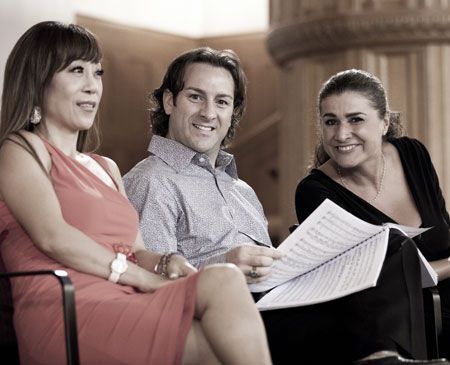
Soprano Jo Su-mi, left, tenor John Osborn, center, and mezzosoprano Cecilia Bartoli take a break during a recording session in Zurich for a latest Decca production of “Norma.” / Courtesy of Decca
Cecilia Bartoli, Jo Su-mi collaborate in ground-breaking ‘Norma’ album
By Do Je-hae
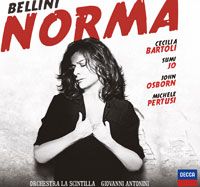
Decca released a new version of “Norma” in May. / Courtesy of Decca
The great mezzo-soprano Cecilia Bartoli has been known for unconventional recording projects, culminating in a latest Decca release of Vincenzo Bellini's "Norma."
In what is widely considered the operatic event of the year, the mezzo-soprano sings the lead role of Norma, which is typically reserved for lyrical sopranos.
Because Norma is such an iconic role in the soprano repertory, the album has received much media attention since its release in late May. Her interpretation was hailed by the Financial Times as “a radical but convincing rethink of the part.”
Another aspect that makes this album unique is the participation of Korean coloratura soprano Jo Su-mi, who sings the role of Adalgisa that is usually sung by mezzo-sopranos. In Korea, the album was released last week.
Bartoli wrote opening essay in the CD booklet outlining her reasons for singing the role.
Premiered at the Salzburg Whitsun Festival, the production is intended to be more like what the audience heard when it was first performed in 1831.
Bartoli's re-invention of "Norma" is the result of several years of intense research. During an interview with The Guardian, she shared a bit of its performance history which backs her decision to sing the part of Norma.
"Bellini composed 'Norma' and 'La Sonnambula' for Giuditta Pasta who was a mezzo," Bartoli said. "But this music was nearly forgotten until the 1950s when Maria Callas and Dame Joan Sutherland performed these roles and made them their own. But they are sopranos. So we have a false understanding of what Bellini did."
The orchestration was based on Bellini's own score and used 19th-century instruments. The sounds of period instruments from the composer’s time are brought to life by Orchestra La Scintilla and conductor Giovanni Antonini.
Norma, often portrayed as a superhuman priestess, emerges in Bartoli's performance as a woman of flesh and blood, torn between duty and love.
Bartoli and Jo are longtime friends who both trained at Rome's National Academy of St Cecilia and auditioned together for Herbert von Karajan in the 1980s.
"Norma," an opera in two acts, tells the story of a Celtic priestess, Norma, who lives in Roman occupied Gaul. Norma is in love with Pollione, a Roman soldier, thus ostensibly her enemy. But, as in many romantic tragedies, Norma has a rival for her lover’s affections, Adalgisa.
For more than two decades, Bartoli has been one of the leading classical musicians of our time despite limitations faced by mezzo-sopranos. Bartoli's innovative recording projects, like the 1999 Vivaldi album, place her in a class by herself. By highlighting the forgotten composer of vocal music, the album made millions realize that the Venetian composer is not just about "The Four Seasons."
Jo is the first Korean opera singer to record for major labels like Erato and Decca and has appeared in major opera houses around the world since her European debut in 1986. The Grammy Award winning artist has over 50 recordings to her credit, including the highly-acclaimed "Carnaval! French Coloratura Arias" by Decca.