Originality holds key to growth of Seoul Arts Center
.jpg?w=728)
Seoul Arts Center (SAC) President Mo Chul-min poses at the opera house of the center. / Courtesy of SAC
By Do Je-hae
Large-scale cultural complexes around the world are rushing to respond to the new demands of the digital era.
Lincoln Center’s Metropolitan Opera, for example, is focusing on “The Met: Live in HD” project, which has been transmitting live performances to 1,500 venues in 46 countries with subtitles in English, French, German, Portuguese, Spanish, Japanese and Korean since 2006.
“That kind of project would be like a dream for us,” Seoul Arts Center (SAC) President Mo Chul-min said during a recent interview with The Korea Times.
“Like many concert venues around the world, we have added more cameras for digital filming. But the primary source of such projects is the content. Our resident companies, like the national ballet and national opera, are not quite up to that level yet,” Mo added.
A culture policy expert, Mo was named as president of the nation’s premier performance complex in Seocho-dong, Seoul, in April. A professor emeritus at the Business School of Donga University in Busan, he replaced former chief, Kim Jang-sil.
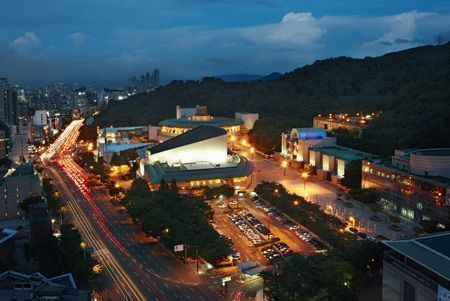
The SAC, home to national ballet and opera companies, has served as the nation’s most comprehensive cultural complex since its establishment in 1988. / Courtesy of SAC
Mo stressed the importance of improving the level of resident companies, and creating original content for musicals and dance productions for the future growth of the SAC.
A former career bureaucrat, Mo served at the culture ministry for more than 30 years. The former vice culture minister headed the Korean Culture Center in Paris from 2004 to 2007.
Mo received a medal from the French government in 2007 for his contribution to promoting cultural exchange between the two countries.
He referred to France as a benchmark country as Korea strives to become more culturally advanced.
“For a long time, Korea has looked up to the cultural policies of France,” Mo said.
“Unlike in Korea, the French government supports around 70 percent of the budget of organizations similar to the SAC. We receive about 20 percent.”
“At places such as the SAC, we also need to have extended leadership that can plan ahead and work toward a long-term vision. In France, when a person becomes president of a large cultural complex, that person usually serves in that position for around 10 years.”
The SAC president’s term is three years.
Mo entered the civil service in 1981 and served in various cultural posts, including head of the Korean Cultural Center in Paris and head of the National Library of Korea. A graduate of Sungkyunkwan University, he also has a doctorate from the University of Oregon.
As SAC president, he has introduced new measures to bring the SAC closer particularly to young people through providing discounts for people under the age of 24, opening up rehearsals for youngsters and running weekend culture classes for teenagers and college students.
In the future, Mo said that Korea has the potential to become a cultural leader in Asia, with mega cultural infrastructure such as the Asian Culture Complex in Gwangju set to open.
“I see the establishment of Gwangju’s Asian Culture Complex as a real turning point in lifting Korea’s status as a culturally advanced country in the next 10 years,” Mo said.
The complex has been under construction since 2007. It will be completed in 2014.
When completed, culture officials expect the Asian Culture Complex in Gwangju to be multi-functional venue, performing a similar function to the Lincoln Center in New York or the Pompidou Center in Paris.
Mo also talked about the need to resolve the cultural gap between people in affluent Gangnam and the comparatively less wealthy Gangbuk areas in Seoul.
“Because of the accessibility, the SAC is convenient for people who live in the Gangnam area. I think it would be a good move to build a large concert venue in the Gangbuk area run by the SAC,” Mo said.
Built during the military regime of the Chun Doo-whan administration, the SAC is the most comprehensive cultural complex in the country. In 2011, more than 2,465,000 people visited it to enjoy various events including 1,019 performances and 137 exhibitions. The SAC will celebrate its 25th anniversary next year.