‘KPop Demon Hunters’ brings Korean culture to global screens in English
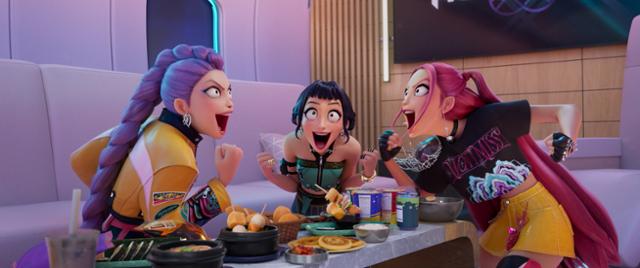
A scene from "KPop Demon Hunters" / Courtesy of Netflix
“KPop Demon Hunters,” an English-language animated film featuring a K-pop storyline, has taken the world by storm — reaching No. 1 on Netflix’s global film rankings. While the film is a U.S. production by Sony Pictures Animation, it weaves in distinctly Korean elements, from food and language to traditional clothing and signs, introducing international audiences to Korean culture in new ways.
The film follows three K-pop superstars — Rumi, Mira and Zoey — who secretly protect the world behind the scenes of their glamorous careers. As members of the fictional girl group Huntrix, the trio faces off against a villainous boy group called The Saja Boys. Their journey explores themes of friendship, growth and trust, paired with vibrant music and dynamic action sequences.
According to Netflix, the global success of “KPop Demon Hunters” is proof that “a great story can transcend language, culture and format.” A Netflix representative said the film’s seamless blend of Korean traditions and modern K-pop aesthetics made it “a well-crafted animation that resonates universally.”
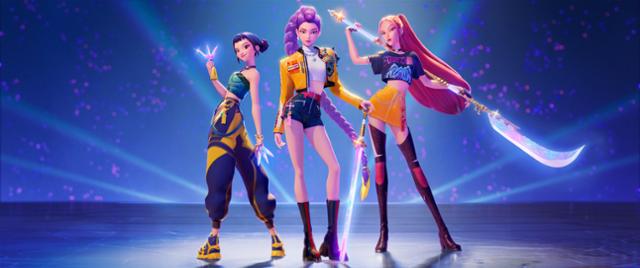
A scene from "KPop Demon Hunters" / Courtesy of Netflix
The film has drawn praise for authentically portraying K-pop fandom and idol culture. Fans in the movie wave slogan banners and film dance challenges, while idols openly express affection for their fans — familiar elements for global K-pop audiences. Beyond the music scene, “KPop Demon Hunters” highlights Korean cultural motifs such as gimbap, hanbok and traditional headgear called gat. Some signs appear in Korean, and the group even refers to their rivals as hoobae — a Korean word meaning “junior.”
These cultural details have helped boost the film’s popularity. Director Maggie Kang said, “Just like K-pop and K-beauty, anything with a ‘K’ in front seems to excite American audiences now. Seeing this made me proud of how far Korean culture has come, and inspired me to create this film.”
Korean culture’s global appeal was on full display recently, even during actress Scarlett Johansson’s press tour in Korea for “Jurassic World: New Era.” She shared that she went shopping for Korean cosmetics in Myeong-dong and had “seven kinds of kimchi” for breakfast — further proof of growing interest in all things Korean.
Although Korean-themed content has enjoyed international success before, “KPop Demon Hunters” stands out for delivering Korea’s unique cultural flavor through an English-language, U.S.-produced film. Director Kang added, “It’s a sign of how powerful and developed Korean culture has become that a fully Korean story could be produced by an American company.”
“KPop Demon Hunters” follows in the footsteps of “XO, Kitty,” another English-language Netflix hit that focused on a Korean setting and characters. The 2023 series featured a Korean international school, Korean actors, and traditional elements such as hanbok. It reached No. 2 on Netflix’s global top 10 for English TV series.
The success of both titles suggests that Korean culture will remain a major theme in global entertainment. But to sustain interest, critics say the industry must continue producing high-quality work that engages international curiosity about Korean life and values.
At the same time, “KPop Demon Hunters” signals a need for evolution in Korea’s own content industry. Pop culture critic Jung Deok-hyun said, “The market has changed. Now we have a system where foreign companies can take culturally trendy material and release it globally.” He added that Korean creators, too, should explore stories rooted in other cultures — like Thailand or India — and present them authentically to the world.
One such example is the U.S. animated hit “Kung Fu Panda,” which earned acclaim for its rich portrayal of East Asian aesthetics despite being a Western production. Similarly, the 2014 Naver webtoon “For Sita” explored Nepalese mythology and received attention for its unique subject matter.
As Korea’s cultural influence grows, industry experts say that embracing both domestic storytelling and respectful global narratives could open a new chapter for Korean content creators.
This article from the Hankook Ilbo, the sister publication of The Korea Times, is translated by a generative AI system and edited by The Korea Times.