How ‘A Minecraft Movie’ broke the game-to-film curse in Korea

A scene from "A Minecraft Movie" / Captured from the movie
The Minecraft movie is making a surprisingly strong showing in theaters, standing out in a market where video game adaptations often struggle to find traction. Despite its niche appeal as a game-based film, “A Minecraft Movie” is winning over audiences.
Released in Korea on April 26, “A Minecraft Movie” follows the story of four characters —Garrett, Natalie, Dawn and Henry — who are unexpectedly pulled into the blocky realm of the Overworld. There, they meet Steve, a seasoned explorer, and embark on an adventure that spans the square-shaped universe. With popular names like Jason Momoa and Jack Black in the cast, the film has gained instant attention from Korean audiences.
Since its debut, the film has topped the foreign box office in Korea and became the third foreign release this year to surpass one million admissions. On Children’s Day, May 5, it even climbed to the No. 1 spot across the entire box office. Overseas, the movie delivered the strongest opening for a Jason Momoa film, posted the best debut score of the year in European markets and grossed $157 million in North America in its first three days.
Part of the movie’s charm lies in its dynamic visuals, physical comedy and strong chemistry among cast members. It also rewards fans with hidden “Easter eggs,” uses the original game’s background music for an immersive effect and features a playful cameo by one of Minecraft’s original developers, who appears as a waiter. However, the film’s greatest strength is its source material: this is the first live-action adaptation of Minecraft, the best-selling video game of all time.
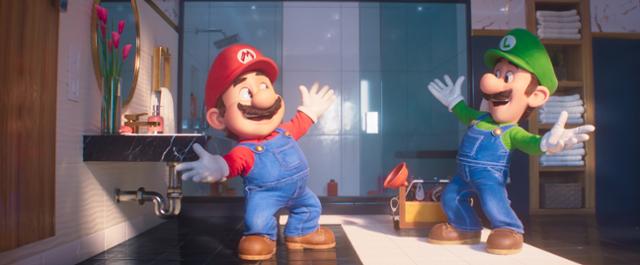
A scene from “The Super Mario Bros. Movie" / Captured from the movie
Korea has previously attempted to bring game-based films to audiences. One such effort was “The Labyrinth,” adapted from the cult horror game “White Day: A Labyrinth Named School.” The movie follows a group of students fighting to survive against vengeful spirits haunting their school at night. Although the premise was praised as fresh, the film struggled at the box office, barely attracting 10,000 viewers.
By contrast, “The Super Mario Bros. Movie,” released in April 2023, became a major hit in Korea, drawing over 2.39 million viewers. On Children’s Day alone, it attracted 430,000 moviegoers.
So why has Korea, home to many blockbuster adaptations of webtoons and novels, struggled to find success with game-based films?
According to a planner at a major gaming company, the issue lies in the absence of globally recognized Korean game IPs. “For a drama or film adaptation to succeed, the game needs a strong narrative, but that’s hard to find,” the planner said. Although titles like “MapleStory” have performed well in both gaming and comics, such examples are rare, and transitioning from print to screen often exposes weaknesses in story and structure.
Culture critic Kim Heon-sik also pointed out a generational disconnect in Korean games. “Disney’s strength is that its IP spans generations. Grandparents to children all grew up watching Disney, which is why Disneyland works,” Kim said. “If a game lacks cross-generational appeal and resonates with only a specific age group or gender, it’s difficult for an adaptation to succeed.”
He added, “If Korean games had more international fandoms, perhaps they could compete. But our content power hasn’t reached that level yet.” He also noted that while Korean audiences tend to prefer realistic storytelling, many games rely on fantasy elements, making them a harder sell.
In contrast, novel- and webtoon-based films can still succeed even without mass appeal, thanks to their strong narratives and detailed world-building. Games, on the other hand, often lack that narrative depth. For them to succeed as original material for dramas or movies, broad-based popularity is essential.
While it may still be too early to expect widespread success from Korean game adaptations, the question remains: could a breakthrough someday arrive in the form of a globally embraced K-drama or film based on a game?
This article from the Hankook Ilbo, the sister publication of The Korea Times, is translated by a generative AI system and edited by The Korea Times.