1st documentary unveiled in Korea retracing Nam June Paik's vision of video art

A scene from Amanda Kim's documentary on Korean American video art visionary, “Nam June Paik: Moon Is the Oldest TV” / Courtesy of Elliott Erwitt, Greenwich Entertainment
Amanda Kim's 'Nam June Paik: Moon Is the Oldest TV' screened in Seoul after premiering at Sundance Film Festival
By Park Han-sol
In today's media-saturated world, the groundbreaking works of Nam June Paik (1932-2006), widely referred to as the father of video art, reverberate more strongly than ever.
The artist's usage of TV monitors ― which he would utilize to produce everything from wearable “clothes” and musical instruments to site-specific installations ― prophetically visualized the contemporary society awash with digital information and electronically transmitted images. He would also directly manipulate, distort and shuffle the images appearing onscreen with magnets and video synthesizers to popularize the whimsical editing of videos and thus democratize technology ― an unthinkable feat at the time.
He coined the term “electronic superhighway” in the 1970s long before the emergence of the Internet, foreseeing the global telecommunications that has since become our everyday reality.
A documentary that paints an alluring portrait of the Korean American video art visionary and his forward-thinking legacy has been unveiled in Korea, several months after its premiere at this year's Sundance Film Festival.
“Nam June Paik: Moon Is the Oldest TV,” directed by Amanda Kim, had its first preview screening in the country at Art House Momo at Seoul's Ewha Womans University, March 29.
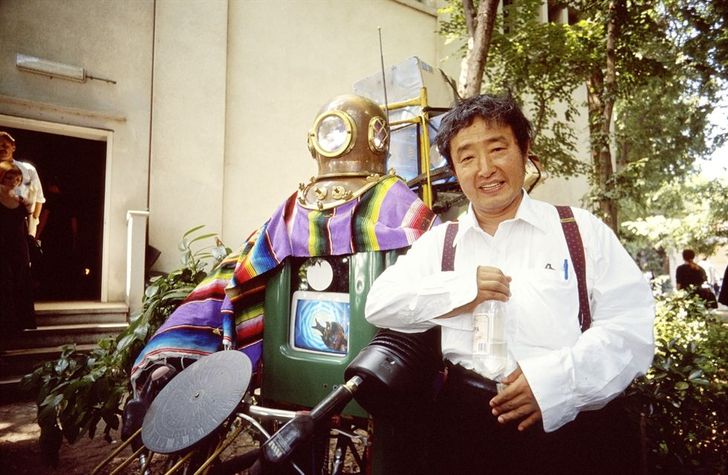
Nam June Paik poses with his robot sculpture "Rehabilitation of Genghis Khan," which was presented at the 1993 Venice Biennale. Courtesy of Age Fotostock
Named after Paik's 1965 piece, where he displays the images of the moon, a primordial source of light in human history, on televisions, the 107-minute-long film retraces the artist's creative trajectory through a wealth of archival footage and interviews with his art world contemporaries ― John Cage, Joseph Beuys, Charlotte Moorman, Ono Yoko, Merce Cunningham and Kubota Shigeko (who was also Paik's wife), among others.
It begins with his early days as a classically trained musician who moved to Munich, Germany, in 1956 to pursue his degree until he felt a jolt of newfound creativity after attending a contentious performance led by avant-garde composer Cage.
“My life started one evening in 1958,” the artist wrote, “1957 was B.C. (Before Cage).”
Armed with the courage to be free, Paik eventually relocated to New York City in 1964 and joined the experimental art collective, Fluxus. He staged a string of guerrilla shows to “disrupt and sabotage” the status quo ― smashing instruments on stage, collaborating with the classical cellist Moorman for a topless performance that got them both arrested for indecency and building a robot that walked around the streets of Manhattan while reciting John F. Kennedy's speeches on repeat.
But it was ultimately the TV screen that became a major artistic tool for Paik. What catapulted the starving creator to stardom was his 1974 landmark piece, “TV Buddha,” in which a statue of Buddha intently watches its own live image projected on an adjacent electronic screen.
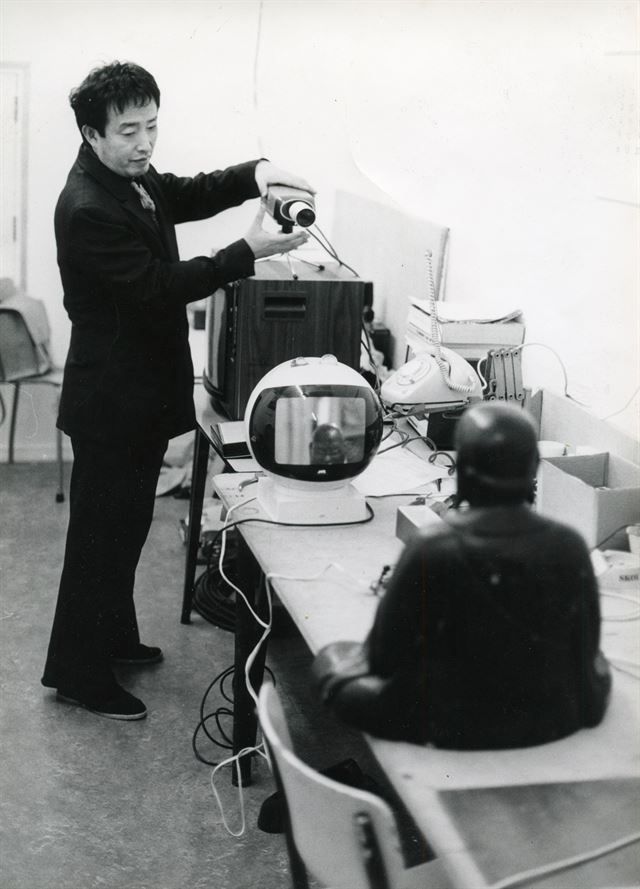
Nam June Paik installs his video sculpture "TV Buddha" (1974) at the Stedelijk Museum Amsterdam. Courtesy of Rene Block
The artist transformed the digital monitor into his canvas, fundamentally restructuring how we think of the image-making process in the age of media. He went on to produce a phantasmagoric collage of electronic images that would appear in humanlike sculptures, monumental video towers and even an internationally broadcast satellite installation, “Good Morning, Mr. Orwell.”
By 1982, Paik was invited to present a solo show at the Whitney Museum of American Art ― the first-ever retrospective dedicated to a video artist mounted in a museum.
The documentary continues to follow the progenitor of video art after he suffers a major stroke in 1996 that bound him to a wheelchair. Despite his declining health, he pushed himself to explore the uncharted terrain of electronic media that was ultimately encapsulated in his tantalizing show at the Guggenheim in 2000.
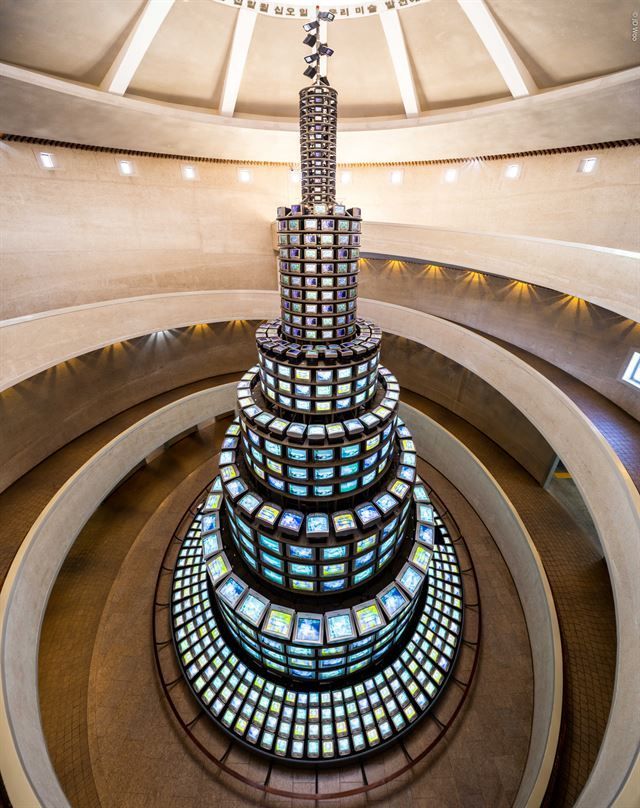
The largest video tower ever created by Nam June Paik, "The More, The Better" (1988), installed at the National Museum of Modern and Contemporary Art, Korea's Gwacheon branch in Gyeonggi Province / Courtesy of MMCA
What adds another layer to the film's storytelling of Paik's career is Korean American actor Steven Yeun's voiceover narrating the artist's personal contemplations expressed in his correspondence, essays and interview transcripts.
At times, they offer a glimpse into how he felt about his home country ― which he had to flee after the outbreak of the 1950-53 Korean War and was only able to return more than three decades later after gaining international recognition.
The Ulsan Art Museum, Korea's first public museum with a focus on media art, has acquired “Moon Is the Oldest TV” and is set to exhibit the film during its screening program from April 6 to 8. The museum also has Paik's other representative installations like “Sistine Chapel,” “Forest of Cage, Revelation of the Forest” and “Turtle” in its collection.