INTERVIEW 'Drive My Car' director on meeting Bong Joon-ho, receiving int'l accolades

Japanese director Hamaguchi Ryusuke / Courtesy of Triple Pictures, ZOA Films
By Kwak Yeon-soo
Japanese director Hamaguchi Ryusuke has had a fantastic year, with “Drive My Car,” his adaptation of a Haruki Murakami short story, winning the Best Screenplay Award at this year's Cannes International Film Festival, and his three-part film anthology “Wheel of Fortune and Fantasy” nabbing the Silver Bear Grand Jury Prize at this year's Berlin Film Festival.
However, the 42-year-old filmmaker recalls that his special dialogue session with Korean auteur Bong Joon-ho at this year's Busan Film Festival was the most memorable moment of 2021.
“It was the most exciting moment of the year. I could feel that Bong had watched my films with deep interest and affection. He led our conversation as if he was directing me. Sometimes he pushed me, even provoked me, to answer some of his tough questions. Overall, I received encouragement and energy from him,” he said through a translator in a video interview with The Korea Times, Thursday.
Hamaguchi credited the success of “Drive My Car” to Haruki, directors Hirokazu Kore-eda (the winner of the 2018 Cannes Palme d'Or for “Shoplifters”) and Bong Joon-ho (the winner of the 2019 Cannes Palme d'Or for “Parasite.”)
“It's really due to the power of Haruki, who has a strong fan base around the globe, and the recent rise of Asian cinema and Asian directors that my film is receiving accolades in this way,” he said.
The filmmaker elaborated that he could feel high expectations for Asian cinema when he meets people at international film festivals. “I'm very grateful and I hope such renewed interest continues on in the future,” he added.
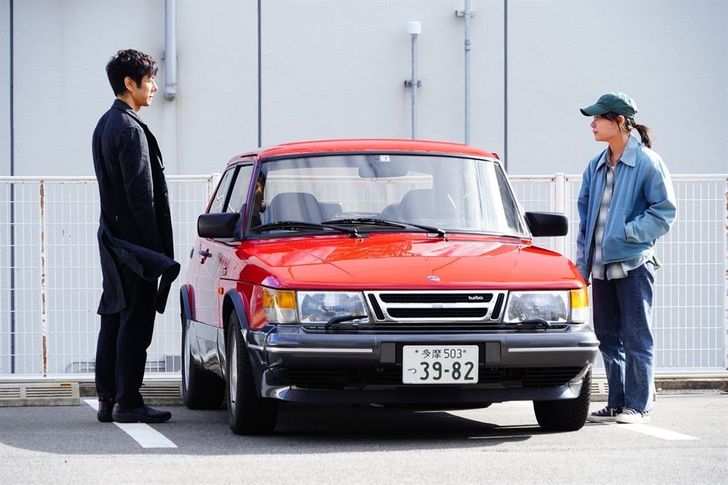
Actors Hidetoshi Nishijima, left, and Toko Miura in a scene from the film “Drive My Car” / Courtesy of Triple Pictures, ZOA Films
The three-hour drama “Drive My Car” is based on the 2014 Haruki's short story collection “Men Without Women.” It tells the story of Kafuku (Hidetoshi Nishijima), an actor and stage director who slowly lets go of his buried past and moves on by preparing a theatrical adaptation of Anton Chekhov's “Uncle Vanya” in Hiroshima.
The theater company hires Misaki (Toko Miura), a young driver, to drive him around the town and the two open up to each other about their wounds. Kafuku takes in the sudden passing of his screenwriter wife Oto (Reika Kirishima) and the affairs Oto had engaged in discreetly before her death while Misaki shares her grief and pain coming from her abusive mother.
Most of the film is confined to conversation inside the car as Kafuku is driven to and from rehearsals.
“The car has a cinematic setting as the background scene changes while moving. The conversation inside the car is the most significant part of the film because the relationship of Kafuku and Misaki is at the center of the storyline,” Hamaguchi said.
As the play “Uncle Vanya” utilizes a cast speaking different languages, including Chinese and Korean Sign Language, the director cast Chinese and Korean actors speaking multiple languages.
“I'm really grateful to wonderful actors who went through rigorous table-reading process and performances. It's really due to the power of the actors that enabled audience to withstand three hours of watching the film,” he said.
Asked about Haruki's response to the film, the director said he was unable to meet him or talk to him directly. “I read through an article that Haruki and his wife watched the film at the movie theater. He was quoted as saying, 'I couldn't tell from where to where I wrote.' For me, that's the best compliment,” he said.
“Drive My Car” will hit local theaters, Dec. 23.