'Family dynamic is at heart of Asian cinema,' BIFF head juror says

Indo-Canadian filmmaker Deepa Mehta, the head juror of the 26th Busan International Film Festival's New Currents Section, speaks via Zoom during a press conference, Thursday. Yonhap
By Kwak Yeon-soo
BUSAN ― Speaking at a press conference to discuss the 26th Busan International Film Festival's (BIFF) New Currents, the competition for up-and-coming directors, head juror Deepa Mehta said she has witnessed two distinctive characteristics in Asian cinema.
“As somebody who comes from India and lives in Canada, there are differences among regions. Perhaps it has something to do with the geography or culture, but I can smell the flavor of Asian cinema more acutely,” she said via Zoom as she was unable to travel to Korea due to health problems.
“Family is of paramount concern in most Asian countries. Then there is a strong desire to better ourselves to be accepted (in the society). For instance, we fight poverty and pandemic to be dignified. That's what makes Asian cinema different,” Mehta added.
This year's BIFF's New Current Section, which showcases emerging Asian directors deemed worthy of wider global recognition, includes 11 titles.
The New Current Award will be given to the two best feature films selected from the first or second feature of new Asian directors. This year, the four jurors for the award are Mehta, Cristina Nord, Jang Joon-hwan and Jeong Jae-eun.
Nord, who is serving as section head of the Berlinale Forum, described Asian cinema as diverse, in terms of both genres, subject matter and filming techniques.
“Asian cinema has all sorts of filmmaking. There is no common tendency. During the early days of my career, Hong Kong martial arts films left me flabbergasted. Then, I found some thorough and convincing documentaries by Wang Bing that portray Chinese reality nowadays. And there are super enjoyable films like Bong Joon-ho's Snowpiercer and Parasite,” she said.
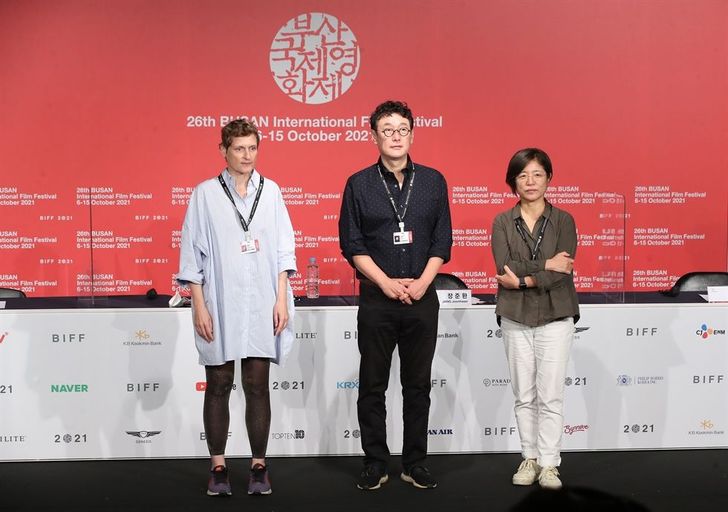
From left, Berlinale Forum head Cristina Nord, directors Jang Joon-hwan and Jeong Jae-eun pose during a press conference held at the KNN Theater in Busan, Thursday. Yonhap
Jeong, whose debut feature “Take Care of My Cat” (2001) was nominated for the New Currents Award 20 years ago, said competing in the section is a sort of gateway for young Asian directors to introduce their films abroad.
“Twenty years ago when I brought my film to the BIFF, some international guests liked my film and introduced it to other countries. This may serve as a great gateway for Asian filmmakers to promote their films abroad. For filmmakers, attending film festivals is a rare chance to meet different audiences and find out how their films are received by them,” she said.
Jang, best known for his 2017 film “1987: When the Day Comes,” said the pandemic has pushed young filmmakers to showcase aspects of death and survival.
“The pandemic has been around for two years and it has shown us a window into death and mortality. I'm looking forward to seeing groundbreaking films that are about to change the ecosystem for the global film industry in a positive way,” he said.
Mehta promised that jurors will put their subjectivity aside and select films that feature innovative ways of storytelling and employ new artistic forms.
“There is a wonderful quote from the brilliant theater director Bertolt Brecht, which became my mantra: 'Art is not a mirror held up to reality, but a hammer with which to shape it.' The films we're about to see are those hammers,” Mehta said.
The winners for New Currents Award will be announced Oct. 15.