'Parasite' producer talks on Bong's quirky brilliance, int'l acclaim
By Kwak Yeon-soo

Kwak Sin-ae, producer of “Parasite” and CEO of its production house Barunson E&M, poses for a photo after an interview with The Korea Times at a cafe in Seoul, Feb. 20. / Courtesy of CJ ENM
Kwak Sin-ae, producer of the Oscar-winning “Parasite” and CEO of its production house Barunson E&A, says she still feels “awkward and uncomfortable” being in the spotlight.
“Until recently, I led my life as an ordinary citizen. I used to sit in the corner on set trying not to be noticed,” Kwak said during an interview with The Korea Times. “To say I'm overwhelmed about winning the Oscars is an understatement.”
On Feb. 9, “Parasite” became the first foreign-language film to win best picture at the Academy Awards in its 92-year history. It also won three other awards for best director, best international feature film and best original screenplay.
Thanks to the Oscar's unconventional move, Kwak became the first Asian female producer to win best picture from the academy.
She recalls how a Korean film winning the Oscars came as a surprise, as the Academy of Motion Picture Arts and Sciences (AMPAS) members were considered conservative, and unlikely to vote for a non-English language film for best picture.
“I know it must have been hard for them to make an unprecedented choice. Great determination is needed to make a change. I respect their brave decision,” she said.
Early days
Kwak was born and raised in the southeastern city of Busan, as the middle child of three siblings. Her father was a doctor.
Her older brother is Kwak Kyung-taek, renowned director of the box-office hit “Friend,” and her younger brother is Kwak Gyu-taek, an attorney and the member of the United Future Party.
The award-winning producer initially dreamed of becoming a writer, so she majored in Korean Language & Literature at Dong-A University.
It was by chance that she began her career in film, as a reporter for film magazine “Kino” in 1994. Kwak was a founding member of the publication.
“It was as a reporter that I developed an obsession with films, studying film and interviewing filmmakers,” she said.
She grew fond of Korean cinema and later met her husband Jung Ji-woo, who is an award-winning director best known for his works “Happy End” (1999) and “Eungyo” (2012).
After four years of reporting, Kwak moved into publicity and marketing at Generation Blue Films, LJ Film and ShinCine Communications. In 2010, she joined production company Barunson E&A and was in charge of film there.
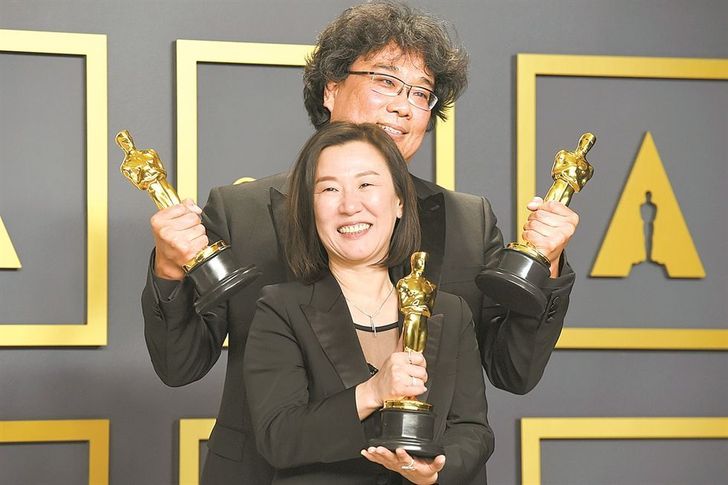
“Parasite” producer Kwak Sin-ae, front, poses with director Bong Joon-ho after winning four Oscars at the Academy Awards ceremony held at the Dolby Theatre in Los Angeles, Feb. 9. Korea Times file
Working with Bong
Kwak met director Bong Joon-ho for her second project as the main producer after working on “Vanishing Time: A Boy Who Returned” (2016).
“When I first read the synopsis, I got the feeling that it was going be selected for the Cannes Film Festival competition due to its slick plot and original ideas,” she said. “But I didn't expect it to win a Palme d'Or and at the Oscars.”
Working with Bong, Kwak coordinated various aspects of the film's production ― she supervised film development, had the final say in casting and creative decisions, managed investor meetings and oversaw the marketing and distribution.
“Though I had a lot of work on my plate, Bong was very supportive about making the best film possible,” she said, lauding his staggering work ethic and humble personality.
“He tries to make the best of what he has. He doesn't make excessive demands, like spending more money than allotted or extending shooting schedules. That's why people call him a 'genius,'” she added.
Kwak attributed such skills to the long years of difficulties Bong endured before accomplishing his many great feats.
“As Bong and I are just one year apart in age, we have grown old together. Our friendship is strong, but that doesn't mean that I get to work with him whenever I want,” she said.
The 52-year-old producer revealed that Bong's nickname is “Bongtail,” for his detail-oriented ability to draw audiences into a film.
“It's true that Bong pays attention to small details, but not all of them are intentional. In fact, Bong's films are idiosyncratic, like the director himself,” she said.
“There was a scene (in Parasite) where Kim's family return home amid heavy rain. Actor Song Kang-ho accidentally twisted his ankle while shooting, but Bong okayed that version. He appreciates that sort of abnormal situation, and turns it into an art form.”
She said that the most exciting event during the awards season race was when the cast members won the Screen Actors Guild (SAG) Award for best ensemble.
“We received a standing ovation at SAG, which was amazing. I've never seen Bong so happy,” Kwak said.
The future
For Kwak, the Oscar win will always be remembered as her biggest career achievement. However, she also expressed her desire to leave the experience as a good memory and start working on new films.
“The official promotional activities are over, but I need to deal further with potential copyright infringement cases, and monitor box office results when the film is released in new territories. The Blue-ray edition is coming soon, and there are few more film festivals that I need to attend on behalf of Bong,” she said.
The producer hinted at the possibility of working with Bong again for his next film.
“Nothing has been decided yet, but I'd love to work with him again,” she said.
Kwak hopes that their latest Oscars win will have bigger impact in the film industry as a whole, and inspire young filmmakers.
When asked if there are any new directors to whom she has been paying attention, Kwak said, “I like films made by directors that cause one to think, 'No-one else has ever made that kind of film,' or something that has a genuine-ness to it.”
That being said, Kwak has been enjoying the great work of female directors.
“I think there are many great female filmmakers these days. Kim Bo-ra of 'House of Hummingbird' and Kim Do-young of 'Kim Ji-young, Born 1982, to name a few,'” she said.
“I'd like to encourage them to be even more original, and not be afraid of expressing their creativity.”