Filmmaker zooms in on migrant workers, wartime sex slaves

Director Shekh Al Mamun speaks during an interview with The Korea Times at the Asia Media & Culture Factory in Seoul, Jan. 20. / Korea Times photo by Wang Tae-seok
By Kwak Yeon-soo
Shekh Al Mamun, a Bangladeshi documentary filmmaker, initially came to Korea in 1998 as a migrant worker.
Al Mamun remembers that his decision to come to Korea was made with no particular purpose. His cousin, who had already settled here in 1995, advised him to follow his lead, an offer he accepted.
“Once I quit college, I just wanted to earn money. In the 1990s, relatively rich Bangladeshis migrated to Japan or Europe. The not-so-wealthy people like me moved to other regions of Asia or to the Middle East,” he said during a recent interview with The Korea Times.
Although he barely knew the country and its culture, he quickly found a job at a furniture factory and adapted to Korean society.
Since the early 1990s, Korea has recruited an increasing number of migrant workers through an industrial trainee program and the workers have toiled away in factories, on construction sites and on farms ― doing work Koreans shied away from.
However, migrants at those workplaces often fell victim to abusive practices. Unpaid wages, limited access to proper healthcare, unsafe working conditions and questionable wage deductions were commonplace, according to Al Mamun.
“Migrant workers are tied to their employers during the term of employment. The employer has an excessive level of power,” he said. “The employer can kick workers out and threaten them with deportation.”
Al Mamun had similar experiences in the past. From 1998 to 2001, he was forced to work an average 10 hours a day with a monthly income of 750,000 won ($633). When he decided to quit and look for a better paying job, his employer refused to give him the retirement pay he was entitled to.
It was then when he was introduced to Migrants' Trade Union (MTU), and with their help, he received 2.3 million won from the employer.
“I joined the union in 2001 as an organizer for the human rights movement for migrant workers. Most of my films are inspired by the activities and issues discussed within the union,” he said.
While living in Korea, Al Mamun experienced countless acts of racism and xenophobia.
“Migrant workers are exposed to verbal abuse and bullying,” he said. “Koreans don't work in factories inhaling dust day and night. The migrant workers do the work that Koreans don't want to do. But the migrant workers cannot say anything because they're afraid of losing their jobs.”
In 2012, after spending 24 years as a factory worker, Al Mamun decided to focus on leading the MTU to create a better environment for migrants.
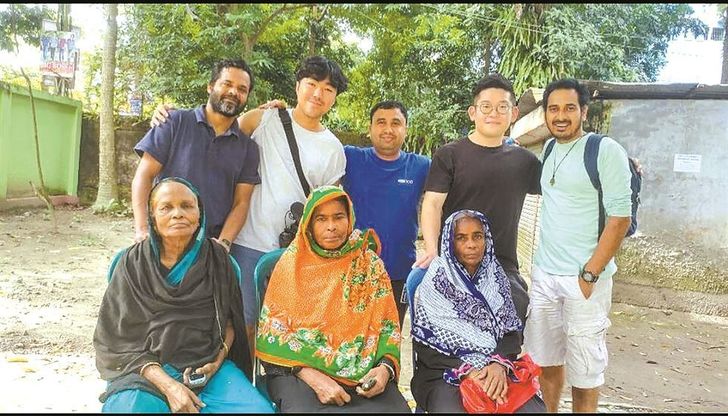
Al Mamun, center second row, poses with his camera crew and those interviewed in his upcoming film “Birangona” in Sirajganj Bangladesh, in this November 2019 photo. Shown in the front row, from left, are Birangonas Korimun, Hajer Akter and Norjahan. / Courtesy of Shekh Al Mamun
Soon after he was offered a job to work as a cultural activist at the Asia Media & Culture Factory, he had a life-changing experience ― he was inspired to become a filmmaker.
Since 2013, he has produced nine short films on migrant worker-centered themes, several of which were invited to international film festivals.
Al Mamun's short documentary film “Vinyl House is Not a Home,” a story about migrant women living in a makeshift converted greenhouse constructed from PVC pipes, was invited to the Tokyo Documentary Film Festival in Japan.
His latest release “Second Home,” a story about an undocumented foreign worker who came to Korea as an industrial trainee, got invited to the Kolkata People's Film Festival in India.
The 46-year-old director said he is currently editing his upcoming film that touches upon a different subject: wartime sexual violence.
The issue of Korean sex slaves, euphemistically called “comfort women,” during World War II is what compelled him to make a documentary named “Birangona.”
Birangona means brave women, a term used by the Bangladesh government to refer to survivors of the mass rapes committed during the 1971 war in an effort to remove the associated stigma.
It is estimated that more than 200,000 women and girls were raped and tortured by the Pakistani army and their Bangladeshi collaborators in the 1971 Bangladesh War of Independence.
“I'm a human rights activist, but I knew little about women's rights,” Al Mamun said. “I was shocked when I heard about comfort women on the news, and it reminded me of Birangona.”
The survivors have struggled to gain recognition and there have been no prosecutions, either in Bangladesh or Pakistan because there has been little recognition of the mass rape ― partly as the subject was taboo.
“Historically wartime sexual violence was prevalent, but victims were mostly buried in silence. Even to this day, there is still no indication of either apology or reparations from the perpetrators.”
Pakistan has neither offered an apology for 1971 nor owned up to the war crimes committed by its army and collaborators, according to Al Mamun.
“Survivors are reluctant to come forward because of the stigma around the issue,” he said. “I've interviewed about 13 to 14 Birangonas, but some of them told me 'What's the point of telling these stories? Nothing happens.'”
He directed the film with an aim to readdress the wartime atrocities.
“Just like comfort women in Korea who are willing to share their stories in public, I wish for women from Bangladesh to speak up about their pains,” he said.
Al Mamun added he also wants to change the negative stereotyping of victims of wartimes sexual violence in the society.
“Currently Bangladesh has a report system, where a Birangona has to bring three witnesses to prove that she was the victim of sexual violence during wartime,” he said. “This could be really difficult and humiliating.”
“There are a few welfare benefits that the government provides to descendants of such victims, such as giving extra points when applying for college or a job, but they aren't significantly helpful.”
Through the film, which is slated for release this year, Al Mamun hopes to expand the scope of discussion to encompass not just questions about Birangona, but about wartime sexual violence victims in general and what countries owe them.
“I don't want the documentary to be merely heart-breaking, or appeal to that kind of sentiment. Rather, I want to provoke deeper response, one that would linger and have power to change the way we remember them.”