Cannes' Japanese director Kore-Eda delivers heartfelt story in French

Japanese director Hirokazu Kore-Eda speaks about his film “The Truth” during a media conference held during the 24TH Busan International Film Festival (BIFF) on Oct. 5, in Haeundae-gu, Busan. Yonhap
By Lee Gyu-lee
Japanese director Hirokazu Kore-Eda has delivered another heartfelt family story to follow his 2018 Cannes' Palme d'Or film “Shoplifters” with the subtle, drama “The Truth.” But this time, he has stepped out of his comfort zone ― his native country ― to a foreign production in successfully delivering a French film.
His first film shot outside Japan premiered as the opening film for the Venice Film Festival in August and was selected for a Gala Presentation screening at the 24th Busan International Film Festival (BIFF), which wrapped up Oct. 12.
The film revolves around famous French actress Fabienne (Catherine Deneuve) who has recently published her memoirs. To celebrate the publication, Fabienne's screenwriter daughter Lumir (Juliette Binoche) comes to visit her from New York with her husband (Ethan Hawke) and their daughter. Though titled “The Truth,” Fabienne's autobiography holds little truth, which upsets her daughter. As the two spend time together, they work to face each other's truths that they have been avoiding.
“The story developed from a question on 'What is acting?'” Kore-Eda explained at a media conference in Busan. “I intended this story to center on an actress. And around her, there's a daughter who failed to become an actress herself and a rival who passed away at a young age. The story revolves around this triangular relationship.”
Fabienne is a successful and legendary actress who is materialistic and ego-centric. As she declares in a scene “I'd prefer to be a bad mother, a bad friend, but a great actress,” she tends to put her career before her family which led her to have a distorted relationship with her daughter.
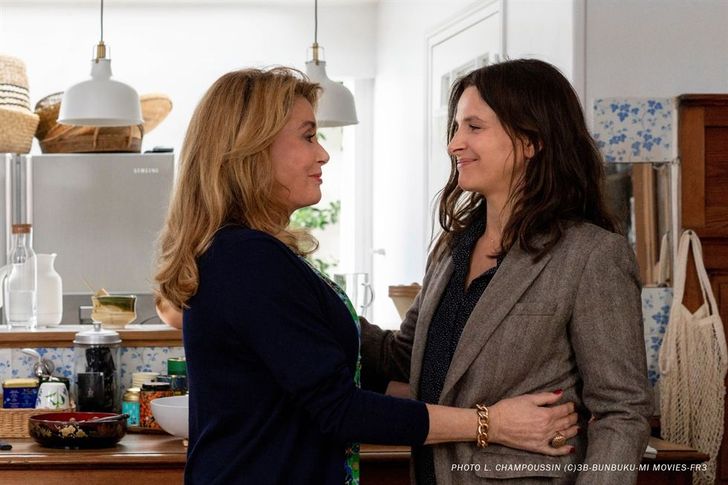
Fabienne (Catherine Deneuve), left, and her daughter Lumir (Juliette Binoche) work to restore their mother-daughter bond as they face the truth about each other. Courtesy of BIFF
The director said he wanted to depict Deneuve's multi-dimensionality and vibrancy. “This was the most important assignment for me. I wanted to draw the multilateral, multilayered character of Fabienne ― as an actress, a grandmother, a mother, and even as a daughter ― and her relationship with her daughter.”
There are no major crises or climax in overcoming a breakdown between the characters, but Kore-Eda still manages to delicately explore all dimensions and angles between Fabienne and Lumir, drawing a warm and emotional family portrait as they rebuild their mother-daughter bond.
The narrative is a universal story about family relationships as it unfolds the truths that each of them have been avoiding ― a mother with an untruthful memoir, and a daughter who has been unconsciously hiding an untruthful history.
“The two try to rewrite their relationship as they spend time together for a week. And this sometimes leads them to act and pretend, but they do so in hopes to reach a step closer to the truth that they want from each other,” he noted.
Casting big-name stars like Deneuve, Binoche, and Hawke was a dream come true, the director expressed. He has known Binoche, who has been offering to work with him, for years, and he said that this was finally the story to accept her offer.
“I handed her the plot in 2015, and it already had the names of Catherine and Ethan on the first page of my note. I had these three actors in my mind from the very beginning of making this film,” he said.
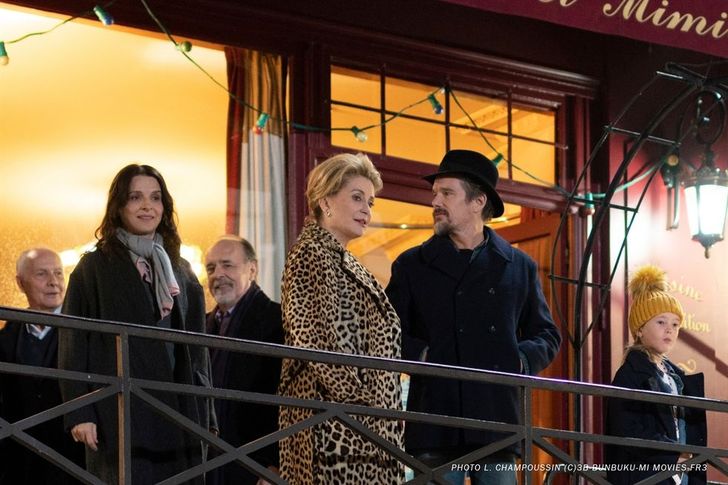
A scene from the film./ Courtesy of BIFF
Kore-Eda expressed that he puts focus on making a good film rather than where it is being filmed. And that's the success behind the borderless piece that laid out the culturally specific details of the French film as Japanese director.
“I get inspired and encouraged by contemporary Asian filmmakers ― Hou Hsiao-hsien, Lee Chang-dong, and Jia Zhangke. For the past 25 years, I have tried to make films that I won't feel ashamed of when showing them to those colleagues."
Kore-Eda has also been awarded as The Asian Filmmaker of the Year for this year's BIFF. As the tension between Japan and Korea continued from the trade dispute, he was asked what it is like to participate in the Korean festival, to which he expressed he believes in solidarity under any circumstances.
“About five years ago, the BIFF suffered political oppression and had difficulties holding the festival. So filmmakers around the world, including myself, raised their voices and supported the BIFF,” he said. “Now, after those times of difficulty, Busan has been able to come to this day and that's how I'm able to come here this year.”
“I believe it is important for filmmakers to show their solidarity so that we can stick together in such circumstances of political issues or difficulties. So, I came to Busan as I think this place is for anyone who believes in the power of cinema.”